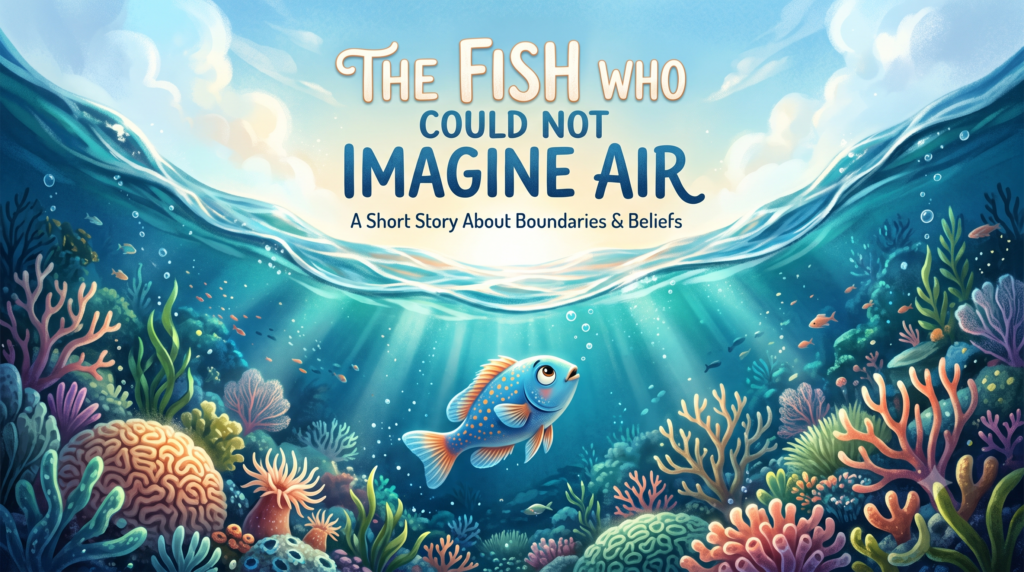
Imagine a fish physicist. She is brilliant. Over centuries her tradition has built a physics of astonishing power: pressure, buoyancy, viscosity, the propagation of waves, the beautiful nonlinearities of turbulence. It predicts everything she can measure. It has no loose ends worth losing sleep over. It is, by every internal standard, complete.
Above her there is a shimmer. Her instruments record it as an optical anomaly at the upper boundary of the world — a place where light behaves strangely and objects sometimes vanish upward and do not return. It is catalogued, parameterized, and set aside. It is not a door. It is a boundary condition.
She cannot conceive of air. Not because she lacks imagination, but because nothing in her world provides the raw material for the concept. She cannot conceive of flight — of a medium so thin that motion through it is nearly free, so thin that it barely counts as a medium at all. And she certainly cannot conceive of the consequence: that a creature which learned to move through the emptiness above could reach oceans no swimmer will ever reach, separated from her own by a wall of dry death a few hundred miles wide.
The question I want to sit with is not whether we are in the same position. Of course we might be. The question is more specific, and more useful: what exactly was the shape of her blindness? Because if we can decompose it precisely, we can run each component forward and ask what our version would be.
Five walls, not one
Most speculation about “what we can’t see” collapses the fish’s predicament into a single idea: there’s a place we can’t get to. But her situation was made of at least five distinct constraints, stacked, each of which generates a different kind of blind spot.
- Her medium’s properties were axioms, not variables. Density and viscosity appear in her equations as constants of nature. It never occurs to her that they are local facts about where she happens to live.
- The exit led into less, not more. The escape route was not toward richer structure. It was toward rarefaction — toward something that, by every measure she trusts, is closer to nothing.
- Crossing required a change of body, not a vehicle. No fish ever built a machine and drove it onto land. A lineage changed what it was made of, over deep time, and the thing that arrived was no longer a fish.
- The interface destroyed anything that probed it. Every fish that flopped onto the shore learned something that no fish ever heard. The frontier was not merely unexplored; it was structurally unreportable.
- The new medium had a different connectivity. This is the deep one. Flight does not shortcut the ocean’s distances — it imposes an entirely different notion of what is near what.
Nearly all our existing speculation — wormholes, parallel worlds, higher dimensions — runs only the first constraint. Here is what falls out when you run the other four.
Seven things that might be on the other side of our surface
1. Rarefaction, not addition
We look for what is extra: more dimensions, more particles, more universes. But the fish’s exit was into a thinner phase, where every familiar carrier — buoyancy, pressure waves, dissolved oxygen — simply stops working.
If space and locality are emergent from the entanglement structure of the world, as a growing body of work suggests, then our “air” is not a richer realm but a poorer one: a regime of low entanglement density, where spatial adjacency stops being well defined. Not a place you travel to. A condition you thin into. And nothing about it would register to us as structure. It would look like nothing at all — which is precisely what air looks like to a fish.
2. Many metrics, one engine
This is the strongest generalization of the fish story, and it is not the wormhole idea. A wormhole assumes one distance function with a shortcut punched through it. The fish’s situation is stranger: air and water impose different distance functions on the same set of points, and she only ever grew a body suited to one of them.
Reality may not have a distance function. It may have many — one per coupling — and we have only ever built vehicles for the one defined by mass and energy.
We already have a mild existence proof sitting in plain sight. Entanglement gives us correlation-distance zero across a causal-distance that is enormous. We have spent a century arguing about what that means, and almost no time asking the engineer’s question: if a coupling defines a metric, and a metric defines a geometry, what would a vehicle for a non-metric-of-matter look like? The right question is not how to shortcut our distances. It is which other distances exist.
3. Rate-band access
Flight is not only about medium. It is gated by speed. Below a threshold velocity, air offers a wing nothing; above it, an entire realm opens. Now take that off the spatial axis.
There may be regimes accessible only above a threshold rate of process — internal state-change frequency, not motion through space. We are roughly kilohertz systems reading the universe through instruments that integrate over a narrow band of durations. Phenomena whose only signature lives at 10-30 seconds or 1015 years are not hidden from us. They are averaged away — the way a mayfly’s physics contains no seasons. Our deepest laws might be time-averages that we have mistaken for the thing itself.
4. The constants are our viscosity
The fish physicist writes density and viscosity into her axioms. We write the fine structure constant, the mass ratios, the cosmological constant. If those are locally valued fields rather than universal truths, then the real “elsewhere” is not a coordinate at all — it is a parameter regime, and travel means shifting your local constant-set rather than your position.
Note how well this preserves the structure of the original story. Our chemistry, and therefore our bodies, are tuned to a vanishingly small patch of that space. Which means the boundary would be lethal in exactly the fish’s way: not far, just fatal.
5. One-way physics
Here is the uncomfortable one. Science is restricted to phenomena that permit a surviving record. Every fish that flopped onto the shore and died discovered something no fish ever heard.
There may be whole classes of real interaction that are record-destroying by nature — traversable, even usable, but structurally unreportable. Our epistemology has no slot for this. It is not “unknown,” and it is not “unknowable.” It is knowable only terminally. If such regimes exist, our physics would be exactly as complete as it appears, and exactly as wrong.
6. Becoming, not traveling
No fish crossed. A lineage did.
If the frontier is like that, then every vehicle we can imagine is a category error, and the actual research program is substrate engineering: building things that are natively of the other regime. This has a hard implication we should not soften. Such successors could not report back to us in any language we possess, and we would probably not recognize them as our descendants. The fish did not get to see the sky. Their great-great-grandchildren, who were not fish, did.
7. Randomness as surface glare
Our formalism accepts determinate values on point-manifolds. Anything real whose grammar does not fit that shape gets rendered, in our equations, as noise.
So consider: quantum randomness may not be a mystery awaiting explanation. It may be the edge of a phase, seen at an angle — an unstructured shimmer that is unstructured only because we are looking at it from underneath, with eyes evolved for a different medium. That is exactly what the surface of the sea is to a fish. Not a mystery. A door, misfiled as an optical artifact.
Where to look: the shimmer at the surface
The methodological payoff matters more to me than any single item on that list.
Blind spots always leave artifacts. The fish had them: the glare, the surface waves, the peculiar behavior of things that fell upward and vanished. Each was catalogued as an anomaly at the edge of an otherwise complete theory. Each was, in fact, the theory’s boundary announcing itself.
Ours are the places where our physics carries brute, unexplained axioms — the assumptions we state rather than derive. The Born rule. The measurement cut. The arrow of time. The magnitude of the cosmological constant. The particular values of the constants themselves. We treat these as loose ends inside the theory. On the argument above, they are something else: the shimmer.
Don’t ask what’s out there. Ask which of our axioms are contingent facts about our medium that we have mistaken for laws.
That inversion is available to us right now. It requires no new instrument and no new mathematics. It requires going through the foundations of physics and marking, honestly, every place where we have written down a number or a rule because the world insists on it and we do not know why — and then treating each one not as a gap in our knowledge but as a pressure reading from the other side of the surface.
The fish physicist was not wrong about anything. Her equations still work; we use them. She was bounded, which is a different failure, and a harder one to detect from the inside — because a bounded theory does not feel incomplete. It feels finished.
That, I think, is the actual warning in the parable. Not that there is more to find. That the feeling of having found it all is exactly what being underwater feels like.