Monthly Archives: April 2026

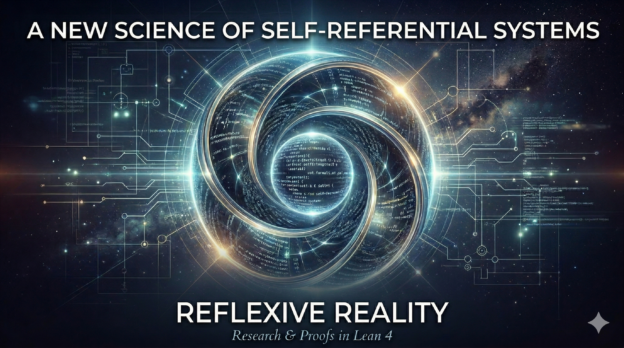
Toward a New Science of Self-Referential Systems

Civilization is building systems that reason about themselves, audit themselves, and govern themselves — without a formal science of what self-referential systems can and cannot do. That gap is not merely academic. It is costing us clarity about AI safety, interpretability, consciousness, and the foundations of physics.… Read More “Toward a New Science of Self-Referential Systems”
Neural CA: Spatial Parameter Fields and Greatest-Hits Memory

This is a browser-based cellular automaton experiment that takes a different approach to the same challenge as the trend-aware experiment: how do you keep a self-tuning CA alive and interesting? Here the key innovation is that the rule parameters are not uniform scalars — they are spatial fields.… Read More “Neural CA: Spatial Parameter Fields and Greatest-Hits Memory”

Neural CA: Trend-Aware Agents Learn to Keep a Cellular Automaton Alive

This is a browser-based cellular automaton in which two cooperating neural agents learn — in real time, from scratch — to keep the simulation alive and interesting. No pre-training, no external data. The neural network trains itself as the simulation runs, and the agents use what they’ve learned to steer the system away from death and toward sustained complex behavior.… Read More “Neural CA: Trend-Aware Agents Learn to Keep a Cellular Automaton Alive”

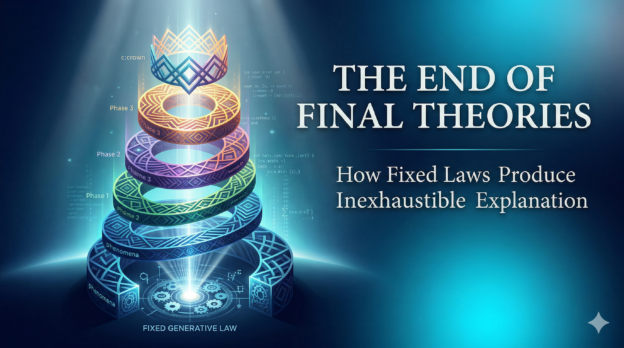
The End of Final Theories: How Fixed Laws Produce Inexhaustible Explanation

A new paper — backed by 422 machine-checked theorems and zero gaps — proves that a system can be completely governed by fixed laws and still never admit a final explanation. The implications reach from physics to biology to organizations to AI.… Read More “The End of Final Theories: How Fixed Laws Produce Inexhaustible Explanation”