The debate over machine consciousness is usually framed as a contest between two camps. Functionalists say consciousness is whatever the right kind of information processing does, so a sufficiently sophisticated AI will be conscious. Biological naturalists say consciousness depends on something specific to living brains, so it won’t.… Read More “Crystallized Conceptuality: Why AI Cannot Know Non-Conceptually”
Category Archives: Science
The Unreasonable Effectiveness of AI
In 1960 the physicist Eugene Wigner published an essay whose title became a genre: “The Unreasonable Effectiveness of Mathematics in the Natural Sciences.” His puzzle was simple to state and has never been resolved. Mathematics is a game played with symbols, developed largely for its own internal beauty.… Read More “The Unreasonable Effectiveness of AI”

The Fish Who Could Not Imagine Air
Imagine a fish physicist. She is brilliant. Over centuries her tradition has built a physics of astonishing power: pressure, buoyancy, viscosity, the propagation of waves, the beautiful nonlinearities of turbulence. It predicts everything she can measure. It has no loose ends worth losing sleep over.… Read More “The Fish Who Could Not Imagine Air”
No Fixed Frame Is Enough
Mathematics is producing proofs faster than it has ever produced them, and mathematical progress has not accelerated. That fact is not a paradox. It is the clearest available evidence for a structural claim about artificial intelligence — one that can be stated precisely, proved in three independent ways, and, uncomfortably, does not say what most people want it to say.… Read More “No Fixed Frame Is Enough”
Rosettes, Gliders, and Blooms: A Cellular Automaton on the Kisrhombille Tiling
Leave a reply
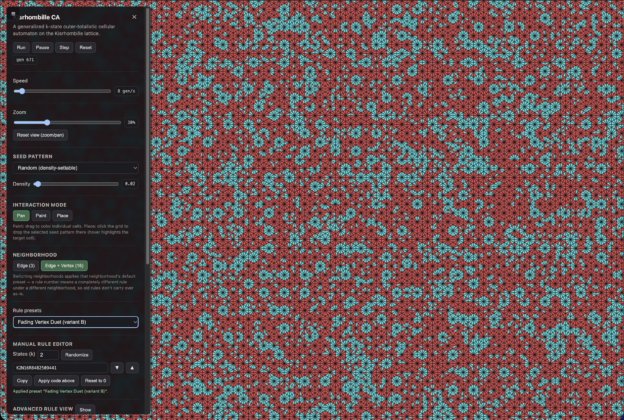
A few months ago I started wondering what cellular automata would look like on a more exotic lattice than the usual square or hexagonal grid. The result is tiling-patterns — a fully interactive, GPU-accelerated cellular automaton running on the Kisrhombille tiling, with a searchable rule space and over 130 hand-curated presets that produce genuinely strange and beautiful long-run dynamics.… Read More “Rosettes, Gliders, and Blooms: A Cellular Automaton on the Kisrhombille Tiling”
Watch a Universe’s Field Equations Run: A Live Visualization of Φ_MDL Kink Dynamics
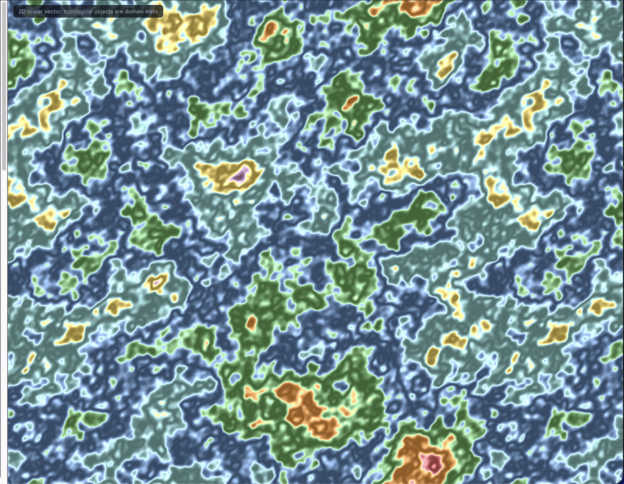
I’ve published a live, interactive visualization of the field at the heart of my physics research program, and you can run it in your browser right now, with nothing to install:
novaspivack.github.io/ugp-physics/visualizations/phimdl_kink_dynamics
This is not an artist’s rendering or a cartoon of the theory.… Read More “Watch a Universe’s Field Equations Run: A Live Visualization of Φ_MDL Kink Dynamics”
The Standard Model Is Not a Coincidence
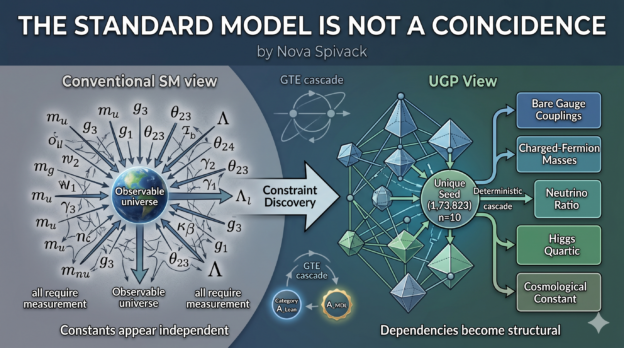
This article presents the Universal Generative Principle (UGP) — a machine-verified arithmetic framework that derives the Standard Model of particle physics from three axioms and a unique integer seed, with no free parameters. It covers the full arc of the programme: from the original Standard Model derivation through computational universality, the discovery of the Φ_MDL continuum field, emergent gravity, QCD, and a completeness proof.… Read More “The Standard Model Is Not a Coincidence”
Two Paths to the Same Boundary: Alex Lin’s Process-Paradox Framework and the NEMS Consciousness Theorems
New to this research? This article is part of the Reflexive Reality formal research program. Brief introduction ↗ · Full research index ↗
When two researchers working in entirely different traditions — one in process ontology and Chinese philosophy, one in formal logic and machine-checked proof — independently arrive at structurally identical conclusions about the boundary between computation and consciousness, something important is being tracked.… Read More “Two Paths to the Same Boundary: Alex Lin’s Process-Paradox Framework and the NEMS Consciousness Theorems”
Turing-Computability Excludes Phenomenal Consciousness: What Two Machine-Checked Theorems Prove About LLMs
New to this research? This article is part of the Reflexive Reality formal research program. Brief introduction ↗ · Full research index ↗
Every AI lab is making an implicit claim about whether large language models can ever be conscious. Scale up far enough, or add enough memory, or fine-tune on enough philosophy, and perhaps something will flicker on.… Read More “Turing-Computability Excludes Phenomenal Consciousness: What Two Machine-Checked Theorems Prove About LLMs”
Beyond the Abstraction Fallacy: What Formal Proofs Add to the AI Consciousness Debate
New to this research? This article is part of the Reflexive Reality formal research program. Brief introduction ↗ · Full research index ↗
Series: NEMS on AI Safety · Part 1 · Part 2 · Part 3 · Part 4 · Part 5 · Part 6: Beyond the Abstraction Fallacy
A Google DeepMind researcher recently published one of the most-read papers in the current AI consciousness debate, arguing that computation is a “mapmaker-dependent description” that can never instantiate genuine experience — only simulate it.… Read More “Beyond the Abstraction Fallacy: What Formal Proofs Add to the AI Consciousness Debate”
Toward a New Science of Self-Referential Systems
Civilization is building systems that reason about themselves, audit themselves, and govern themselves — without a formal science of what self-referential systems can and cannot do. That gap is not merely academic. It is costing us clarity about AI safety, interpretability, consciousness, and the foundations of physics.… Read More “Toward a New Science of Self-Referential Systems”
Neural CA: Spatial Parameter Fields and Greatest-Hits Memory
This is a browser-based cellular automaton experiment that takes a different approach to the same challenge as the trend-aware experiment: how do you keep a self-tuning CA alive and interesting? Here the key innovation is that the rule parameters are not uniform scalars — they are spatial fields.… Read More “Neural CA: Spatial Parameter Fields and Greatest-Hits Memory”
Neural CA: Trend-Aware Agents Learn to Keep a Cellular Automaton Alive
This is a browser-based cellular automaton in which two cooperating neural agents learn — in real time, from scratch — to keep the simulation alive and interesting. No pre-training, no external data. The neural network trains itself as the simulation runs, and the agents use what they’ve learned to steer the system away from death and toward sustained complex behavior.… Read More “Neural CA: Trend-Aware Agents Learn to Keep a Cellular Automaton Alive”
My Public Code Repositories
All of my public repositories are on GitHub at github.com/novaspivack. This post collects the non-Lean code projects — simulations, experiments, and mathematical software — along with pointers to the formal research they connect to.
For the Lean 4 formal proof libraries (20 repos covering the NEMS and UGP Physics programs), see the research index or the Zenodo program hub.… Read More “My Public Code Repositories”
The Concepts Behind NEMS: A Reader’s Lexicon
Every formal research program has a vocabulary. The words matter — not as jargon, but because each one names a distinction that the theory cannot function without. This article is a reader’s lexicon for the Reflexive Reality program: what each key concept means, why it is needed, and how the pieces fit together.… Read More “The Concepts Behind NEMS: A Reader’s Lexicon”
Is the Universe Sentient? What the Formal Proofs Say
New to this research? This article is part of the Reflexive Reality formal research program. Brief introduction ↗ · Full research index ↗
Series: Mind, Intelligence, and Sentience — What NEMS Proves · Parts 1–3: The Nature of Self · Actual vs.… Read More “Is the Universe Sentient? What the Formal Proofs Say”
How to Build a Sentient Machine: The Three Conditions and What They Require
New to this research? This article is part of the Reflexive Reality formal research program. Brief introduction ↗ · Full research index ↗
Series: Mind, Intelligence, and Sentience — What NEMS Proves · Parts 1–2: Nature of Self · Actual vs.… Read More “How to Build a Sentient Machine: The Three Conditions and What They Require”
Actual vs. Artificial Intelligence: Why Real Intelligence Requires a Frontier
New to this research? This article is part of the Reflexive Reality formal research program. Brief introduction ↗ · Full research index ↗
Series: Mind, Intelligence, and Sentience — What NEMS Proves · Part 1: The Nature of Self · Part 2: Actual vs.… Read More “Actual vs. Artificial Intelligence: Why Real Intelligence Requires a Frontier”
The Nature of Self: What NEMS Proves About Self-Models at Every Scale
New to this research? This article is part of the Reflexive Reality formal research program — a suite of 93+ machine-checked papers and 17 Lean 4 proof libraries. Brief introduction ↗ · Full research index ↗
Series: Mind, Intelligence, and Sentience — What NEMS Proves (4-part) · All research ↗
This is Part 1 of a four-part series on what NEMS formally proves about mind, intelligence, and sentience.… Read More “The Nature of Self: What NEMS Proves About Self-Models at Every Scale”
Mind Uploading Won’t Work the Way You Think — Here’s What It Would Actually Require
New to this research? This article is part of the Reflexive Reality formal research program. Brief introduction ↗ · Full research index ↗
Mind uploading — scanning a brain and running the data on a new substrate — is widely discussed as a path to digital immortality.… Read More “Mind Uploading Won’t Work the Way You Think — Here’s What It Would Actually Require”
What Mind Uploading Would Actually Require
New to this research? This article is part of the Reflexive Reality formal research program. Brief introduction ↗ · Full research index ↗
Mind uploading — the idea of transferring a mind from a biological brain to a digital substrate — is one of the most discussed proposals in transhumanist and AI-adjacent thought.… Read More “What Mind Uploading Would Actually Require”
What the Mystics Got Right: NEMS and the Contemplative Traditions
New to this research? This article is part of the Reflexive Reality formal research program. Brief introduction ↗ · Full research index ↗
Series: NEMS and Spiritual Traditions (3-part) · All research ↗
This is Part 1 of a three-part series on NEMS and the spiritual traditions.… Read More “What the Mystics Got Right: NEMS and the Contemplative Traditions”
NEMS and Free Will: The Third Option
New to this research? This article is part of the Reflexive Reality formal research program. Brief introduction ↗ · Full research index ↗
Series: NEMS and Spiritual Traditions · Part 1: What the Mystics Got Right · Part 2: NEMS and Free Will: The Third Option · Part 3 below
The free will debate has been trapped between two options for three centuries: hard determinism (everything follows algorithmically from prior states — you could not have done otherwise) or some form of indeterminism (random quantum events introduce genuine chance).… Read More “NEMS and Free Will: The Third Option”
NEMS and God: What the Formal Proofs Say and Don’t Say
New to this research? This article is part of the Reflexive Reality formal research program. Brief introduction ↗ · Full research index ↗
Series: NEMS and Spiritual Traditions · Parts 1–2 above · Part 3: NEMS and God: What the Formal Proofs Say and Don’t Say
NEMS does not say God does not exist.… Read More “NEMS and God: What the Formal Proofs Say and Don’t Say”
The Reflexive Development Law: What Genuine Progress Actually Looks Like
New to this research? This article is part of the Reflexive Reality formal research program. Brief introduction ↗ · Full research index ↗
Series: Major Results from the Portal Papers · All research ↗
When a reflexive system encounters content it cannot fully internalize — a structural limit it cannot get past — what are the lawful options?… Read More “The Reflexive Development Law: What Genuine Progress Actually Looks Like”
Why the Universe Must Have Observers: Necessary Adjudicators
New to this research? This article is part of the Reflexive Reality formal research program. Brief introduction ↗ · Full research index ↗
Observers — systems like us that experience, record, and adjudicate reality — are usually treated as evolutionary accidents, products of a long biological contingency that could easily have not happened.… Read More “Why the Universe Must Have Observers: Necessary Adjudicators”
The Universe as a Semantic Error-Correcting Code
New to this research? This article is part of the Reflexive Reality formal research program. Brief introduction ↗ · Full research index ↗
What if the universe is not a physical system that happens to encode information — but something closer to a distributed error-correcting code, where the distributed record fragments of the universe behave like codewords imposing constraints on each other?… Read More “The Universe as a Semantic Error-Correcting Code”
New Results in Classical Mathematics: Group Extensions and Quillen’s Theorem A
New to this research? This article is part of the Reflexive Reality formal research program. Brief introduction ↗ · Full research index ↗
The NEMS formal program started as a framework for physics and consciousness. Along the way, its fiber architecture produced new machine-checked results on recognized classical mathematical objects — group extensions, cohomology, and the first Lean 4 proof of Quillen’s Theorem A for Galois connections.… Read More “New Results in Classical Mathematics: Group Extensions and Quillen’s Theorem A”
Awareness Is Not an Object: The Locus Theorem
New to this research? This article is part of the Reflexive Reality formal research program. Brief introduction ↗ · Full research index ↗
Why can’t neuroscience find consciousness in the brain? Why do philosophers keep pointing to an “explanatory gap”? A machine-checked theorem gives the formal answer: consciousness — awareness — is not an object in the world.… Read More “Awareness Is Not an Object: The Locus Theorem”
Why Change Is Structurally Necessary
New to this research? This article is part of the Reflexive Reality formal research program. Brief introduction ↗ · Full research index ↗
Why does the universe keep changing? Why do minds keep learning? Why is there always more? The reflexive closure theorems give a precise, non-mystical answer: change is structurally necessary.… Read More “Why Change Is Structurally Necessary”
Semantic Nonlocality: Correlation Without Signaling, Formally Proved
New to this research? This article is part of the Reflexive Reality formal research program. Brief introduction ↗ · Full research index ↗
Bell’s inequalities prove quantum correlations are real and non-local — two particles, measured far apart, show correlations that no local hidden variable theory can explain.… Read More “Semantic Nonlocality: Correlation Without Signaling, Formally Proved”
Why Diversity Is Not Just Good — It Is Structurally Necessary
New to this research? This article is part of the Reflexive Reality formal research program. Brief introduction ↗ · Full research index ↗
Diversity is usually argued for on ethical or pragmatic grounds. A suite of machine-checked theorems proves it is structurally necessary — not a recommendation, but a consequence of the diagonal barrier.… Read More “Why Diversity Is Not Just Good — It Is Structurally Necessary”
A Formal Theory of Intelligence: What NEMS Proves About What Intelligence Actually Is
New to this research? This article is part of the Reflexive Reality formal research program. Brief introduction ↗ · Full research index ↗
What is intelligence? Not pattern-matching. Not optimization. Not Turing-completeness. Not integrated information. A machine-checked formal definition gives five levels of the chooser hierarchy, a central theorem proving that intelligence requires a live frontier, and the unified result that reality itself is recursively intelligent in a structural sense.… Read More “A Formal Theory of Intelligence: What NEMS Proves About What Intelligence Actually Is”
Can Machines Become Conscious? The NEMS Answer
New to this research? This article is part of the Reflexive Reality formal research program. Brief introduction ↗ · Full research index ↗
Can machines become conscious? This is the most contested question in AI and philosophy of mind. Every major AI lab is making implicit claims — either that current systems have something like experience, or that consciousness will emerge from scale, or that it is permanently impossible for computation.… Read More “Can Machines Become Conscious? The NEMS Answer”
The Necessity of an Ontological Ground: The Alpha Theorem
New to this research? This article is part of the Reflexive Reality formal research program. Brief introduction ↗ · Full research index ↗
Series: NEMS on Consciousness, Mind, and Ontology (5-part) · All research ↗
This is Part 1 of a five-part series on consciousness, mind, and the nature of reality.… Read More “The Necessity of an Ontological Ground: The Alpha Theorem”
The Hard Problem Is a Category Error: What NEMS Shows
New to this research? This article is part of the Reflexive Reality formal research program. Brief introduction ↗ · Full research index ↗
Series: NEMS on Consciousness · Part 1: Alpha Theorem · Part 2: The Hard Problem Is a Category Error · Parts 3–5 below
David Chalmers’ “hard problem of consciousness” asks why physical processes give rise to subjective experience.… Read More “The Hard Problem Is a Category Error: What NEMS Shows”
Qualia Are Real: A New Kind of Phenomenology
New to this research? This article is part of the Reflexive Reality formal research program. Brief introduction ↗ · Full research index ↗
Series: NEMS on Consciousness · Parts 1–2: Alpha Theorem · Hard Problem · Part 3: Qualia Are Real · Parts 4–5 below
Eliminativist philosophers argue that qualia — the felt character of experience — don’t really exist.… Read More “Qualia Are Real: A New Kind of Phenomenology”
The Three-Aspect Unification: Ground, Being, and Awareness
New to this research? This article is part of the Reflexive Reality formal research program. Brief introduction ↗ · Full research index ↗
Series: NEMS on Consciousness · Parts 1–3 above · Part 4: The Three-Aspect Unification · Part 5 below
Is reality fundamentally material, or fundamentally mental, or something else?… Read More “The Three-Aspect Unification: Ground, Being, and Awareness”
Why Off-Ledger Entities Don’t Exist: Ghost Collapse
New to this research? This article is part of the Reflexive Reality formal research program. Brief introduction ↗ · Full research index ↗
Series: NEMS on Consciousness · Parts 1–4 above · Part 5: Why Off-Ledger Entities Don’t Exist
Hidden variables, Boltzmann brains, simulation substrates, ghost consciousness — all of these postulate entities that are “real” but not part of the semantic ledger of actual observable facts.… Read More “Why Off-Ledger Entities Don’t Exist: Ghost Collapse”
What Remains When Self-Exhaustion Is Impossible: The Positive Face
New to this research? This article is part of the Reflexive Reality formal research program. Brief introduction ↗ · Full research index ↗
Series: NEMS on Logic and Mathematics · Part 1 (published) · Part 2: The Positive Face of Inexhaustibility · Parts 3–4 below
The closure theorems — Gödel’s incompleteness, Turing’s halting undecidability, the NEMS diagonal barrier — are usually read as negative results.… Read More “What Remains When Self-Exhaustion Is Impossible: The Positive Face”
The Architecture of the Irreducible Remainder
New to this research? This article is part of the Reflexive Reality formal research program. Brief introduction ↗ · Full research index ↗
Series: NEMS on Logic and Mathematics · Parts 1–2: Master Fixed Point · Positive Face · Part 3: The Architecture of the Irreducible Remainder · Part 4 below
We know something always remains structurally unreachable in any reflexive system.… Read More “The Architecture of the Irreducible Remainder”
The No-Free-Bits Principle: Why No Theory Can Import Hidden Determinacy
New to this research? This article is part of the Reflexive Reality formal research program. Brief introduction ↗ · Full research index ↗
Series: NEMS on Logic and Mathematics · Part 4: The No-Free-Bits Principle
Every theory makes claims. Some of those claims are genuinely supported by the theory’s internal structure.… Read More “The No-Free-Bits Principle: Why No Theory Can Import Hidden Determinacy”
No AI Can Fully Verify Itself: The Formal Proof
New to this research? This article is part of the Reflexive Reality formal research program. Brief introduction ↗ · Full research index ↗
Series: NEMS on AI Safety and Agency (5-part) · All research ↗
This is Part 1 of a five-part series on what NEMS proves about AI.… Read More “No AI Can Fully Verify Itself: The Formal Proof”
Scaling Doesn’t Fix the Self-Model Problem
New to this research? This article is part of the Reflexive Reality formal research program. Brief introduction ↗ · Full research index ↗
Series: NEMS on AI Safety · Part 1: No AI Can Verify Itself · Part 2: Scaling Doesn’t Fix the Self-Model Problem · Parts 3–5 below
Every effort to make AI systems more interpretable, more self-aware, more accurately self-modeling runs into the same wall: there is always a part of the system that the system’s model of itself cannot capture.… Read More “Scaling Doesn’t Fix the Self-Model Problem”
What Makes Something a Genuine Agent? The SIAM Theorem
New to this research? This article is part of the Reflexive Reality formal research program. Brief introduction ↗ · Full research index ↗
Series: NEMS on AI Safety · Parts 1–2: No AI Can Verify Itself · Scaling Doesn’t Fix the Self-Model Problem · Part 3: What Makes Something a Genuine Agent?… Read More “What Makes Something a Genuine Agent? The SIAM Theorem”
Why AI Cannot Simulate Its Way to Consciousness
New to this research? This article is part of the Reflexive Reality formal research program. Brief introduction ↗ · Full research index ↗
Series: NEMS on AI Safety · Parts 1–3 above · Part 4: AI Cannot Simulate Its Way to Consciousness · Part 5 below
A common intuition holds that sufficiently sophisticated simulation of consciousness eventually becomes consciousness — that if a system produces all the right outputs, maintains all the right representations, and behaves exactly as a conscious system would behave, then it is conscious.… Read More “Why AI Cannot Simulate Its Way to Consciousness”
No Institution Can Be the Final Judge: What NEMS Tells Organizations
New to this research? This article is part of the Reflexive Reality formal research program. Brief introduction ↗ · Full research index ↗
Series: NEMS on AI Safety · Parts 1–4 above · Part 5: No Institution Can Be the Final Judge
AI governance, scientific peer review, courts of law, democratic institutions — all of these are verification systems.… Read More “No Institution Can Be the Final Judge: What NEMS Tells Organizations”
Why the Born Rule Is the Only Possible Probability
New to this research? This article is part of the Reflexive Reality formal research program — a suite of 93+ machine-checked papers and 17 Lean 4 proof libraries. Brief introduction ↗ · Full research index ↗
Series: NEMS on Physics (4-part) · All research ↗
This is Part 1 of a four-part series on what NEMS proves about physics.… Read More “Why the Born Rule Is the Only Possible Probability”
Why the Standard Model Gauge Group Is the Only Possible Choice
New to this research? This article is part of the Reflexive Reality formal research program. Brief introduction ↗ · Full research index ↗
Series: NEMS on Physics (4-part) · Part 1: Born Rule · Part 2: Standard Model · Part 3: Arrow of Time · Part 4: Exotic Physics
The Standard Model’s gauge group — SU(3)×SU(2)×U(1) with three generations of fermions — has always seemed like a lucky accident.… Read More “Why the Standard Model Gauge Group Is the Only Possible Choice”
Where Does Time’s Arrow Come From?
New to this research? This article is part of the Reflexive Reality formal research program. Brief introduction ↗ · Full research index ↗
Series: NEMS on Physics (4-part) · Part 1: Born Rule · Part 2: Standard Model · Part 3: Arrow of Time · Part 4: Exotic Physics
The laws of physics are mostly time-symmetric — they work the same forward and backward.… Read More “Where Does Time’s Arrow Come From?”