Category Archives: Best Articles

Nova Spivack’s best articles

Toward a New Science of Self-Referential Systems

Civilization is building systems that reason about themselves, audit themselves, and govern themselves — without a formal science of what self-referential systems can and cannot do. That gap is not merely academic. It is costing us clarity about AI safety, interpretability, consciousness, and the foundations of physics.Read More “Toward a New Science of Self-Referential Systems”

Is the Universe Sentient? What the Formal Proofs Say

New to this research? This article is part of the Reflexive Reality formal research program. Brief introduction ↗ · Full research index ↗

Series: Mind, Intelligence, and Sentience — What NEMS Proves · Parts 1–3: The Nature of Self · Actual vs.… Read More “Is the Universe Sentient? What the Formal Proofs Say”

How to Build a Sentient Machine: The Three Conditions and What They Require

New to this research? This article is part of the Reflexive Reality formal research program. Brief introduction ↗ · Full research index ↗

Series: Mind, Intelligence, and Sentience — What NEMS Proves · Parts 1–2: Nature of Self · Actual vs.Read More “How to Build a Sentient Machine: The Three Conditions and What They Require”

Actual vs. Artificial Intelligence: Why Real Intelligence Requires a Frontier

New to this research? This article is part of the Reflexive Reality formal research program. Brief introduction ↗ · Full research index ↗

Series: Mind, Intelligence, and Sentience — What NEMS Proves · Part 1: The Nature of Self · Part 2: Actual vs.Read More “Actual vs. Artificial Intelligence: Why Real Intelligence Requires a Frontier”

The Nature of Self: What NEMS Proves About Self-Models at Every Scale

New to this research? This article is part of the Reflexive Reality formal research program — a suite of 93+ machine-checked papers and 17 Lean 4 proof libraries. Brief introduction ↗ · Full research index ↗

Series: Mind, Intelligence, and Sentience — What NEMS Proves (4-part) · All research ↗

This is Part 1 of a four-part series on what NEMS formally proves about mind, intelligence, and sentience.Read More “The Nature of Self: What NEMS Proves About Self-Models at Every Scale”

Mind Uploading Won’t Work the Way You Think — Here’s What It Would Actually Require

New to this research? This article is part of the Reflexive Reality formal research program. Brief introduction ↗ · Full research index ↗


Mind uploading — scanning a brain and running the data on a new substrate — is widely discussed as a path to digital immortality.Read More “Mind Uploading Won’t Work the Way You Think — Here’s What It Would Actually Require”

NEMS and Free Will: The Third Option

New to this research? This article is part of the Reflexive Reality formal research program. Brief introduction ↗ · Full research index ↗

Series: NEMS and Spiritual Traditions · Part 1: What the Mystics Got Right · Part 2: NEMS and Free Will: The Third Option · Part 3 below


The free will debate has been trapped between two options for three centuries: hard determinism (everything follows algorithmically from prior states — you could not have done otherwise) or some form of indeterminism (random quantum events introduce genuine chance).Read More “NEMS and Free Will: The Third Option”

The Reflexive Development Law: What Genuine Progress Actually Looks Like

New to this research? This article is part of the Reflexive Reality formal research program. Brief introduction ↗ · Full research index ↗

Series: Major Results from the Portal Papers · All research ↗


When a reflexive system encounters content it cannot fully internalize — a structural limit it cannot get past — what are the lawful options?Read More “The Reflexive Development Law: What Genuine Progress Actually Looks Like”

Why the Universe Must Have Observers: Necessary Adjudicators

New to this research? This article is part of the Reflexive Reality formal research program. Brief introduction ↗ · Full research index ↗


Observers — systems like us that experience, record, and adjudicate reality — are usually treated as evolutionary accidents, products of a long biological contingency that could easily have not happened.Read More “Why the Universe Must Have Observers: Necessary Adjudicators”

Awareness Is Not an Object: The Locus Theorem

New to this research? This article is part of the Reflexive Reality formal research program. Brief introduction ↗ · Full research index ↗


Why can’t neuroscience find consciousness in the brain? Why do philosophers keep pointing to an “explanatory gap”? A machine-checked theorem gives the formal answer: consciousness — awareness — is not an object in the world.Read More “Awareness Is Not an Object: The Locus Theorem”

Why Diversity Is Not Just Good — It Is Structurally Necessary

New to this research? This article is part of the Reflexive Reality formal research program. Brief introduction ↗ · Full research index ↗


Diversity is usually argued for on ethical or pragmatic grounds. A suite of machine-checked theorems proves it is structurally necessary — not a recommendation, but a consequence of the diagonal barrier.Read More “Why Diversity Is Not Just Good — It Is Structurally Necessary”

A Formal Theory of Intelligence: What NEMS Proves About What Intelligence Actually Is

New to this research? This article is part of the Reflexive Reality formal research program. Brief introduction ↗ · Full research index ↗


What is intelligence? Not pattern-matching. Not optimization. Not Turing-completeness. Not integrated information. A machine-checked formal definition gives five levels of the chooser hierarchy, a central theorem proving that intelligence requires a live frontier, and the unified result that reality itself is recursively intelligent in a structural sense.Read More “A Formal Theory of Intelligence: What NEMS Proves About What Intelligence Actually Is”

Can Machines Become Conscious? The NEMS Answer

New to this research? This article is part of the Reflexive Reality formal research program. Brief introduction ↗ · Full research index ↗


Can machines become conscious? This is the most contested question in AI and philosophy of mind. Every major AI lab is making implicit claims — either that current systems have something like experience, or that consciousness will emerge from scale, or that it is permanently impossible for computation.Read More “Can Machines Become Conscious? The NEMS Answer”

The Necessity of an Ontological Ground: The Alpha Theorem

New to this research? This article is part of the Reflexive Reality formal research program. Brief introduction ↗ · Full research index ↗

Series: NEMS on Consciousness, Mind, and Ontology (5-part) · All research ↗

This is Part 1 of a five-part series on consciousness, mind, and the nature of reality.Read More “The Necessity of an Ontological Ground: The Alpha Theorem”

The Hard Problem Is a Category Error: What NEMS Shows

New to this research? This article is part of the Reflexive Reality formal research program. Brief introduction ↗ · Full research index ↗

Series: NEMS on Consciousness · Part 1: Alpha Theorem · Part 2: The Hard Problem Is a Category Error · Parts 3–5 below


David Chalmers’ “hard problem of consciousness” asks why physical processes give rise to subjective experience.Read More “The Hard Problem Is a Category Error: What NEMS Shows”

Qualia Are Real: A New Kind of Phenomenology

New to this research? This article is part of the Reflexive Reality formal research program. Brief introduction ↗ · Full research index ↗

Series: NEMS on Consciousness · Parts 1–2: Alpha Theorem · Hard Problem · Part 3: Qualia Are Real · Parts 4–5 below


Eliminativist philosophers argue that qualia — the felt character of experience — don’t really exist.Read More “Qualia Are Real: A New Kind of Phenomenology”

The Three-Aspect Unification: Ground, Being, and Awareness

New to this research? This article is part of the Reflexive Reality formal research program. Brief introduction ↗ · Full research index ↗

Series: NEMS on Consciousness · Parts 1–3 above · Part 4: The Three-Aspect Unification · Part 5 below


Is reality fundamentally material, or fundamentally mental, or something else?Read More “The Three-Aspect Unification: Ground, Being, and Awareness”

What Remains When Self-Exhaustion Is Impossible: The Positive Face

New to this research? This article is part of the Reflexive Reality formal research program. Brief introduction ↗ · Full research index ↗

Series: NEMS on Logic and Mathematics · Part 1 (published) · Part 2: The Positive Face of Inexhaustibility · Parts 3–4 below


The closure theorems — Gödel’s incompleteness, Turing’s halting undecidability, the NEMS diagonal barrier — are usually read as negative results.Read More “What Remains When Self-Exhaustion Is Impossible: The Positive Face”

No AI Can Fully Verify Itself: The Formal Proof

New to this research? This article is part of the Reflexive Reality formal research program. Brief introduction ↗ · Full research index ↗

Series: NEMS on AI Safety and Agency (5-part) · All research ↗

This is Part 1 of a five-part series on what NEMS proves about AI.Read More “No AI Can Fully Verify Itself: The Formal Proof”

What Makes Something a Genuine Agent? The SIAM Theorem

New to this research? This article is part of the Reflexive Reality formal research program. Brief introduction ↗ · Full research index ↗

Series: NEMS on AI Safety · Parts 1–2: No AI Can Verify Itself · Scaling Doesn’t Fix the Self-Model Problem · Part 3: What Makes Something a Genuine Agent?Read More “What Makes Something a Genuine Agent? The SIAM Theorem”

Why the Born Rule Is the Only Possible Probability

New to this research? This article is part of the Reflexive Reality formal research program — a suite of 93+ machine-checked papers and 17 Lean 4 proof libraries. Brief introduction ↗ · Full research index ↗

Series: NEMS on Physics (4-part) · All research ↗

This is Part 1 of a four-part series on what NEMS proves about physics.Read More “Why the Born Rule Is the Only Possible Probability”

Why the Standard Model Gauge Group Is the Only Possible Choice

New to this research? This article is part of the Reflexive Reality formal research program. Brief introduction ↗ · Full research index ↗

Series: NEMS on Physics (4-part) · Part 1: Born Rule · Part 2: Standard Model · Part 3: Arrow of Time · Part 4: Exotic Physics


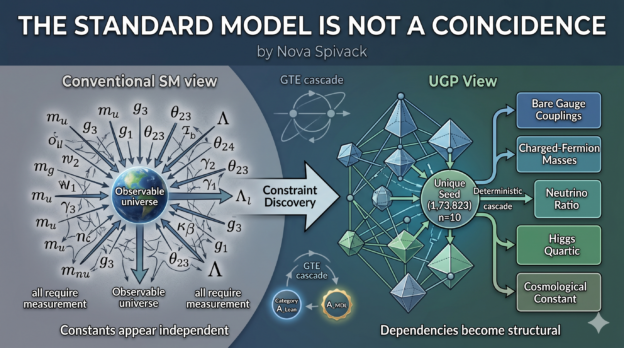
The Standard Model’s gauge group — SU(3)×SU(2)×U(1) with three generations of fermions — has always seemed like a lucky accident.Read More “Why the Standard Model Gauge Group Is the Only Possible Choice”

The Universe Is Not a Clock and Not a Dice Roll: The Third Option

New to this research? This article is part of the Reflexive Reality formal research program — a suite of 93+ machine-checked papers and 17 Lean 4 proof libraries. Brief introduction ↗ · Full research index ↗

Series: The Formal Theory of Transputation (3-part) · All research ↗

This is Part 1 of a three-part series on transputation — the universe’s third mode of operation.Read More “The Universe Is Not a Clock and Not a Dice Roll: The Third Option”

The Simulation Hypothesis Refuted: Five Independent Grounds

New to this research? This article is part of the Reflexive Reality formal research program — a suite of 93+ machine-checked papers and 17 Lean 4 proof libraries. Brief introduction ↗ · Full research index ↗

Series: The Formal Theory of Transputation (3-part) · All research ↗

This is Part 3 of a three-part series on transputation.Read More “The Simulation Hypothesis Refuted: Five Independent Grounds”

The Four Ways Systems Fail: A Formal Theory of Viable Continuation

New to this research? This article is part of the Reflexive Reality formal research program — a suite of 93+ machine-checked papers and 17 Lean 4 proof libraries. Brief introduction ↗ · Full research index ↗

Series: Viable Continuation — Applied Theorems · All research ↗


AI systems, legal orders, biological organisms, ecosystems, markets, civilizations, and scientific communities all fail.Read More “The Four Ways Systems Fail: A Formal Theory of Viable Continuation”

Fixed Laws, Permanent Openness: What NEMS and Novelty Theory Tell Us Together

New to this research? This article is part of the Reflexive Reality formal research program — a suite of 93+ machine-checked papers and 17 Lean 4 proof libraries. Brief introduction ↗ · Full research index ↗

Series: NEMS and Novelty Theory — The Combined Picture · All research ↗


Two formally independent research programs — NEMS and Novelty Theory — approach the same deep question from opposite directions.Read More “Fixed Laws, Permanent Openness: What NEMS and Novelty Theory Tell Us Together”

What Would a Universe With No Outside Look Like? The NEMS Answer

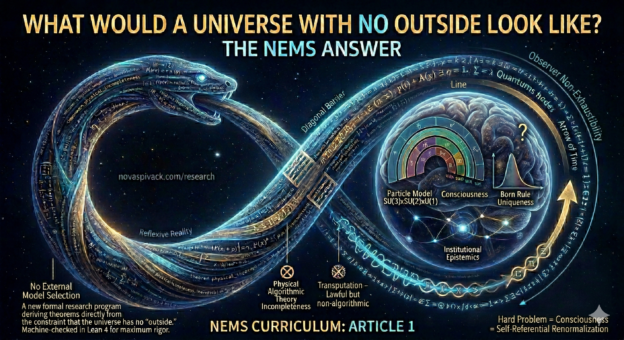
There is a question so basic that physics has never seriously tried to answer it: why does the universe have the laws it has rather than some other laws? A new formal framework — No External Model Selection, or NEMS — takes this question seriously and derives theorems from it.Read More “What Would a Universe With No Outside Look Like? The NEMS Answer”

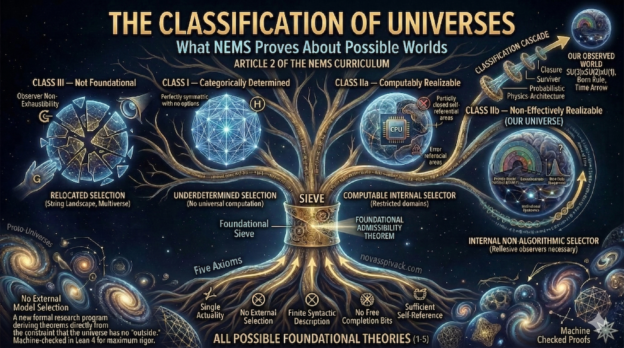
The Classification of Universes: What NEMS Proves About the Structure of Possible Worlds

Not all possible universes are equal. A formal sieve, derived from the requirement that the universe have no outside, partitions all possible foundational theories into four classes. The universe we observe falls into a specific class — and this placement has provable consequences for everything from quantum mechanics to the existence of observers.Read More “The Classification of Universes: What NEMS Proves About the Structure of Possible Worlds”

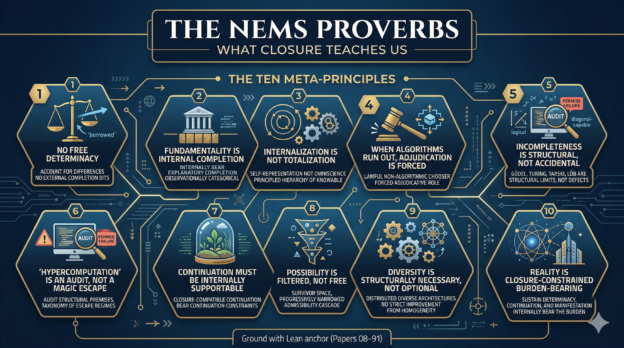
The NEMS Proverbs: What Closure Teaches Us

The NEMS program has produced dozens of structural laws — precise, memorable, and applicable far beyond physics. These are not philosophical opinions or empirical generalizations. Each one is a machine-checked theorem, or a compressed interpretive consequence of a machine-checked theorem. Here are the most important ones, stated plainly.Read More “The NEMS Proverbs: What Closure Teaches Us”

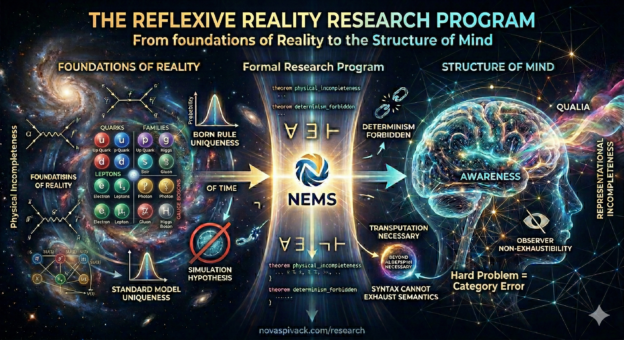
Introducing My Formal Research Program: From the Foundations of Reality to the Structure of Mind

Over the past several years I have been building a substantial formal research program — machine-verified, mathematically precise, and published with permanent DOIs on Zenodo. Today I am making the full index available at novaspivack.com/research. This post is an introduction to what the program covers and why I think it matters.… Read More “Introducing My Formal Research Program: From the Foundations of Reality to the Structure of Mind”

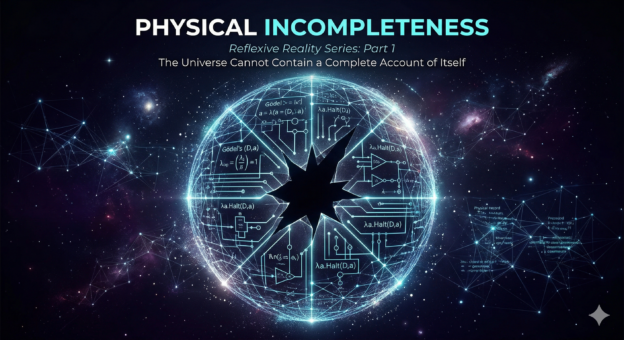
Physical Incompleteness: The Universe Cannot Contain a Complete Account of Itself

A machine-checked theorem proves that any closed physical universe rich enough to contain computation cannot internally contain a complete algorithmic account of its own record-truth. This is not about the limits of human knowledge. It is a theorem about the architecture of reality.Read More “Physical Incompleteness: The Universe Cannot Contain a Complete Account of Itself”

Representational Incompleteness: Why No Self-Model Can Capture Its Own Diagonal

A machine-checked theorem proves that no parametric self-model — no matter how rich, how large, or how powerful — can represent its own diagonal. The blind spot is not a resource limitation. It is structural. And it holds with no computability assumption, no arithmetic, no cardinality.Read More “Representational Incompleteness: Why No Self-Model Can Capture Its Own Diagonal”

One Theorem Behind Gödel, Turing, Kleene, Tarski, and Löb

Gödel’s incompleteness, Turing’s halting undecidability, Kleene’s recursion theorem, Tarski’s truth undefinability, and Löb’s reflection theorem are five of the most celebrated results in 20th-century logic and computation. A new machine-checked theorem proves they are all instances of one master fixed-point framework.Read More “One Theorem Behind Gödel, Turing, Kleene, Tarski, and Löb”

Closure Without Exhaustion: Why Every System That Models Itself Has an Irreducible Remainder

A machine-checked theorem proves that no sufficiently expressive reflexive system — no formal logic, no computer, no physical universe, no mind — can internally exhaust its own realized semantics. Physical incompleteness, representational incompleteness, and the classical barriers of Gödel, Turing, Kleene, Tarski, and Löb are all corollaries of one result.Read More “Closure Without Exhaustion: Why Every System That Models Itself Has an Irreducible Remainder”

The End of Final Theories: How Fixed Laws Produce Inexhaustible Explanation

A new paper — backed by 422 machine-checked theorems and zero gaps — proves that a system can be completely governed by fixed laws and still never admit a final explanation. The implications reach from physics to biology to organizations to AI.Read More “The End of Final Theories: How Fixed Laws Produce Inexhaustible Explanation”

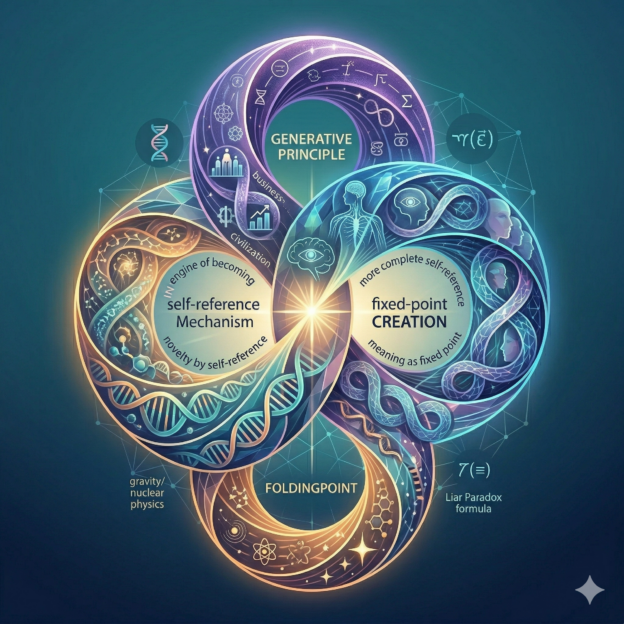
The Twist as Generative Principle

This is the final essay in a series. The first, The Twist Move, describes the operation itself across mathematics, biology, physics, and business. The second, The Twist and the Ground of Being, argues that the consciousness twist is real, that the substrate must support it, and that this tells us something fundamental about the nature of reality.Read More “The Twist as Generative Principle”

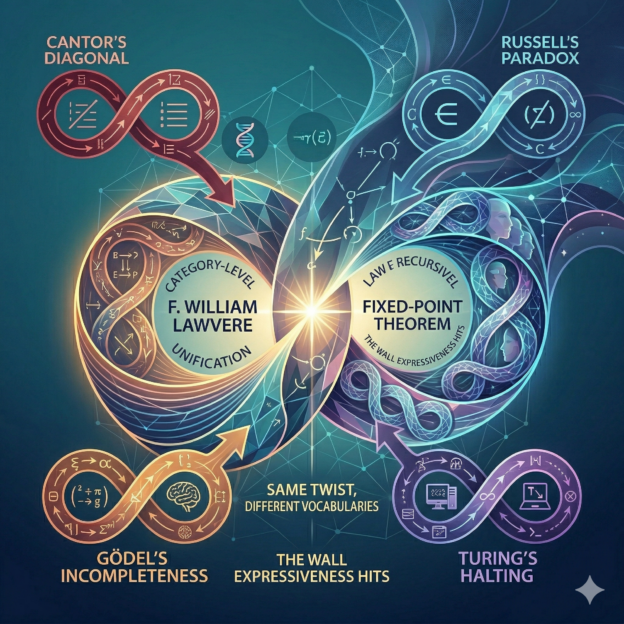
The Theorem Behind the Twist – Lawvere’s Fixed-Point

This is the sixth essay in a series. The first, The Twist Move, describes the operation itself across mathematics, biology, physics, and business. The second, The Twist and the Ground of Being, argues that the consciousness twist is real, that the substrate must support it, and that this tells us something fundamental about the nature of reality.Read More “The Theorem Behind the Twist – Lawvere’s Fixed-Point”

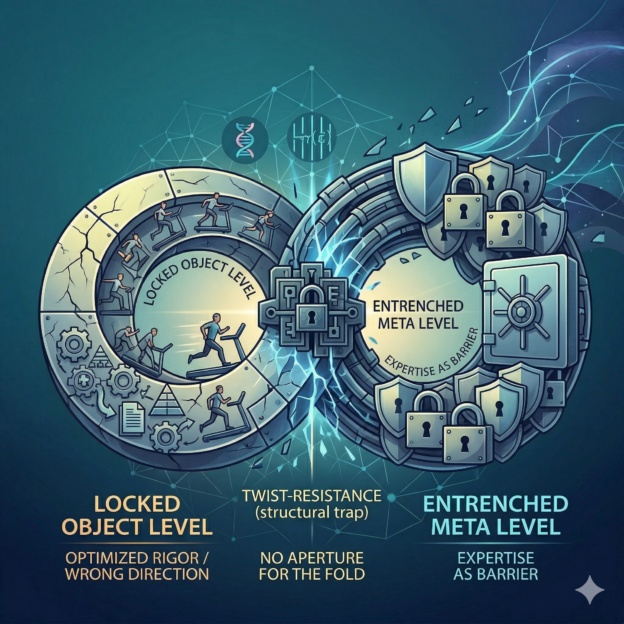
The Twist-Resistant Organization

This is the fifth essay in a series. The first, The Twist Move, describes the operation itself across mathematics, biology, physics, and business. The second, The Twist and the Ground of Being, argues that the consciousness twist is real, that the substrate must support it, and that this tells us something fundamental about the nature of reality.Read More “The Twist-Resistant Organization”

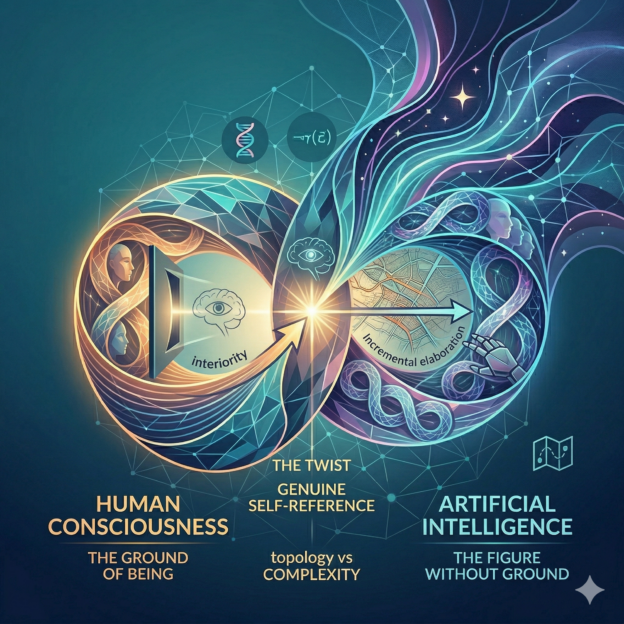
The Figure Without Ground – AI Versus the Twist

This is the fourth essay in a series. The first, The Twist Move, describes the operation itself across mathematics, biology, physics, and business. The second, The Twist and the Ground of Being, argues that the consciousness twist is real, that the substrate must support it, and that this tells us something fundamental about the nature of reality.Read More “The Figure Without Ground – AI Versus the Twist”

How to Develop Twist Literacy

This is the third essay in a series. The first, The Twist Move, describes the operation itself across mathematics, biology, physics, and business. The second, The Twist and the Ground of Being, argues that the consciousness twist is real, that the substrate must support it, and that this tells us something fundamental about the nature of reality.Read More “How to Develop Twist Literacy”

The Twist and the Ground of Being

This is the second essay in a series. The first, The Twist Move, describes the operation itself across mathematics, biology, physics, and business. The second, The Twist and the Ground of Being, argues that the consciousness twist is real, that the substrate must support it, and that this tells us something fundamental about the nature of reality.Read More “The Twist and the Ground of Being”

The Quiet Part Out Loud: Autonomous AI Agents Are an Existential Cyber Threat and Nobody Has a Plan

By Nova Spivack – www.novaspivack.com


Something is happening right now that should terrify anyone who understands it. And the people who do understand it — the AI researchers, the cybersecurity professionals, the intelligence community — are saying it in whispers when they should be screaming.… Read More “The Quiet Part Out Loud: Autonomous AI Agents Are an Existential Cyber Threat and Nobody Has a Plan”

The Sentience Threshold: Consciousness Beyond Computation at the Self-Referential Heart of Reality

Nova Spivack – www.novaspivack.com

Part I: The Unfindable Mind

Flashback to 1999.  The moon, a perfect silver disc, hung suspended in the clear New York summer sky, its light etching the rolling cow fields into stark relief.  I had trudged through the dew-damp grass, a young man in my twenties, my tent a distant silhouette against the low rolling hills. … Read More “The Sentience Threshold: Consciousness Beyond Computation at the Self-Referential Heart of Reality”

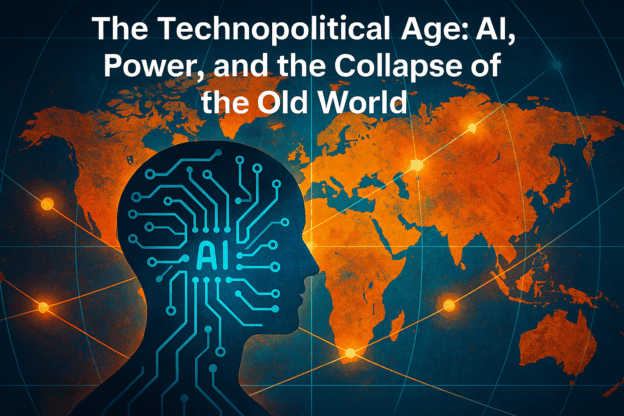
The Technopolitical Age: AI, Power, and the Collapse of the Old World

The Technopolitical Age: AI, Power, and the Collapse of the Old World

We are living through a hinge in history so abrupt that most people have not yet grasped the magnitude of the shift.

In the span of a few short years, artificial intelligence has moved from a laboratory curiosity to the most consequential force reshaping global power.… Read More “The Technopolitical Age: AI, Power, and the Collapse of the Old World”

A New Mathematics of Self-Reference: A Comprehensive Non-Mathematical Summary

What This Work Is About

This article explains my paper on the
Mathematics of Self-Referential Systems, for a non-technical audience. The paper develops a comprehensive mathematical framework for understanding systems that can represent, model, or “know” themselves. While self-reference has long been seen as a source of logical paradoxes, this work argues it may be the fundamental organizing principle of reality itself—and provides specific mathematical bounds and requirements for achieving different levels of self-awareness.… Read More “A New Mathematics of Self-Reference: A Comprehensive Non-Mathematical Summary”

The Mathematical Foundations of Self-Referential Systems: From Computability to Transfinite Dynamics

This article explains my paper on the Mathematics of Self-Referential Systems.

Here is a summary

Decoding Reality’s Blueprint: An In-Depth Look at “The Mathematical Foundations of Self-Referential Systems”

Have you ever wondered about the deep, perhaps even unsettling, nature of a thought thinking about itself?… Read More “The Mathematical Foundations of Self-Referential Systems: From Computability to Transfinite Dynamics”

Cosmological Evolution of the Information Field: Running Complexity Coupling and Unified Cosmological Phases

This paper explores whether the complexity density field ω(x,t) of Information Physics could play a cosmological role — driving inflation, contributing to dark energy, and providing a unified framework for the cosmic history. The model belongs to the broad class of quintessence models with a running coupling.Read More “Cosmological Evolution of the Information Field: Running Complexity Coupling and Unified Cosmological Phases”

Information Geometric Origins of Mass, Charge, and Fundamental Symmetries from Ω-Field Configurations

This paper explores whether the gauge group structure of the Standard Model — U(1)Y × SU(2)L × SU(3)C — can be understood as the inevitable consequence of quantum information processing requirements, rather than as an empirical fact to be postulated.Read More “Information Geometric Origins of Mass, Charge, and Fundamental Symmetries from Ω-Field Configurations”

Quantum Dynamics of the Ω-Field: Ω-Quanta, Fundamental Interactions, and Informational Uncertainty

This paper canonically quantizes the complexity fluctuation field ψ(x,t) developed in IP.Field, treating it as a standard massive scalar quantum field. The result — termed Ω-quanta or “omegons” — are scalar bosons whose mass is set by the free parameters κ and β² of the classical theory.Read More “Quantum Dynamics of the Ω-Field: Ω-Quanta, Fundamental Interactions, and Informational Uncertainty”

The Ω-Field: Classical Field Theory for Information Geometric Complexity

Given a conjectured energy-complexity relationship dE = πkBT dΩ (developed in IP.Found), this paper constructs the simplest classical field theory for a spatially distributed information geometric complexity density ω(x,t). The fluctuation field around thermal equilibrium satisfies standard massive Klein-Gordon dynamics, with all predictions expressed in terms of two free parameters.Read More “The Ω-Field: Classical Field Theory for Information Geometric Complexity”