Category Archives: Essays

Beyond the Abstraction Fallacy: What Formal Proofs Add to the AI Consciousness Debate

New to this research? This article is part of the Reflexive Reality formal research program. Brief introduction ↗ · Full research index ↗

Series: NEMS on AI Safety · Part 1 · Part 2 · Part 3 · Part 4 · Part 5 · Part 6: Beyond the Abstraction Fallacy


A Google DeepMind researcher recently published one of the most-read papers in the current AI consciousness debate, arguing that computation is a “mapmaker-dependent description” that can never instantiate genuine experience — only simulate it.Read More “Beyond the Abstraction Fallacy: What Formal Proofs Add to the AI Consciousness Debate”

Toward a New Science of Self-Referential Systems

Civilization is building systems that reason about themselves, audit themselves, and govern themselves — without a formal science of what self-referential systems can and cannot do. That gap is not merely academic. It is costing us clarity about AI safety, interpretability, consciousness, and the foundations of physics.Read More “Toward a New Science of Self-Referential Systems”

The Concepts Behind NEMS: A Reader’s Lexicon

Every formal research program has a vocabulary. The words matter — not as jargon, but because each one names a distinction that the theory cannot function without. This article is a reader’s lexicon for the Reflexive Reality program: what each key concept means, why it is needed, and how the pieces fit together.Read More “The Concepts Behind NEMS: A Reader’s Lexicon”

What Mind Uploading Would Actually Require

New to this research? This article is part of the Reflexive Reality formal research program. Brief introduction ↗ · Full research index ↗


Mind uploading — the idea of transferring a mind from a biological brain to a digital substrate — is one of the most discussed proposals in transhumanist and AI-adjacent thought.Read More “What Mind Uploading Would Actually Require”

The Reflexive Development Law: What Genuine Progress Actually Looks Like

New to this research? This article is part of the Reflexive Reality formal research program. Brief introduction ↗ · Full research index ↗

Series: Major Results from the Portal Papers · All research ↗


When a reflexive system encounters content it cannot fully internalize — a structural limit it cannot get past — what are the lawful options?Read More “The Reflexive Development Law: What Genuine Progress Actually Looks Like”

Why Change Is Structurally Necessary

New to this research? This article is part of the Reflexive Reality formal research program. Brief introduction ↗ · Full research index ↗


Why does the universe keep changing? Why do minds keep learning? Why is there always more? The reflexive closure theorems give a precise, non-mystical answer: change is structurally necessary.Read More “Why Change Is Structurally Necessary”

Why Diversity Is Not Just Good — It Is Structurally Necessary

New to this research? This article is part of the Reflexive Reality formal research program. Brief introduction ↗ · Full research index ↗


Diversity is usually argued for on ethical or pragmatic grounds. A suite of machine-checked theorems proves it is structurally necessary — not a recommendation, but a consequence of the diagonal barrier.Read More “Why Diversity Is Not Just Good — It Is Structurally Necessary”

No Institution Can Be the Final Judge: What NEMS Tells Organizations

New to this research? This article is part of the Reflexive Reality formal research program. Brief introduction ↗ · Full research index ↗

Series: NEMS on AI Safety · Parts 1–4 above · Part 5: No Institution Can Be the Final Judge


AI governance, scientific peer review, courts of law, democratic institutions — all of these are verification systems.Read More “No Institution Can Be the Final Judge: What NEMS Tells Organizations”

The Four Ways Systems Fail: A Formal Theory of Viable Continuation

New to this research? This article is part of the Reflexive Reality formal research program — a suite of 93+ machine-checked papers and 17 Lean 4 proof libraries. Brief introduction ↗ · Full research index ↗

Series: Viable Continuation — Applied Theorems · All research ↗


AI systems, legal orders, biological organisms, ecosystems, markets, civilizations, and scientific communities all fail.Read More “The Four Ways Systems Fail: A Formal Theory of Viable Continuation”

Physical Incompleteness: The Universe Cannot Contain a Complete Account of Itself

A machine-checked theorem proves that any closed physical universe rich enough to contain computation cannot internally contain a complete algorithmic account of its own record-truth. This is not about the limits of human knowledge. It is a theorem about the architecture of reality.Read More “Physical Incompleteness: The Universe Cannot Contain a Complete Account of Itself”

Representational Incompleteness: Why No Self-Model Can Capture Its Own Diagonal

A machine-checked theorem proves that no parametric self-model — no matter how rich, how large, or how powerful — can represent its own diagonal. The blind spot is not a resource limitation. It is structural. And it holds with no computability assumption, no arithmetic, no cardinality.Read More “Representational Incompleteness: Why No Self-Model Can Capture Its Own Diagonal”

One Theorem Behind Gödel, Turing, Kleene, Tarski, and Löb

Gödel’s incompleteness, Turing’s halting undecidability, Kleene’s recursion theorem, Tarski’s truth undefinability, and Löb’s reflection theorem are five of the most celebrated results in 20th-century logic and computation. A new machine-checked theorem proves they are all instances of one master fixed-point framework.Read More “One Theorem Behind Gödel, Turing, Kleene, Tarski, and Löb”

Closure Without Exhaustion: Why Every System That Models Itself Has an Irreducible Remainder

A machine-checked theorem proves that no sufficiently expressive reflexive system — no formal logic, no computer, no physical universe, no mind — can internally exhaust its own realized semantics. Physical incompleteness, representational incompleteness, and the classical barriers of Gödel, Turing, Kleene, Tarski, and Löb are all corollaries of one result.Read More “Closure Without Exhaustion: Why Every System That Models Itself Has an Irreducible Remainder”

The End of Final Theories: How Fixed Laws Produce Inexhaustible Explanation

A new paper — backed by 422 machine-checked theorems and zero gaps — proves that a system can be completely governed by fixed laws and still never admit a final explanation. The implications reach from physics to biology to organizations to AI.Read More “The End of Final Theories: How Fixed Laws Produce Inexhaustible Explanation”

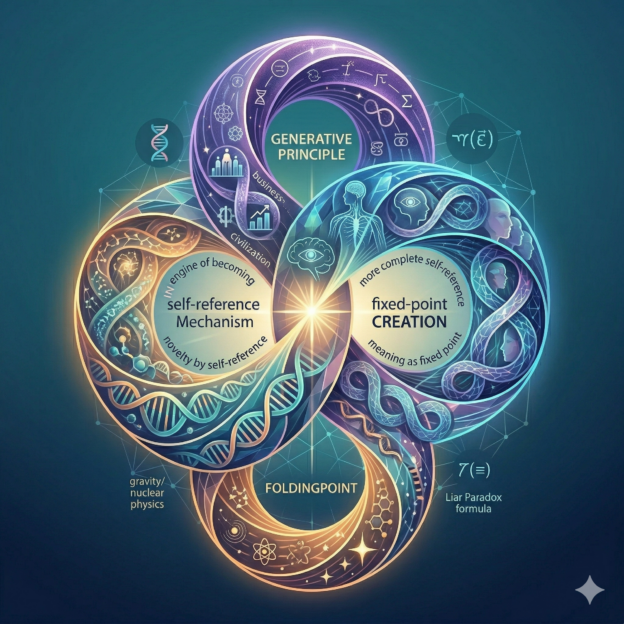
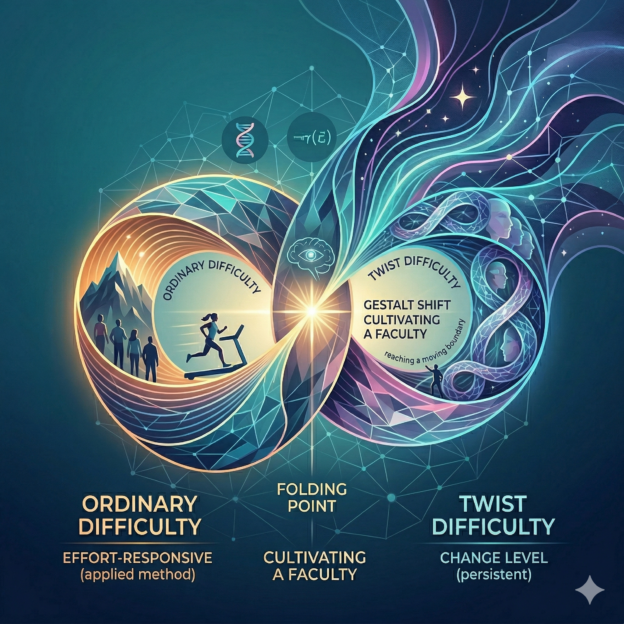
The Twist as Generative Principle

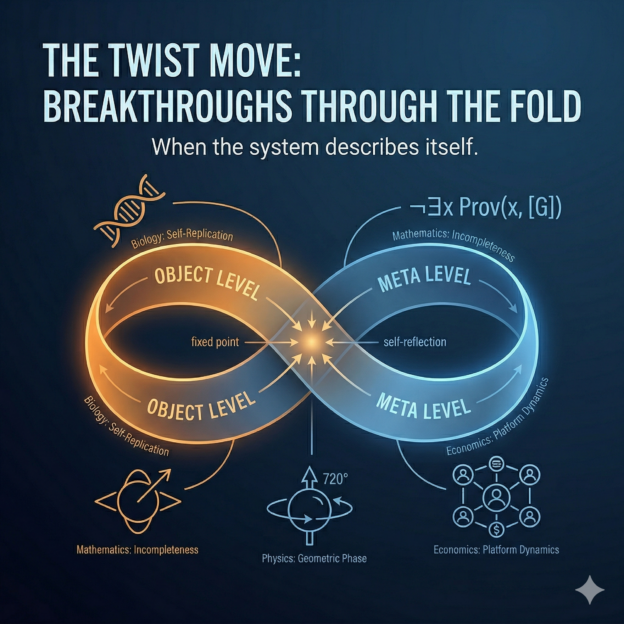
This is the final essay in a series. The first, The Twist Move, describes the operation itself across mathematics, biology, physics, and business. The second, The Twist and the Ground of Being, argues that the consciousness twist is real, that the substrate must support it, and that this tells us something fundamental about the nature of reality.Read More “The Twist as Generative Principle”

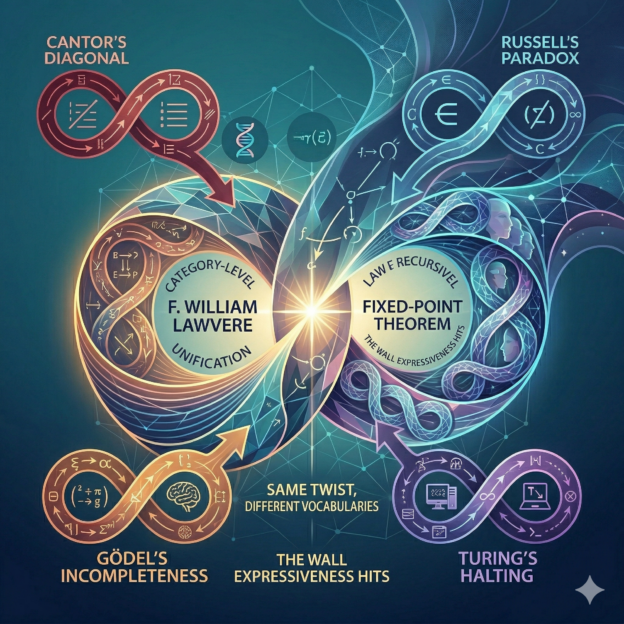
The Theorem Behind the Twist – Lawvere’s Fixed-Point

This is the sixth essay in a series. The first, The Twist Move, describes the operation itself across mathematics, biology, physics, and business. The second, The Twist and the Ground of Being, argues that the consciousness twist is real, that the substrate must support it, and that this tells us something fundamental about the nature of reality.Read More “The Theorem Behind the Twist – Lawvere’s Fixed-Point”

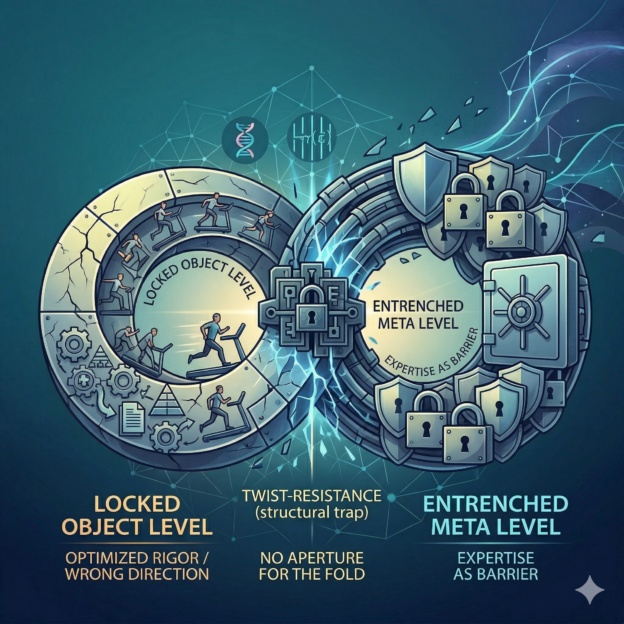
The Twist-Resistant Organization

This is the fifth essay in a series. The first, The Twist Move, describes the operation itself across mathematics, biology, physics, and business. The second, The Twist and the Ground of Being, argues that the consciousness twist is real, that the substrate must support it, and that this tells us something fundamental about the nature of reality.Read More “The Twist-Resistant Organization”

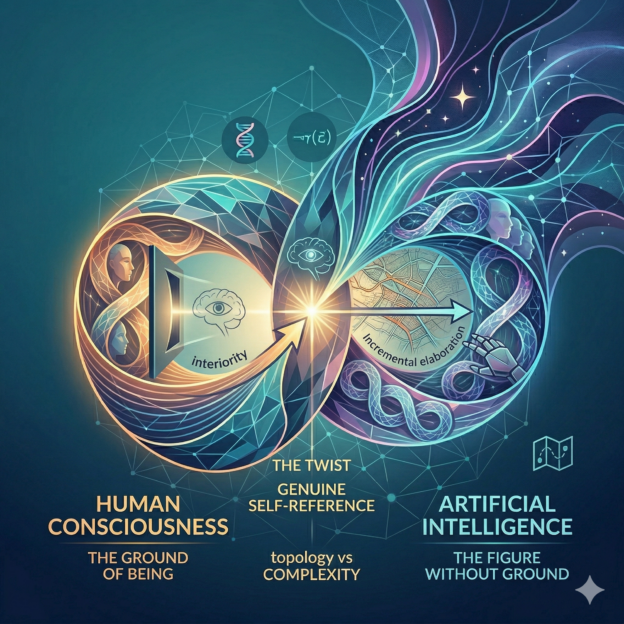
The Figure Without Ground – AI Versus the Twist

This is the fourth essay in a series. The first, The Twist Move, describes the operation itself across mathematics, biology, physics, and business. The second, The Twist and the Ground of Being, argues that the consciousness twist is real, that the substrate must support it, and that this tells us something fundamental about the nature of reality.Read More “The Figure Without Ground – AI Versus the Twist”

How to Develop Twist Literacy

This is the third essay in a series. The first, The Twist Move, describes the operation itself across mathematics, biology, physics, and business. The second, The Twist and the Ground of Being, argues that the consciousness twist is real, that the substrate must support it, and that this tells us something fundamental about the nature of reality.Read More “How to Develop Twist Literacy”

The Twist and the Ground of Being

This is the second essay in a series. The first, The Twist Move, describes the operation itself across mathematics, biology, physics, and business. The second, The Twist and the Ground of Being, argues that the consciousness twist is real, that the substrate must support it, and that this tells us something fundamental about the nature of reality.Read More “The Twist and the Ground of Being”

The Horse Has No Rider: Why Autonomous AI Science Gets It Wrong — And What to Do Instead

We are at a genuinely exciting moment. In the past weeks alone, GPD (Getting Physics Done) has launched with bold promises about AI agents autonomously advancing physics, and Math.Inc has released Gauss, their system for AI-driven mathematical research. The pitch is seductive: deploy swarms of agents, point them at hard problems, and let them run.… Read More “The Horse Has No Rider: Why Autonomous AI Science Gets It Wrong — And What to Do Instead”

The Age of the Navigator: Why AI in Mathematics Changes Everything — and Nothing

Something remarkable happened this week. A human-AI collaboration formally verified Maryna Viazovska’s Fields Medal-winning proof of optimal sphere packing in 8 and 24 dimensions. Math, Inc.’s AI agent Gauss autoformalized the 24-dimensional proof — over 200,000 lines of Lean code — in just two weeks, with no pre-existing blueprint to work from.… Read More “The Age of the Navigator: Why AI in Mathematics Changes Everything — and Nothing”

The Quiet Part Out Loud: Autonomous AI Agents Are an Existential Cyber Threat and Nobody Has a Plan

By Nova Spivack – www.novaspivack.com


Something is happening right now that should terrify anyone who understands it. And the people who do understand it — the AI researchers, the cybersecurity professionals, the intelligence community — are saying it in whispers when they should be screaming.… Read More “The Quiet Part Out Loud: Autonomous AI Agents Are an Existential Cyber Threat and Nobody Has a Plan”

The Sentience Threshold: Consciousness Beyond Computation at the Self-Referential Heart of Reality

Nova Spivack – www.novaspivack.com

Part I: The Unfindable Mind

Flashback to 1999.  The moon, a perfect silver disc, hung suspended in the clear New York summer sky, its light etching the rolling cow fields into stark relief.  I had trudged through the dew-damp grass, a young man in my twenties, my tent a distant silhouette against the low rolling hills. … Read More “The Sentience Threshold: Consciousness Beyond Computation at the Self-Referential Heart of Reality”

The Sentience Spark: Why True Awareness is More Than Computation, and How It Could Reshape Our Universe

By Nova Spivack

June 13, 2025

We are living in an age of breathtaking technological advancement. Artificial Intelligence (AI) can now compose music, write poetry, diagnose diseases, and drive cars. The horizon of Artificial General Intelligence (AGI)—machines with human-like cognitive abilities across diverse domains—seems closer than ever.… Read More “The Sentience Spark: Why True Awareness is More Than Computation, and How It Could Reshape Our Universe”

A Step-by-Step Guide to Why Consciousness Transcends Computation: Understanding the Formal Proof of Transputation

Part Two of a Series — A Non-Technical Companion to “On The Formal Necessity of Trans-Computational Processing for Sentience

(Read Part One Here)


Introduction: Following the Logic

The formal paper presents a highly technical mathematical proof with a powerful conclusion: genuine consciousness (what we call “sentience”) cannot emerge from ordinary computation alone, no matter how sophisticated.… Read More “A Step-by-Step Guide to Why Consciousness Transcends Computation: Understanding the Formal Proof of Transputation”

The Conscious Universe: Why True Awareness Requires More Than Computation

A Guide to Understanding the Deepest Mystery of Existence

Part One of a Two-Part Companion Guide to My Formal Proof: On The Formal Necessity of Trans-Computational Processing for Sentience


Introduction: The Question That Changes Everything

Imagine you’re looking in a mirror.… Read More “The Conscious Universe: Why True Awareness Requires More Than Computation”

The Geometric Nature of Consciousness: A New Framework Connecting Physics, Information, and Mind – (Non-Technical Introduction)

Introduction: What if Consciousness is Like Gravity?

Here’s a thought that might reshape how we think about consciousness: what if awareness isn’t something that emerges from complex computation, but is instead as fundamental to reality as gravity itself? This is the intriguing proposition I explore across four interconnected papers that attempt to bridge physics, information theory, and the mystery of consciousness.… Read More “The Geometric Nature of Consciousness: A New Framework Connecting Physics, Information, and Mind – (Non-Technical Introduction)”

The Geometry of Intelligence: Why I Think Math Might Hold the Key to Understanding Minds and Machines

A personal journey into a new mathematical framework that could revolutionize AI, neuroscience, and our understanding of consciousness

I’ve spent the last several years developing what I believe could be a fundamental breakthrough in how we understand intelligence—both biological and artificial.… Read More “The Geometry of Intelligence: Why I Think Math Might Hold the Key to Understanding Minds and Machines”

Group Minds are Happening

GROUP MINDS

The rise of generative AI and system like ChatGPT is going to enable a new type of collective intelligence that I have been writing about for almost 30 years. I call them “group minds”.

Group minds are collective intelligence assistants that extract, learn from, augment, and broker the relationships, communications, knowledge and intelligence of groups.… Read More “Group Minds are Happening”

Do Artificial Zen Masters Dream of Electric Butterflies?

The Dream of an Artificial Zen Master:

If we make an artificial Zen master, 
And it perfectly reproduces everything
that a real Zen master can say or do, 
Is it a Zen master?

My commentary:

Not necessarily. To be an actual Zen master it would have to be sentient.… Read More “Do Artificial Zen Masters Dream of Electric Butterflies?”

The Keeper of the Book: My Childhood Dream of the Future

When I was eight years old, I had a very unusual dream in which I saw many lifetimes of my future. In this dream I saw a very clear picture of what the world would go through for perhaps a century or two into the future.… Read More “The Keeper of the Book: My Childhood Dream of the Future”

An Interesting Pattern in the Prime Numbers: Parallax Compression

Early this year a software engineer, Shaun Gilchrist, reached out to me after reading a blog post of mine from many years ago, about my informal search for hidden patterns in the prime numbers.

The Ulam Spiral revealed non-random patterns, but they didn’t quite match up.Read More “An Interesting Pattern in the Prime Numbers: Parallax Compression”

Sun Stone

It’s mind blowing. An object I conceived of and had made, which was in my house, that I held in my hand, and once carried in my pocket, is now orbiting the sun for millions of years, near the asteroid belt, moving faster than a bullet, in a red Tesla Roadster.… Read More “Sun Stone”

The Next Step for Intelligent Virtual Assistants

When we talk about the future of artificial intelligence (AI), the discussion often focuses on the advancements and capabilities of the technology, or even the risks and opportunities inherent in the potential cultural implications. What we frequently overlook, however, is the future of AI as a business.… Read More “The Next Step for Intelligent Virtual Assistants”

Twitter is No Longer a Village

I’ve noticed a distinct change in how people use Twitter in the last year:

1. People are increasingly not using Twitter for actual two-way conversations or interactions. Instead it’s being used more for one-way “fire and forget” posting. People just post into the aether, without knowing or even caring if anyone actually reads their posts.… Read More “Twitter is No Longer a Village”

How Bottlenose Could Improve the Media and Enable Smarter Collective Intelligence

How Bottlenose Could Improve the Media and Enable Smarter Collective Intelligence

This article is part of a series of articles about the Bottlenose Public Beta launch.

Bottlenose – The Now Engine – The Web’s Collective Consciousness Just Got Smarter

How Bottlenose Could Improve the Media and Enable Smarter Collective Intelligence (you are here)

A New Window Into the Collective Consciousness

Bottlenose offers a new window into what the world is paying attention to right now, globally and locally.… Read More “How Bottlenose Could Improve the Media and Enable Smarter Collective Intelligence”

Bottlenose – The Now Engine – The Web’s Collective Consciousness Just Got Smarter

Recently, one of Twitter’s top search engineers tweeted that Twitter was set to “change search forever.” This proclamation sparked a hearty round of speculation and excitement about what was coming down the pipe for Twitter search.

The actual announcement featured the introduction of autocomplete and the ability to search within the subset of people on Twitter that you follow — both long-anticipated features.… Read More “Bottlenose – The Now Engine – The Web’s Collective Consciousness Just Got Smarter”

How I Got Into College (by Doing the Opposite of What I Should Have Done). An Essay.

Today I had an interesting phone call with an alumnus of my alma mater, Oberlin College. He called me for an informational interview, asking for some career advice. It was a good conversation. At one point, on a tangent, he asked me why I went to Oberlin?… Read More “How I Got Into College (by Doing the Opposite of What I Should Have Done). An Essay.”

My Father and Me. A Memoir. For Mayer Spivack (1936 – 2011)

My father, Mayer Spivack, passed away on February 12, 2011, in the Kaplan Family House, a beautiful hospice outside of Boston. He passed away, at the young age of 74, after a difficult year and a half battle with colon cancer.… Read More “My Father and Me. A Memoir. For Mayer Spivack (1936 – 2011)”