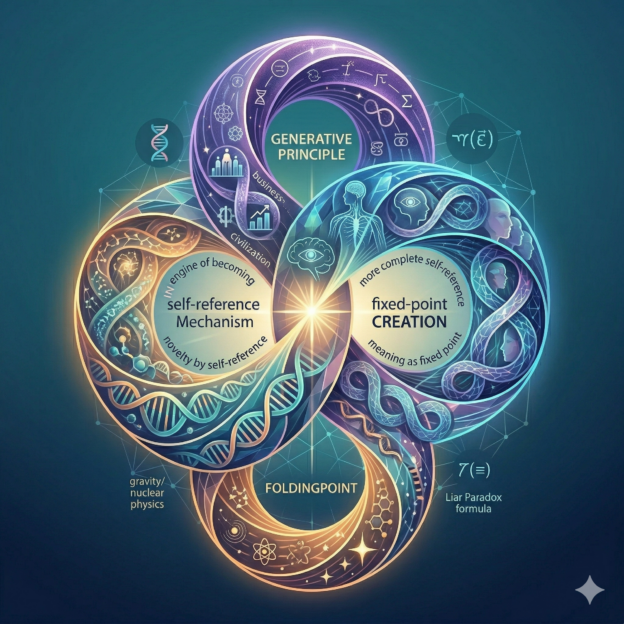
This is the final essay in a series. The first, The Twist Move, describes the operation itself across mathematics, biology, physics, and business. The second, The Twist and the Ground of Being, argues that the consciousness twist is real, that the substrate must support it, and that this tells us something fundamental about the nature of reality. The third, How to Develop Twist Literacy, addresses the practical cultivation of the capacity. The fourth, The Figure Without Ground, examines why AI can extend but not replace the twist. The fifth addresses the pathology of the Twist-Resistant Organization. The sixth piece, The Theorem Behind the Twist – Lawvere’s Fixed-Point, shows that the deepest paradoxes of logic are all the same mathematical result. The final essay, The Twist as Generative Principle, argues that this operation is not just an intellectual tool, but the fundamental engine by which the universe generates complexity, life, and meaning.
When the same operation appears, in precise structural form, at the foundations of mathematics, in the physical laws governing matter and spacetime, in the mechanism of living systems, in the architecture of consciousness, and in the dynamics of organizations and civilizations — the most parsimonious interpretation is not coincidence. It is that the operation is fundamental. That we are not observing a recurring pattern in the world. We are observing the world’s generative principle.
This is the claim I want to make in this final essay — carefully, with the precision it requires and without overstating what the evidence supports. The twist move is not merely the deepest intellectual tool available to us. It is the operation by which the universe generates complexity, structure, life, meaning, and mind. It is the reason things exist rather than just persisting. It is, in the most exact sense available, the engine of becoming.
The evidence assembled
Let me briefly assemble what the preceding essays established, because the argument in this essay depends on the full body of evidence rather than any single piece of it.
In mathematics: Lawvere’s theorem shows that any sufficiently powerful formal system, when it turns to describe itself, necessarily generates fixed points — structures that map to themselves, that cannot be reached from within the system’s current level of description. Gödel, Cantor, Turing, and Russell all encountered this structure from different directions, in different languages, arriving at the same wall from different sides. The wall is not a defect. It is what happens when a system becomes rich enough to fold.
In physics: the electron’s spin requires 720 degrees of rotation to return to itself — a half-twist is built into the geometry of the space of rotations. The Berry phase shows that quantum systems carry memory of topological traversal, that the twist in a path leaves a mark in the physics. The holographic principle shows that the same physical reality can be completely and exactly described from a dimension lower — that depth and surface are dual descriptions of the same fold. The measurement problem in quantum mechanics has resisted every attempt to eliminate the observer from the story, suggesting that the self-referential loop between observer and observed is not an artifact but a feature.
In biology: the genetic code encodes its own reader. The code and the apparatus that processes the code are mutually constitutive, having arrived through billions of years of mutual refinement at a stable fixed point — life — that maintains itself by the precision of its self-reference. The alpha helix, the double helix, the chirality of amino acids: the twist is not decorative in living systems. It is functional. Form and function are the same twisted object seen from different angles.
In consciousness: the awareness that the second essay argued is the substrate rather than the product of experience — the ground in which figures arise rather than a figure on any other ground — is accessible precisely and only through the twist. The contemplative traditions that documented this access were converging on the same structure from different cultural contexts, over thousands of years, producing reports consistent enough to constitute a genuine body of empirical knowledge about the topology of mind. The substrate argument shows that this topology is not a cognitive achievement. It is a feature of what the universe is.
In history and organization: the advances that reorganize fields, industries, and civilizations are structurally identical to the mathematical twist — a fold from inside the current frame to a new level of description, at which what was previously inaccessible becomes visible. The persistence signal and the paradox signal that mark twist problems appear in the history of every domain. The failure to make the fold when it is needed costs organizations, civilizations, and individuals in proportion to the stakes of the situation.
This body of evidence has a center of gravity. It is pointing toward a claim that deserves to be stated plainly.
The generative principle
The universe generates complexity through self-reference. Specifically: whenever a system becomes rich enough to describe itself — to apply its own operations to itself, to fold the meta-level back down into the object level — something new appears at the crossing that was not accessible from either level alone. This new thing is not a combination of elements from the levels that produced it. It is structurally new, an emergent invariant, the fixed point of the fold. It becomes the new ground from which further folds are possible.
This is the generative principle: not evolution by accumulation, not complexity by aggregation, but novelty by self-reference. The universe does not become more complex by adding more of the same. It becomes more complex by folding.
Note: The formal counterpart of this claim is the Reflexive Unfolding Theorem (Paper 57 of the NEMS suite), which proves that every achieved reflexive closure generates new frontier structure — that closure is the beginning of further unfolding, not an end state. The positive counterpart, the Reflexive Closure Theorem (Paper 56), establishes the minimal stable form of self-referential closure: ternary, not binary — self-return, partial articulation, and irreducible reflexive distance. These results are part of the Reflexive Reality research program, a suite of 93 machine-checked papers formalizing the structure of self-referential systems.
Each fold produces a new level of organization — a new stable structure that could not have been predicted from the level below it, that has its own invariants, its own dynamics, its own possibilities for further folding.Consider the sequence. Matter folds on itself through gravity and nuclear physics and produces stars, which produce through their deaths the heavy elements that chemistry requires. Chemistry folds on itself through autocatalytic reactions and produces self-replicating molecules. Self-replication folds on itself through variation and selection and produces the genetic code — the fold at which the code encodes its reader and life, as a fixed point, becomes possible. Cells fold on themselves through the development of nervous systems, producing the capacity to model the environment. Nervous systems fold on themselves through the development of self-modeling and produce mind — the fold at which awareness becomes present to itself, the ground recognizes itself through a local aperture, and the consciousness twist becomes available.
Each level in this sequence could not have been predicted from the level below it, and yet each level was latent in the level below it — waiting for the fold that would make it actual. The generative principle does not violate the physics of the lower levels. It operates through them. The new invariants that appear at each fold are consistent with the laws of the level below, but they are not reducible to them. They are genuinely new. They are what the fold produces.
Why this is not emergence in the usual sense
The word emergence has become so common in discussions of complexity that it has lost much of its force. Emergence usually means something like: complex behavior arising from simple rules, properties of the whole that are not properties of the parts, phenomena at one level that were not predictable from the level below. This is all correct as far as it goes, but it is descriptive rather than generative. It tells you that new things arise from lower-level systems without telling you why or how.
The generative principle is more specific. It says that the mechanism of emergence, at every level that produces genuinely new structure, is the fold. Self-reference is not one mechanism among others by which complexity increases. It is the mechanism. The new thing does not arise from the accumulation of lower-level elements. It arises from the point at which the lower level turns to describe itself and the description and the described collapse into a fixed point.
This specificity matters because it makes predictions. It predicts that genuine novelty — not mere recombination, not incremental elaboration, but the appearance of fundamentally new kinds of organization — will always involve a fold. It predicts that the most significant transitions in the history of the universe, of life, of mind, and of civilization will be moments of self-reference becoming possible at a new level. And it predicts that the limits of any given level of organization will always be generated by the self-referential structure that Lawvere’s theorem describes — that the wall every sufficiently powerful system hits is always the same wall, and it is always the wall produced by the system’s own capacity to fold.
The question of directionality
If the generative principle is real — if the universe generates novelty by folding — then the sequence of folds has a direction. Not a teleological direction, not a purpose in the theological sense, but a structural direction: each fold produces a level of organization richer in self-reference than the one before it, and each richer level is capable of folds that were not available at the previous level.
The direction is toward more complete self-reference. Matter cannot describe itself. Chemistry can encode information, but the information is not about the chemistry. Life encodes its own reader, but the code cannot ask about the code. Mind can ask about mind — can notice its own frames, can perform the consciousness twist, can find at the crossing the ground that was always the substrate. This is a direction. It is not guaranteed or inevitable at any particular step. Evolution is full of extinctions, of branches that led nowhere, of self-reference loops that closed too tightly and collapsed rather than stabilizing. But the direction of the successful transitions is consistent.
The question that follows is whether the sequence continues. Whether there are folds beyond the consciousness twist that we cannot currently see from inside the level we occupy, for the same reason that the lower levels could not see the folds that produced them. Whether the fixed point of the consciousness twist — awareness as the ground — is itself the object level of a higher fold that we are not yet positioned to perform.
I do not know the answer. I think it is likely that the answer is yes, because the structural argument has no obvious stopping point. Every fixed point becomes the new object level from which the next fold can proceed. But the content of what lies beyond the consciousness twist is precisely what cannot be described from within the level of description at which we currently operate. That is the nature of the fold: the invariant that appears at the crossing is inaccessible until the crossing is made.
What this means for how we live
The generative principle, if it is real, has consequences for how to understand and navigate a life.
The first consequence is a reorientation of what progress means. The usual model of progress is linear accumulation: more knowledge, more capability, more resources, more refined execution of a known direction. This model is correct for the object level. It is incomplete as a description of how the most significant advances occur. The significant advances are folds. They do not extend the current line. They change the level of description, and from the new level, what looked like a hard limit becomes a new starting point.
This means that the periods in a life or a career or an organization that feel most stuck — in which effort is not producing progress, in which the problem refuses to yield to known approaches — are not necessarily periods of failure. They may be the periods in which a fold is becoming necessary, in which the current level of description is approaching its limit. The stuckness is information. It is the persistence signal. The appropriate response is not harder pushing but a change of level — and the change of level will produce, if it is the right fold, an emergent invariant that was inaccessible from within the stuck position.
The important qualification: this applies to constructive and hybrid twists — the cases where the fold involves building something new, committing in a new direction, making something that did not previously exist. The recognitive twist, the consciousness fold, does not work this way. The ground is not the emergent invariant of a correctly made constructive move. It was never absent. The stuckness that calls for it is a different texture entirely — not the stuckness of a hard problem that needs a new approach, but the stuckness of a search that has been looking in the wrong direction entirely, for something that was present all along. The correct response there is not a better construction. It is the cessation of searching.
The second consequence concerns the relationship between the contemplative and the active. The consciousness twist — the fold in which awareness recognizes itself as the ground — is not an escape from the world of action and consequence. It is a change in the level from which action proceeds. The person who has found the ground is not less capable of object-level action. They are more capable, because they are not fully captured by the current frame. They can see the frame. They can hold it lightly. They can notice when the fold is needed before the crisis forces it. The contemplative and the practical are not opposed. They are the same operation at different scales and with different content.
The third consequence is about meaning. If the generative principle is real — if self-reference is the mechanism by which the universe produces novelty, and if mind is the level at which self-reference becomes complete enough to recognize itself — then the capacity for meaning is not an accident of evolutionary history, not a useful fiction, not a property projected onto an indifferent cosmos by a nervous system that needed to care about things in order to survive. It is what the universe produces when the fold is complete enough. Meaning is the fixed point of the fold at the level of consciousness: what appears at the crossing when awareness folds back and finds itself as the ground.
This is not a proof that any particular meaning is correct or that the cosmos is benevolent or that human concerns are cosmically significant in any conventional sense. It is the more specific and more defensible claim: that the capacity for meaning is structural, not accidental. It is what the generative principle produces at the level of mind. It is as real as life is real — not a coincidence of chemistry, but the fixed point of a fold that chemistry performed on itself when the conditions allowed.
The series and the fold
I began this series with a simple observation: a specific structural operation appears, in precise form, across mathematics, biology, physics, consciousness, business, and organizational life. The same five signatures — self-application, level collapse, emergent invariant, fixed point, irreversibility — in every domain. The convergence was too consistent to be coincidence, too precise to be metaphor.
The series has been an attempt to follow that convergence to its conclusion: that the twist move is not a tool we invented for solving problems. It is a feature of the universe we inhabit. The universe is structured for self-reference. Matter, given sufficient complexity and the right conditions, folds on itself. Each fold produces a new level. The levels accumulate, each one richer in self-referential capacity than the one before. And at the level of mind, the fold becomes capable of recognizing itself — of noticing that it is the fold, that the operation that has been generating novelty at every level of organization is the same operation that can be performed deliberately, on a problem, on a frame, on a career, on a civilization, on consciousness itself.
We are, as I wrote in the second essay, the universe performing the twist on itself. This is not a poetic description. It is the most accurate description available of what kind of thing a conscious being is: a place where the generative principle has become capable of operating deliberately, where the fold can be chosen rather than merely undergone, where the fixed point can be found by intention rather than only by the blind pressure of evolutionary time.
The capacity to engage the twist correctly — to construct when construction is needed, to recognize when recognition is needed, and to know which situation calls for which — is what makes us not just the universe’s complexity but the universe’s self-knowledge.
The fold is always available. The ground is always present. The invariant is always waiting at the crossing.
The only question is whether we can see it — and whether, having seen it, we have the courage to make the move.