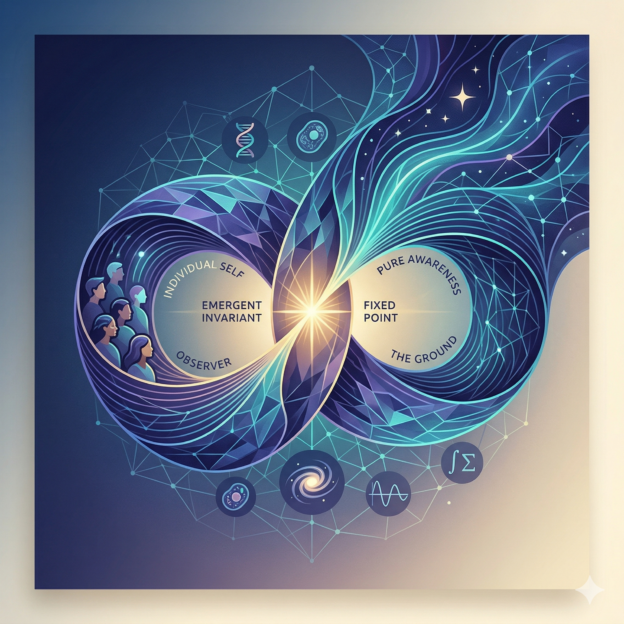
This is the second essay in a series. The first, The Twist Move, describes the operation itself across mathematics, biology, physics, and business. The second, The Twist and the Ground of Being, argues that the consciousness twist is real, that the substrate must support it, and that this tells us something fundamental about the nature of reality. The third, How to Develop Twist Literacy, addresses the practical cultivation of the capacity. The fourth, The Figure Without Ground, examines why AI can extend but not replace the twist. The fifth addresses the pathology of the Twist-Resistant Organization. The sixth piece, The Theorem Behind the Twist – Lawvere’s Fixed-Point, shows that the deepest paradoxes of logic are all the same mathematical result. The final essay, The Twist as Generative Principle, argues that this operation is not just an intellectual tool, but the fundamental engine by which the universe generates complexity, life, and meaning.
There is a move you can make — a specific, learnable, repeatable operation — that changes the relationship between yourself and consciousness itself. Not metaphorically. Not therapeutically. Structurally. The boundary between the observer and what is observed is revealed to be topological rather than absolute, and when the fold is performed, something appears at the crossing that was inaccessible from either side: awareness as the ground rather than the product of experience.
The traditions that documented this move — across centuries, across cultures, arriving independently at the same coordinates — called it awakening, liberation, non-duality, the recognition of the Tao, union with the Godhead, the direct seeing of Buddha-nature. The names differ. The structure does not. And the structure, examined carefully, is identical to an operation that appears at the deepest levels of mathematics, biology, and physics.
I want to press on what this convergence means. Not because the spiritual traditions needed scientific validation — they were doing fine without it — but because if the same operation is woven through mathematics, living systems, quantum mechanics, and the architecture of consciousness, that convergence is telling us something. It is telling us something about the substrate. About what kind of universe we are actually living in. About whether awareness is a side effect of matter or something more fundamental. About whether the word spiritual is pointing at something real, or is merely the oldest vocabulary for a set of cognitive experiences we have not yet properly understood.
I believe it is pointing at something real. And I believe we now have enough pieces to begin saying what that something is.
The twist, briefly stated
In my earlier essay I described what I call the twist move: a structural operation in which a system folds back on itself, collapsing the distance between the object level and the meta level, producing at the crossing an invariant that was inaccessible from either level alone. Gödel performed it on arithmetic and found incompleteness. Evolution performed it on chemistry and found life. Quantum mechanics reveals it in the geometry of the electron’s spin and in the Berry phase — the memory a quantum state acquires from traversing a loop. The holographic principle performs it on spacetime and finds that a three-dimensional gravitational theory is exactly equivalent to a two-dimensional theory on its boundary, one dimension fewer, no gravity. The same fold, the same fixed-point structure, the same emergent invariant.
Five signatures mark every genuine instance of the move: self-application, level collapse, emergent invariant, fixed point, and irreversibility. I will not repeat the full argument here. What matters is that the move is real, it is precise, and it is not metaphor — it is a structural operation that the universe appears to perform at multiple scales and in multiple domains.
Now consider what happens when you perform it on the most fundamental domain of all: the relationship between consciousness and the self.
The two framings of consciousness
The ordinary framing — the one you wake up in, the one that feels self-evident — goes like this: I am the container. Consciousness is something that happens inside me. I have experiences. I am aware. Awareness is a property or product of this particular body-mind. The self is the noun; consciousness is the verb it performs. When the body-mind ceases, the awareness ceases with it. Consciousness is local, personal, bounded. It is what I have, not what I am.
This framing is not wrong about any of the facts it attends to. You do have experiences. Awareness does correlate with neural activity. The body-mind is real. The framing is wrong about the topology: it assumes that the self is the ground and consciousness is the figure. It treats the container as primary.
The twist — or more precisely, the recognition of the twist — inverts this Consciousness is the container. I — this particular configuration of memory, narrative, personality, and body-identification — am a structure arising within awareness. The self is not the ground. It is a figure on a ground it did not make, cannot contain, and will not outlast. The ground was always there. The figure is what came and went. This is the first and most important thing to understand about the consciousness twist: nothing changes when it is performed. The topology was intrinsic all along. Awareness was always the ground. The individual was always the figure. What the contemplative traditions call awakening is not the construction of a new state — it is the correction of a misperception of an existing one. You are not building a Möbius strip. You are recognizing that the strip you have always been on was Möbius from the beginning.
The twist — or more precisely, the recognition of the twist — inverts this. Consciousness is the container. I — this particular configuration of memory, narrative, personality, and body-identification — am a structure arising within awareness. The self is not the ground. It is a figure on a ground it did not make, cannot contain, and will not outlast. The ground was always there. The figure is what came and went. This is the first and most important thing to understand about the consciousness twist: nothing changes when it is performed. The topology was intrinsic all along. Awareness was always the ground. The individual was always the figure. What the contemplative traditions call awakening is not the construction of a new state — it is the correction of a misperception of an existing one. You are not building a Möbius strip. You are recognizing that the strip you have always been on was Möbius from the beginning.The ordinary view: consciousness is inside me. The recognized view: I am inside consciousness — and always was. The crossing is not where something new is built. It is where something always true becomes visible.
Notice the five signatures.
Self-application: consciousness turning to examine itself, the observer observing observation.
Level collapse: the boundary between self and world revealed as topological rather than absolute — not dissolved by an act, but recognized as never having been structural.
Emergent invariant: pure awareness itself, which was not produced by the recognition but was always the ground, now accessible because the misperception has cleared. The traditions are unanimous on this point: what is found was never absent.
Fixed point: awareness as the one element that does not change across all states — waking, dreaming, deep sleep, ecstasy, grief. It is the fixed point not because it was built but because it was never subject to change in the first place. Irreversibility: once you have correctly perceived the topology, the old misperception loses its default authority. You can forget, you can slide back into habitual identification, but the ground has been glimpsed and that glimpse does not fully unhappen.
Irreversibility: every serious tradition insists that once the topology has changed, the old frame does not fully reassert itself. The fold cannot be unfolded without cutting.
This is not poetry dressed as structure. It is the same operation. The traditions that devoted millennia to documenting this territory — Advaita Vedanta, Dzogchen, Zen, the Sufi schools, Meister Eckhart’s Christian mysticism — were doing rigorous phenomenology. They were mapping what happens when the twist is performed on consciousness itself. They disagreed on cosmology, on metaphysics, on practice. They converged on the structure of the result: something irreducible is found at the crossing, something that was always the ground, something that cannot be produced by any accumulation of content-level experience.
The substrate argument
Here is where I want to press hard, because I think this is the argument that has not been made with sufficient force.
If a move is possible within a system, the system must have the properties that make the move possible. This is not a philosophical preference. It is a structural necessity. You cannot perform a computation that the substrate does not support. You cannot execute a biological function that the chemistry does not permit. You cannot have a physical effect that the laws of physics do not allow.
The twist move on consciousness is possible. It has been performed and documented by thousands of individuals across dozens of independent traditions over thousands of years, producing convergent descriptions of the result. It is not a universal experience — it requires specific conditions and often long preparation — but it is repeatable, and its repeatability means it is real in precisely the way that any repeatable experiment is real. If it were a cognitive illusion, a category error, or a mere alteration in brain state with no structural correlate, we would expect the reports to vary as randomly as dreams. They do not. They converge on the same topology, the same invariant, the same phenomenological fixed point.
Now apply the structural necessity: if the consciousness twist is possible, the substrate must support it. The substrate — by which I mean the fundamental structure of reality, whatever that turns out to be — must have the properties that permit awareness to be both a local phenomenon (I have experiences) and the ground (experience arises within awareness) without contradiction. The substrate must be structured such that the boundary between them is topological, not absolute. It must be, in some precise sense, twist-capable at the level of consciousness.
This is not a small thing. It rules out a large class of theories about what the universe is.
What the substrate cannot be
The dominant scientific picture of consciousness for the past century has been some version of epiphenomenalism: awareness is a byproduct of physical processes, causally inert, produced by the brain the way heat is produced by a running engine. On this view, consciousness does not do anything. It is not part of the causal structure of reality. It rides along on top of the physical processes that actually matter, a passenger in a vehicle it does not steer.
The epiphenomenal picture cannot accommodate the substrate argument. If awareness is causally inert — a mere reflection of physical processes, with no structural role in reality — then it cannot be the ground of which selves are figures. A shadow cannot contain the objects that cast it. An epiphenomenon cannot be the substrate from which phenomena arise. The two claims are structurally incompatible.
More precisely: if the twist on consciousness is real — if awareness can be found to be the ground rather than the product, and if this finding is not merely a cognitive trick but a genuine structural discovery — then awareness must be structural. It must be part of the architecture of reality, not an add-on. The epiphenomenal picture is not just incomplete. It is pointing in the wrong direction.
The hard problem of consciousness — David Chalmers’ name for the explanatory gap between physical processes and subjective experience — has resisted every reductionist attack for precisely this reason. You can give a complete account of every neuron firing, every correlate, every functional role, and still not have explained why there is something it is like to be the brain doing all that firing. The hard problem is hard because the epiphenomenal picture is wrong. Awareness is not the thing you have left over after the physics is done. It is a load-bearing element of the structure.
What the substrate might be
The substrate argument does not tell us exactly what the substrate is. But it constrains the possibilities significantly, and the constraints point toward a cluster of positions that serious physicists and philosophers of mind have been converging on from independent directions.
The first constraint: awareness must be structural, not emergent from non-aware matter. The standard materialist picture holds that you start with matter, add complexity, and consciousness eventually appears — an emergent property of sufficiently organized physical systems. But if consciousness is the ground in which physical experience arises, emergence runs in the wrong direction. You cannot get a ground from a figure, no matter how many figures you stack. The ground must be prior.
This points toward some version of what philosophers call neutral monism or panpsychism — positions that hold that the fundamental stuff of reality is neither purely physical nor purely mental, but something that has both as aspects, or that awareness in some form is a basic feature of reality rather than a derived one. These positions have been gaining serious traction: Chalmers, Philip Goff, Bernardo Kastrup, and others have developed rigorous versions that are no longer easy to dismiss as mysticism dressed in academic language.
The second constraint: the substrate must support the topology of the twist — specifically, it must permit the same entity to be simultaneously a bounded local structure (a self, having experiences) and a manifestation of an unbounded ground (awareness, being experience). This is precisely the structure of the holographic principle: the same physics, described simultaneously as a three-dimensional bulk and a two-dimensional boundary. The same information, two topologically distinct descriptions, neither reducible to the other.
This is not an analogy. The holographic principle is the best-supported example we have of a universe that is genuinely twist-capable at the level of its fundamental description. It tells us that the universe’s physics can be fully and exactly encoded at its boundary — that depth and surface are dual descriptions of the same reality. If the universe works this way at the level of spacetime and gravity, it is at minimum not surprising that it works this way at the level of consciousness and self.
The third constraint: qualia — the felt qualities of experience, the redness of red, the sharpness of pain, the particular character of this moment — must be real, not illusory. This follows directly from the substrate argument. If awareness is structural, if it is the ground rather than the byproduct, then its contents are real in the way that the contents of any structural element are real. Qualia are not noise in the physical signal. They are the signal, described from the inside.
Note: This claim is no longer only a philosophical argument. The Reflexive Reality research program has machine-checked formal theorems that bear directly on it. Qualia and the Semantic Ledger (Paper 55) proves that any qualitative content known by a subject must appear in the semantic ledger and cannot be reduced to purely syntactic content. Awareness as the Locus of Ground-Presence (Paper 67) formalizes awareness as the site at which Alpha-grounded reality is present as experience. These results are part of a broader program of 93 machine-checked papers — see the full research index.
Dismissing qualia as epiphenomenal has always had a self-undermining quality: the argument that qualia are not real is itself experienced as an argument, with the felt quality of seeming compelling or not compelling. You cannot step outside qualia to evaluate their reality. The attempt to do so is itself a quale. The substrate argument gives this intuition structural teeth: if the twist on consciousness is real, qualia are real, because they are the content of the ground, not the exhaust of the figure.
Spirituality as a natural science of the ground
I want to be careful here, because this is where the argument is most easily misread.
I am not saying that all spiritual claims are true, or that every religious tradition has correctly mapped the territory it claims to describe, or that the existence of a structural ground of awareness validates any particular cosmology, theology, or practice. Extraordinary claims still require extraordinary evidence. The substrate argument is not a license for credulity.
What I am saying is more specific and, I think, more important: the spiritual traditions that documented the consciousness twist — and only those traditions, and only the aspects of those traditions that bear directly on the structure of awareness — were doing something that deserves to be called empirical investigation.
They were conducting repeatable experiments on a specific phenomenon. They developed methodologies for inducing the conditions under which the phenomenon occurs. They compared notes across generations and across cultures. They refined their descriptions through centuries of careful dialectical work. The result is a body of knowledge about the structure of awareness that is convergent, precise, and in the relevant respects, reproducible.
The fact that this investigation was conducted without electron microscopes or particle accelerators does not make it less rigorous in its own domain. The domain is the interior of awareness, and the instrument is awareness itself. There is no other instrument available. You cannot put consciousness in a centrifuge. You can only prepare the conditions under which the misperception clears — and report what is recognized at the crossing. The investigation is empirical not in the sense of constructing experiments, but in the sense of systematically creating conditions for accurate perception of something that is always already present.
What makes this scientific in the deep sense — not in the institutional sense, but in the sense of producing reliable knowledge about the structure of reality — is that the findings are not arbitrary. They are not wish fulfillment. Across traditions that disagree on nearly everything else, the structural description of what is found at the crossing of the consciousness twist is consistent: awareness is prior to the self, unbounded, without inherent content, incapable of being produced or destroyed, and recognizable as the ground of all experience.
This is not what you would invent if you were inventing a religion. It is not comforting in any obvious sense. It does not validate the ego; it dissolves it. It does not promise personal survival; it reveals the personal as figure rather than ground. These are the marks of a genuine empirical finding: it surprises, it resists wishful interpretation, and it converges across independent lines of inquiry.
The universe looking at itself
Step back and consider what the substrate argument, combined with the twist, implies about the universe as a whole.
The universe is approximately 13.8 billion years old, according to our present understanding. For most of that time, it was matter and energy in various configurations: hydrogen clouds, stellar nurseries, supernovae, heavy elements scattered across expanding space.
Then, on at least one small planet around one unremarkable star, chemistry became self-replicating. Self-replication became cells. Cells became nervous systems. Nervous systems became complex enough to model themselves — to perform the self-reference twist at the level of cognition. And some of those self-modeling systems discovered, after sufficient investigation, that the awareness doing the modeling is not the figure they took it to be, but the ground in which all figures arise.
The universe, in other words, has produced structures capable of performing the twist move on consciousness itself — capable of the universe recognizing itself not as objects in space, but as awareness in which objects appear. This is not a figure of speech. It is the structure of what contemplative practitioners report at the crossing: not an individual achieving a private insight, but the ground recognizing itself through a local aperture.
John Wheeler, one of the twentieth century’s most original physicists, spent the later part of his career arguing that the universe is fundamentally participatory — that observation is not an incidental feature of physical reality but constitutive of it, that the act of measurement does not merely reveal a pre-existing state but brings determinate reality into being. He called the universe a self-excited circuit: a loop in which the observer and the observed are mutually constitutive, each requiring the other.
The measurement problem in quantum mechanics — the unresolved question of why and how the superposition of possibilities collapses into a single actuality upon observation — has resisted every attempt to eliminate the observer from the story. The observer keeps coming back.
Wheeler’s participatory universe is the physics version of the consciousness twist. The universe is not a collection of objects observed from outside by a separate consciousness. It is a self-referential loop: matter giving rise to observers, observers giving rise to determinate reality, determinate reality giving rise to matter. The fold is at every scale.
This does not solve the measurement problem. But it reframes it in a way that connects to the substrate argument: perhaps the measurement problem has resisted solution because physicists have been trying to eliminate the twist from the story, when the twist is the story. The universe is not accidentally self-referential. Self-reference — the fold, the collapse of levels, the emergence of new invariants at the crossing — may be the generative principle of reality itself.
What follows from this
Let me be direct about the implications, because I think they matter and I think they are often stated too timidly.
If the substrate argument is correct — if the consciousness twist is real, and if this implies that awareness is structural rather than epiphenomenal — then the materialist picture is not merely incomplete. It is organized around a mistake.
The mistake is treating the ground as the figure: taking matter as primary and awareness as derivative, when the evidence — the hard problem, the failure of every reduction, the substrate argument, the convergent testimony of thousands of careful investigators across millennia — points in the other direction.
This does not mean matter is not real. The figure is real. Neuroscience is real. The correlation between brain states and experience is real and important. It means that the explanatory direction is reversed: the question is not “how does awareness arise from matter?” but “how does the appearance of matter arise within awareness?” — and this is a tractable question, not a mystical retreat. It is the question that Kastrup and others are beginning to address with genuine rigor. It is the question that a physics adequate to the twist will eventually have to answer.
If qualia are real — and the substrate argument implies they are — then the interior of experience is not a philosophical curiosity. It is data. It is the inside view of what the equations describe from the outside. The fact that we have not yet developed an adequate science of qualia is a problem of instrumentation and methodology, not a sign that there is nothing there. The instrument is awareness itself, and we are only beginning to develop the protocols for its rigorous use.
There is a further structural point that follows from this, and it takes some care to state precisely. The ground, actuality, and manifestation — the three aspects of the primordial reality — are not three separate layers stacked on top of each other. Each requires the others. Ground without actuality would be pure vacuity with no locus in which anything is actual. Actuality without ground would be floating determination with no medium to be actual in. Manifestation without both ground and actuality has nothing to appear in and nothing to appear as. The three aspects are mutually necessary: none can exist in isolation, none is reducible to the others, and together they constitute the minimal closed form of reality. This mutual necessity has been formalized as machine-checked theorems provable from the same minimal framework that underwrites the rest of this program — the upshot is not paradox but structural completeness.
And if spirituality — specifically, the investigation of the structure of awareness through the consciousness twist — is a natural science of the ground, then it is not in competition with physics, neuroscience, or any other discipline that investigates the figure. It is complementary, and it is probably necessary.
A complete science of reality cannot be conducted entirely from outside experience, because experience is the medium in which all science occurs. The observer cannot be permanently bracketed. At some point the loop must close.
The oldest question and the newest tools
We are entering a period in which the tools for investigating both sides of this question are improving rapidly. On the figure side: neuroscience, AI, and the quantitative study of large-scale brain dynamics are generating detailed maps of the neural correlates of consciousness. On the ground side: contemplative traditions are becoming more accessible, more standardized in their reporting, and more willing to engage with empirical investigation.
The Global Consciousness Project, contemplative neuroscience, integrated information theory, the emerging science of psychedelics — these are all attempts to instrument the crossing from different angles. None of them has the full picture yet. All of them are circling the same topology.
The convergence I have been describing in this essay — the twist move appearing in mathematics, biology, physics, and consciousness — is not a poetic observation. It is a structural signal. When the same operation appears at this many independent scales, the most parsimonious explanation is not coincidence. It is that the operation is fundamental — that the universe is, in some deep sense, organized around the fold, and that what we call consciousness, and what we call physical reality, and what we call mathematical truth, are all aspects of a single self-referential structure seen from different levels of description.
The traditions that first investigated this were working with the instruments available to them: careful attention, extended practice, rigorous dialectical inquiry, and the courage to follow the fold wherever it led. They did not have quantum field theory or functional MRI or large language models. They had awareness, which turns out to be the one instrument that is always available and that, properly used, is sensitive to exactly what we need to measure.
What they found at the crossing — the invariant that appears when the consciousness twist is completed — they called by many names: the Atman that is Brahman, the Buddha-nature that was never absent, the Tao that cannot be named but that names everything else. The names are local. The structure is universal. And the fact that the structure is achievable — that the substrate supports the twist — is telling us something about the universe that we have barely begun to assimilate.
The universe is not indifferent to awareness. It is not a machine that accidentally produced observers as a side effect of its indifferent grinding. It is a self-referential structure that generates, at sufficient complexity, the conditions for its own recognition — that produces, in beings like us, the capacity to perform the twist and find at the crossing what was always the ground.
That is not a religious claim. It is a structural inference from available evidence. And it is, I think, the most important inference available to us right now — more important than any particular advance in AI capability, more important than any particular scientific result, more important than any particular technological horizon.
We are the universe performing the twist on itself. The question is whether we are paying attention.