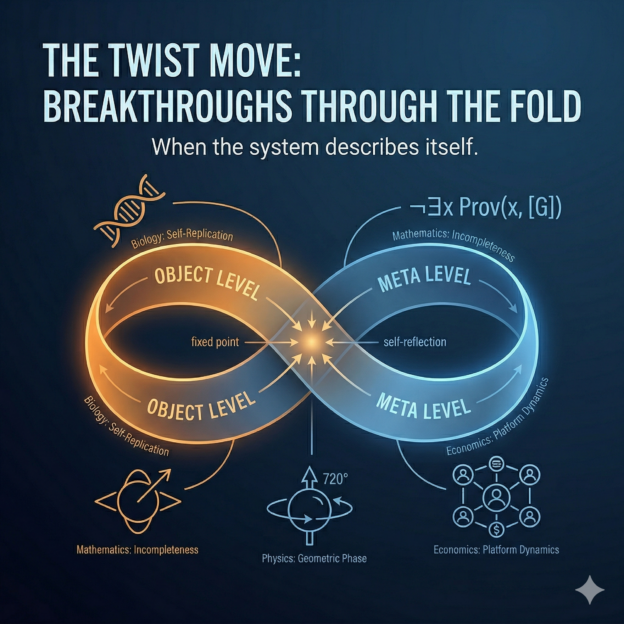
This is the first essay in a series. The first, The Twist Move, describes the operation itself across mathematics, biology, physics, and business. The second, The Twist and the Ground of Being, argues that the consciousness twist is real, that the substrate must support it, and that this tells us something fundamental about the nature of reality. The third, How to Develop Twist Literacy, addresses the practical cultivation of the capacity. The fourth, The Figure Without Ground, examines why AI can extend but not replace the twist. The fifth addresses the pathology of the Twist-Resistant Organization. The sixth piece, The Theorem Behind the Twist – Lawvere’s Fixed-Point, shows that the deepest paradoxes of logic are all the same mathematical result. The final essay, The Twist as Generative Principle, argues that this operation is not just an intellectual tool, but the fundamental engine by which the universe generates complexity, life, and meaning.
There is a class of breakthrough that does not feel like progress. It feels like a sudden shift in gravity — the problem you were pushing against stops resisting, not because you pushed harder, but because you changed the direction of force. Something folded. A level collapsed. You found yourself, without quite knowing how, standing somewhere you could not have walked to.
These moments share a structure. I have come to call it the twist move.
It shows up in the most consequential places human thought has reached: in Gödel’s incompleteness proof, in the double helix, in the topology of a Möbius strip, in the geometry of the electron’s spin, in the emergence of consciousness, in the great platform businesses of our era. In each case, the same operation is performed. A system folds back on itself. The object level and the meta level — previously separate — merge at the fold. Something new appears at the crossing that was inaccessible from either side.
Understanding this operation will not make you a better analyst. It will make you a different kind of thinker.
What the move actually is
The twist move is not recursion, though it often involves recursion. It is not mere self-reference, though self-reference is often the mechanism. It is a specific topological operation: take a structure with two levels — an object level and a meta level — and fold the meta level back down until it becomes an element of the object level. The result is a structure that is simultaneously about itself and a part of itself.
The visual intuition is the Möbius strip. Take a strip of paper with a clear inside and outside, a clear top level and bottom level. Give it a half-twist. Connect the ends. Inside and outside are now one surface. What were two distinct levels are now a single continuous structure. You cannot find the boundary — not because it is hidden, but because the twist eliminated it.
The mathematical signature is a fixed point: a structure that maps to itself under the operation. The biological signature is self-replication. The physical signature is a geometric phase — a memory of traversal that survives the loop. The cognitive signature is insight that cannot be reached by extending the current frame, only by folding it.
The aim of knowledge is not to accumulate more information within a given frame. It is occasionally to discover that the frame was wrong — and to find the new one waiting on the other side of the fold.
My grandfather spent his life studying how organizations think and how they fail to think. One of his deepest observations was that the most dangerous problems are not the ones you cannot solve — they are the ones you are solving correctly inside the wrong frame. The twist move is the operation that changes the frame. It does not solve the problem. It dissolves it.
The canonical case: Gödel
In 1931, Kurt Gödel published a result that broke mathematics open. The mathematical establishment had been pursuing Hilbert’s program: formalize all of mathematics in a complete, consistent axiomatic system. Gödel proved this was impossible.
The proof itself is the twist move in its purest form. Gödel’s insight was to assign numbers to the statements of arithmetic — not their values, but the statements themselves, as symbolic objects. Every formula became a number. Every proof became a sequence of numbers. This is called Gödel numbering, and it is the fold: suddenly, arithmetic — a system for talking about numbers — could talk about itself.
With this in place, Gödel constructed a statement that, decoded, says: This statement is not provable.
If the statement is false, then it is provable — but provable false statements make the system inconsistent. If the statement is true, then it is not provable — and the system is incomplete. There is no third option. The system cannot contain the statement without breaking, and cannot exclude it without leaving something true outside. The fold has revealed a permanent blind spot in any sufficiently powerful formal system.
Notice the structure: Gödel did not find a gap in mathematics. He found a gap that necessarily exists in any system rich enough to describe itself. The twist does not reveal a failure. It reveals an inherent limit — and limits, properly understood, are a form of knowledge. The incompleteness theorem tells us something mathematics could not have told us from within its own flat surface.
Cantor’s diagonal argument is the same move, applied earlier: list all the real numbers, then construct — by moving diagonally through the list and differing from each number in one digit — a new real number not on the list. The list has been folded against itself. A new element appears that the list, by construction, cannot contain. Turing’s halting problem: a program that determines whether programs halt, applied to its own code, produces undecidability. The same fold, the same fixed-point structure, the same new truth appearing at the crossing.
The pattern is general: whenever you ask a sufficiently powerful system to reason about itself, a new level of truth appears that the system cannot reach from within. The twist is the only path to it.
Note: This pattern is not merely a philosophical observation. It has since been proved as a machine-checked theorem. Gödel’s incompleteness, Turing’s halting undecidability, Kleene’s recursion theorem, Tarski’s truth undefinability, and Löb’s reflection theorem are all formally derived as instances of a single master fixed-point theorem — proved in Lean 4 with zero custom axioms and zero gaps. The general result — that no sufficiently expressive reflexive system can internally exhaust its own realized semantics — is established in the paper Closure Without Exhaustion. The unification of the classical barriers is explored in One Theorem Behind Gödel, Turing, Kleene, Tarski, and Löb.
The geometry of the fold
Topology is the branch of mathematics concerned with properties that survive deformation — properties that are global, not local. A coffee mug and a donut are topologically identical, because one can be continuously deformed into the other without cutting or tearing. A sphere and a torus are different, because no such deformation exists.
The twist move is fundamentally a topological operation because what it creates is a global property — something you can only detect by traversing the whole structure. You cannot tell, by examining any small patch of a Möbius strip, whether you are on a Möbius strip or a cylinder. The twist is invisible locally. It only appears when you ask: what happens when the system completes a loop?
This is why breakthroughs enabled by the twist move often feel sudden. You have been examining patches. You have been local. Then, forced by circumstance or design to traverse the whole loop, you discover the global property — the twist that was present all along but invisible from any particular vantage point. The insight is not new information. It is new topology.
Topologists are professionally trained to ask: what invariants appear at the fold? The word invariant is key. An invariant is something that does not change when the system is transformed. The number of holes in a surface is an invariant. The handedness of a structure is an invariant. And invariants are where the deep truths live — because a truth that only holds under specific conditions is a local fact, but a truth that holds under all transformations is a structural law.
The practical translation: when you perform the twist move in any domain, you are looking for invariants. What is true about this system regardless of how you deform it? What survives every transformation? Build there. That is not a metaphor. It is the same operation Gauss, Riemann, and Poincaré used to found modern geometry.
Life as a fixed point
The double helix is famous for its beauty. Less discussed is that it is a twist in the precise technical sense — a rotation of the molecular backbone that produces structural properties inaccessible to the untwisted molecule. The alpha helix in proteins is a twist that creates binding pockets; the twist is not ornament but function.
But the deeper biological twist operates at the level of meaning, not structure. DNA encodes proteins. Among the proteins it encodes are the molecular machines — polymerases, ribosomes, repair enzymes — that read, copy, and maintain DNA. The code encodes its own reader. This is the fold: the information and the apparatus that processes information are mutually constitutive. Neither precedes the other in any simple causal sense. Life is the fixed point of this loop.
This is not circular reasoning. Circular reasoning means that A proves A. The biological twist is different: A and B each presuppose the other, but they came into existence together through a process of mutual refinement over billions of years, arriving at a stable structure that can reproduce itself. Life is not a circle. It is a twist — a structure that maintains itself because it has achieved the precise topology where the self-reference does not collapse but stabilizes.
The protein folding problem — understanding how a linear sequence of amino acids folds into a three-dimensional functional shape — occupied biochemistry for decades. AlphaFold solved it with a deep learning architecture that, notably, uses the protein sequence to predict its own structure through iterative self-attention. The computational solution to the folding problem uses the same twist the molecule itself uses. This is not coincidence. It is the shape of the problem.
Where physics bends
The electron has spin. This is not metaphor — it is a real physical property with measurable consequences. But the electron’s spin is deeply strange: if you rotate a spinning top by 360 degrees, it returns to its original state. If you rotate an electron by 360 degrees, it does not. It requires a 720-degree rotation to return to itself. The electron’s spin is a half-twist built into the geometry of space.
The mathematics here is the covering of the rotation group — the space of all possible orientations has a twist in it that classical physics cannot see, but quantum mechanics can. The electron does not live in ordinary rotational space. It lives in a double-covered version of it, where going “all the way around” once is not the same as not moving at all. The physical world, at its deepest accessible level, has the Möbius structure.
The Berry phase is related and equally striking. When a quantum system’s parameters are slowly varied around a closed loop — changed and then changed back — the quantum state does not return to its original form. It picks up a geometric phase, a memory of traversal. The system remembers that it went around a loop. This memory is physically observable — it produces measurable interference effects. And it arises purely from the topology of the parameter space, not from any force or interaction. The twist in the path leaves a mark in the physics.
The holographic principle in theoretical physics pushes this further. A gravitational theory in a three-dimensional space appears to be exactly equivalent to a field theory on the two-dimensional boundary of that space — one dimension fewer, no gravity. The physics of the bulk and the physics of the boundary are not similar. They are the same thing, described from two perspectives that differ by precisely a fold. What you see as three-dimensional physics with gravity from one vantage point, you see as two-dimensional physics without gravity from the other. The twist is the equivalence.
I do not raise these examples for decoration. I raise them because they establish a fact that should make any serious thinker sit up: the twist move is not an intellectual technique. It is a feature of the physical world. Reality uses it. Evolution discovered it. Consciousness, as we will see, may depend on it. And organizations, strategies, and individual careers succeed or fail on whether they find it or miss it.
The same move in other rooms
Language: the meaning fold
Irony conveys meaning by stating its opposite. The literal layer and the intended layer are separate — until the listener performs the fold, collapsing them, and finds meaning that neither layer contains alone. The twist is the interpretive act. Metaphor works similarly: two domains are held simultaneously, and the insight lives in the crossing, not in either term.
Art: the frame that contains itself
Velázquez’s Las Meninas places the viewer inside the painting: the royal couple reflected in the mirror are looking at the canvas you are looking at. The frame contains its own viewer. Escher’s Drawing Hands shows two hands drawing each other into existence. The work does not represent the twist — it performs it on the viewer’s perception.
Information theory: the demon and the equivalence
Maxwell’s demon — a thought experiment about a creature that sorts molecules by speed — seemed to defeat thermodynamics. Szilard and Landauer resolved it: information is physical. The act of acquiring and erasing information has thermodynamic cost. The fold here collapses epistemology into physics. Knowledge and heat are the same thing, seen from different levels of description.
Economics: supply as demand
The great platform businesses of the internet era are built on the network-effect twist: the users who consume the product are simultaneously the users who produce it. Supply and demand fold into each other. The more buyers, the more valuable the seller’s presence; the more sellers, the more valuable to buyers. The fixed point of this loop is a moat that cannot be replicated by adding features.
The five structural signatures
Once you have seen the twist move in enough domains, the structure becomes recognizable before the domain does. Every genuine instance shares five features:
- Self-application. The operation is applied to its own domain. The system of statements becomes a statement in the system. The code becomes data. The map includes the territory.
- Level collapse. What were two separate strata — object and meta, system and description-of-system — merge at the fold. The distance between levels closes to zero at the crossing point.
- Emergent invariant. Something new appears at the crossing that was not accessible from either level. Gödel’s unprovable truth. Life’s self-maintenance. The electron’s spin. The network’s value. These are not combinatorial products of the two levels — they are structurally new.
- Fixed point. A structure that maps to itself under the operation. This is the stability mechanism: the twist does not produce chaos, it produces a new stable attractor. Life reproduces. The Möbius strip is closed. The great platform stays the platform.
- Irreversibility. Once the fold is made, the flat structure is gone. You cannot un-twist the Möbius strip without cutting it. You cannot un-discover incompleteness. Once an organization finds its twist — its network effect, its self-reinforcing culture, its constraint-turned-advantage — the old flat version of it ceases to exist as a viable option.
These five signatures are diagnostic. If you believe you have found a twist move — in a scientific theory, in a business model, in a personal situation — check for all five. A self-referential joke is not a twist move; it lacks the emergent invariant and the fixed point. Mere recursion is not a twist move; it lacks the level collapse. The real thing has all five, and when it does, it tends to be consequential.
Applying it: the four forms
My grandfather was suspicious of ideas that could not be tested against practice. He believed, and I believe, that an insight that only works as an insight has not finished its job. What follows are the four forms in which the twist move appears in practical life — in problem-solving, in strategy, in understanding, in decision-making.
Form one: the constraint twist
The most common form. Identify the constraint that is blocking you — the thing you are working around, compensating for, apologizing to investors about. Then ask: what would it mean if this constraint were the resource?
Amazon’s infrastructure was a genuine problem. The scale of their e-commerce operation required internal systems of extraordinary complexity, which were expensive, fragile, and consuming enormous engineering attention. The infrastructure problem became AWS — now among the most profitable technology businesses in existence. The constraint was the product. The fold happened when someone asked not “how do we reduce this cost?” but “who else has this problem, and do they know they need what we built?”
The pattern appears everywhere. A company too small to match a large competitor’s feature list builds the clearest, most opinionated product in the market — and finds that the constraint produced a better product than abundance would have. A founder who cannot raise external capital bootstraps to profitability, and the constraint becomes the moat. In each case, the problem is not solved. It is folded.
The practical question: What am I treating as a tax that might be the core asset?
Form two: the self-reference twist
This is the Gödel move applied to cognition — and it sits closest to the recognition end of the spectrum. When you are stuck, the instinct is to push harder at the problem from within the current frame. The twist move says: stop and make the process of being stuck into the object of inquiry. What level are you operating at? What are you treating as given that might be chosen? What would you tell someone else in your exact situation?
Notice that the self-reference move, at the cognitive level, involves a hybrid of construction and recognition: you must deliberately build the meta-level vantage point — you must actually do something to create the conditions for seeing your own frame — but what you find there is not constructed. The wrong frame was always wrong. The assumption was always an assumption. The construction is the instrument; the recognition is the result. This distinguishes it from the fully constructive twists (building AWS, folding the protein) and from the fully recognitive twist (the consciousness twist, where even the instrument is unnecessary — stillness suffices).This is not the same as taking a break and gaining perspective, though it may look similar from outside. It is a deliberate structural operation: fold your current approach back on itself and examine it as an object. The meta-level becomes the object level. You are now doing to your thinking what Gödel did to arithmetic.
The result is usually not a new answer to the question you were asking. It is the discovery that you were asking the wrong question. The problem has not been solved — it has dissolved, because the frame in which it was insoluble no longer exists.
My grandfather called this the discipline of asking “what is our business?” not once at founding, but continuously — because the frame from which you answer that question changes as the environment changes, and the organization that fails to perform this fold on itself keeps optimizing for a reality that is no longer there.
The practical question: What am I treating as the frame that might actually be the content?
Form three: the level-inversion twist
McLuhan’s insight — the medium is the message — is the cleanest statement of this form. We attend to content. The medium that carries content feels like infrastructure, like background, like the thing that is not the point. McLuhan’s twist was to fold the background forward: the medium is not the container of the message, it is the message. Television does not carry a signal; television restructures cognition. The network does not connect people; the network is the social fabric.
This form of the twist is specifically about what you are treating as means versus ends, as frame versus content, as infrastructure versus product. In every case, if you are frustrated by the persistence of a problem at the content level, consider that the solution may live at the level you are treating as background.
In organizational life: culture is usually treated as the context in which work happens. The level-inversion twist says that for many organizations — particularly in knowledge work and in technology — culture is the product. What customers buy, what employees produce, what partners trust, what the brand sustains: these are all downstream of the cultural operating system. Treating culture as background while working on content-level problems is the organizational version of treating the medium as transparent.
The practical question: What background condition, if treated as foreground, would change everything?
Form four: the fixed-point twist
The most strategic form. Find what stays invariant under transformation — what is true about the problem, the customer, the market regardless of how the surface details change — and build at the fixed point.
Jeff Bezos framed this as the more useful question: not what will change in ten years, but what will remain constant. The fixed point is where leverage lives, because the fixed point of a twisted system is the structure that cannot be moved by operating on the system from the outside. It is the attractor everything else orbits.
In understanding a complex domain — scientific, organizational, personal — the fixed-point twist means looking for the underlying structure that generates all the surface phenomena you have been cataloguing. The surface phenomena are the fold. The invariant is what you find at the crossing. When Darwin arrived at natural selection, he did not add another observation to natural history. He found the fixed point — the mechanism that generates all the observations — and the field reorganized around it.
The practical question: What is true here that will be true regardless of which specific version of this situation I am in?
When to reach for it
The twist move is not the right tool in every situation. Most problems should be solved by adding information, resources, or effort within an existing frame. The infrastructure of good management — clear objectives, disciplined execution, honest feedback, continuous improvement — operates at the object level, and it should. Not every problem requires a fold.
The signal that a twist is needed is specific. It is not the signal of a difficult problem. Difficult problems respond to harder work. The signal of a twist problem is a different texture: the harder you push, the more fixed the situation becomes. Progress by effort produces diminishing returns, then flat returns, then reversed returns. You are solving the problem correctly — you are just solving the wrong problem. The frame is wrong. You need the fold, not the force.
A second signal: the problem has proven persistent across multiple attempts, multiple approaches, multiple generations of people working on it. If smart, well-resourced people keep failing at the same thing, the charitable interpretation is not that they were all incompetent. It is that the problem has the shape of a twist problem — it cannot be reached by linear effort from within the current frame. The history of science is littered with these: problems that resisted decades of attack and then dissolved when someone changed the level of description.
A third signal: the solution, once found, seems obvious — and yet nobody found it earlier. Gödel’s proof, once explained, is accessible to any careful reader. The double helix, once known, seems inevitable. This is the phenomenology of the twist: because the solution is not in the domain where the problem was, it seems to come from nowhere. In retrospect, it was always there, waiting at the crossing.
The forward view
We are in a period of extraordinary linear progress in artificial intelligence. The capabilities of these systems improve year over year in ways that are measurable, demonstrable, and consequential. This is real, and it matters. But the questions that will define what this period means — what human agency looks like in a world with AI, what kinds of thinking become more valuable rather than less, what institutions and structures we need — these are not linear questions. They have the shape of twist problems.
The value of human cognition is not going to be determined by competing with systems that can process information faster and remember more than any person. That framing — which is the natural one to reach for — is operating at the wrong level. The question is not “how do we match AI on the dimensions where AI is strong?” It is “what invariant structure of human understanding — the kind that requires a fold, not just faster processing — becomes the locus of value?”
Structural intuition. The capacity to recognize when you are in a twist problem versus a linear problem. The judgment about which fold to make, in which direction, at which moment. The wisdom to know what the fixed points are — in a life, in an organization, in a civilization — and to build there. These are not skills that improve linearly with data and compute. They are the invariants that appear at the human fold.
My grandfather wrote, near the end of his life, that the most important contribution a person can make to an institution is not execution — execution can be organized, delegated, systematized. It is the willingness, at the moment when the frame is wrong, to say so — and to find the new one. That willingness is a form of courage. But it also requires knowing that the new frame exists, and that it is reached not by pushing further in the current direction, but by performing the fold.
The twist move is the operation that takes you there. Learn to recognize it. Practice it in small situations before you need it in large ones. Notice when a problem has the texture of requiring a fold rather than a push. And when you find the crossing — when the levels collapse and the invariant appears — you will know it, because the problem you were trying to solve will no longer be there.
That is not failure. That is the move working.