The debate over machine consciousness is usually framed as a contest between two camps. Functionalists say consciousness is whatever the right kind of information processing does, so a sufficiently sophisticated AI will be conscious. Biological naturalists say consciousness depends on something specific to living brains, so it won’t.… Read More “Crystallized Conceptuality: Why AI Cannot Know Non-Conceptually”
Category Archives: Cognitive Science
Two Paths to the Same Boundary: Alex Lin’s Process-Paradox Framework and the NEMS Consciousness Theorems
Leave a reply
New to this research? This article is part of the Reflexive Reality formal research program. Brief introduction ↗ · Full research index ↗
When two researchers working in entirely different traditions — one in process ontology and Chinese philosophy, one in formal logic and machine-checked proof — independently arrive at structurally identical conclusions about the boundary between computation and consciousness, something important is being tracked.… Read More “Two Paths to the Same Boundary: Alex Lin’s Process-Paradox Framework and the NEMS Consciousness Theorems”
Turing-Computability Excludes Phenomenal Consciousness: What Two Machine-Checked Theorems Prove About LLMs
New to this research? This article is part of the Reflexive Reality formal research program. Brief introduction ↗ · Full research index ↗
Every AI lab is making an implicit claim about whether large language models can ever be conscious. Scale up far enough, or add enough memory, or fine-tune on enough philosophy, and perhaps something will flicker on.… Read More “Turing-Computability Excludes Phenomenal Consciousness: What Two Machine-Checked Theorems Prove About LLMs”
Beyond the Abstraction Fallacy: What Formal Proofs Add to the AI Consciousness Debate
New to this research? This article is part of the Reflexive Reality formal research program. Brief introduction ↗ · Full research index ↗
Series: NEMS on AI Safety · Part 1 · Part 2 · Part 3 · Part 4 · Part 5 · Part 6: Beyond the Abstraction Fallacy
A Google DeepMind researcher recently published one of the most-read papers in the current AI consciousness debate, arguing that computation is a “mapmaker-dependent description” that can never instantiate genuine experience — only simulate it.… Read More “Beyond the Abstraction Fallacy: What Formal Proofs Add to the AI Consciousness Debate”
Toward a New Science of Self-Referential Systems
Civilization is building systems that reason about themselves, audit themselves, and govern themselves — without a formal science of what self-referential systems can and cannot do. That gap is not merely academic. It is costing us clarity about AI safety, interpretability, consciousness, and the foundations of physics.… Read More “Toward a New Science of Self-Referential Systems”
Mind Uploading Won’t Work the Way You Think — Here’s What It Would Actually Require
New to this research? This article is part of the Reflexive Reality formal research program. Brief introduction ↗ · Full research index ↗
Mind uploading — scanning a brain and running the data on a new substrate — is widely discussed as a path to digital immortality.… Read More “Mind Uploading Won’t Work the Way You Think — Here’s What It Would Actually Require”
What Mind Uploading Would Actually Require
New to this research? This article is part of the Reflexive Reality formal research program. Brief introduction ↗ · Full research index ↗
Mind uploading — the idea of transferring a mind from a biological brain to a digital substrate — is one of the most discussed proposals in transhumanist and AI-adjacent thought.… Read More “What Mind Uploading Would Actually Require”
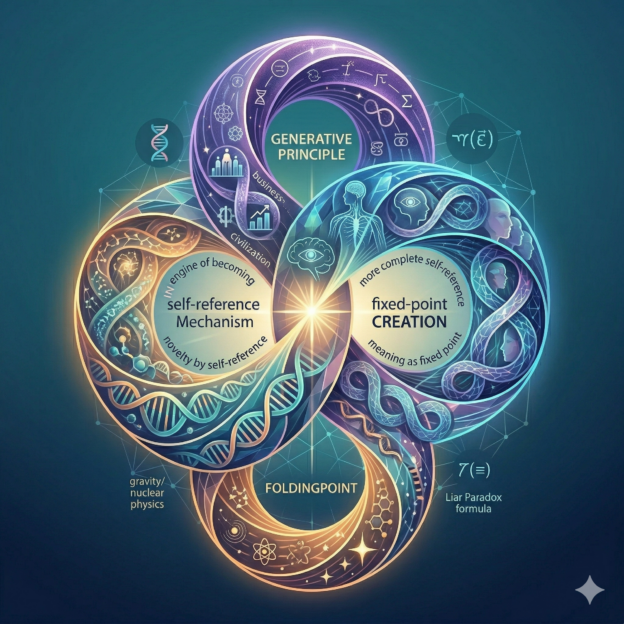
The Twist as Generative Principle
This is the final essay in a series. The first, The Twist Move, describes the operation itself across mathematics, biology, physics, and business. The second, The Twist and the Ground of Being, argues that the consciousness twist is real, that the substrate must support it, and that this tells us something fundamental about the nature of reality.… Read More “The Twist as Generative Principle”
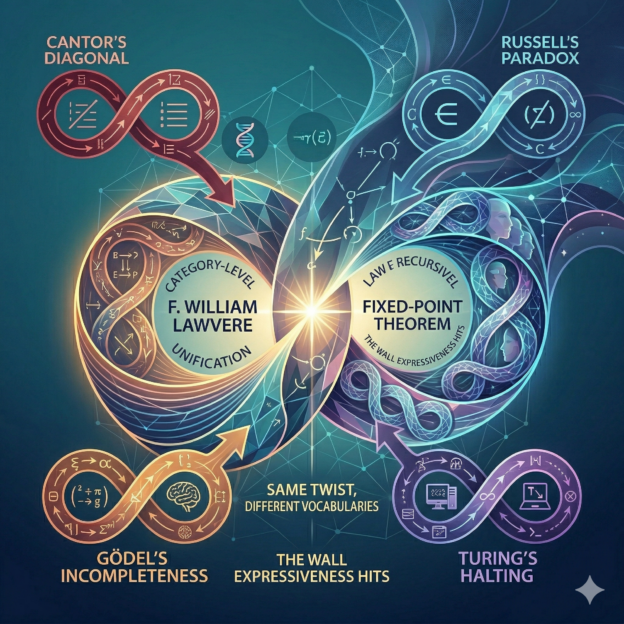
The Theorem Behind the Twist – Lawvere’s Fixed-Point
This is the sixth essay in a series. The first, The Twist Move, describes the operation itself across mathematics, biology, physics, and business. The second, The Twist and the Ground of Being, argues that the consciousness twist is real, that the substrate must support it, and that this tells us something fundamental about the nature of reality.… Read More “The Theorem Behind the Twist – Lawvere’s Fixed-Point”
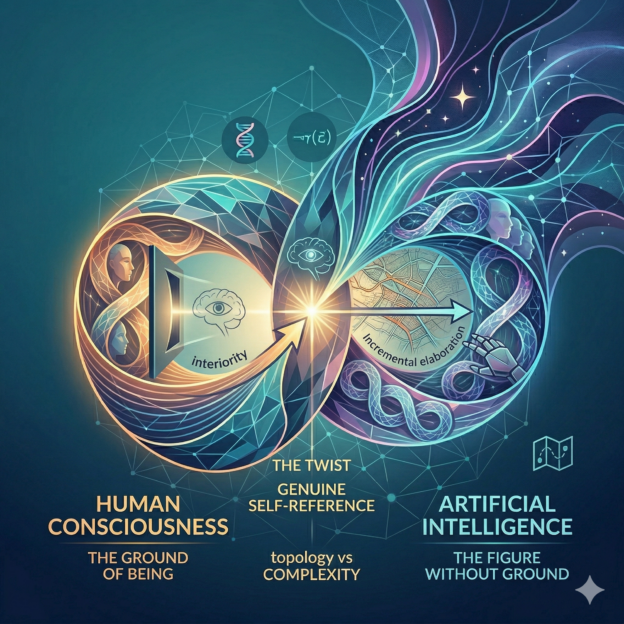
The Figure Without Ground – AI Versus the Twist
This is the fourth essay in a series. The first, The Twist Move, describes the operation itself across mathematics, biology, physics, and business. The second, The Twist and the Ground of Being, argues that the consciousness twist is real, that the substrate must support it, and that this tells us something fundamental about the nature of reality.… Read More “The Figure Without Ground – AI Versus the Twist”
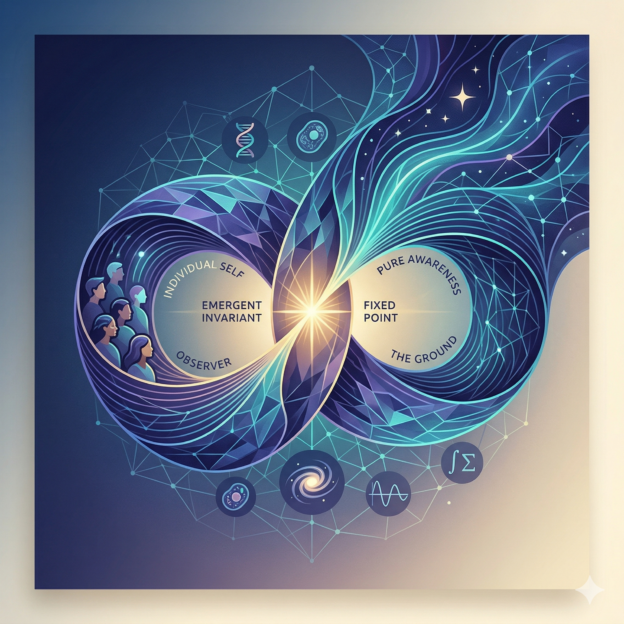
The Twist and the Ground of Being
This is the second essay in a series. The first, The Twist Move, describes the operation itself across mathematics, biology, physics, and business. The second, The Twist and the Ground of Being, argues that the consciousness twist is real, that the substrate must support it, and that this tells us something fundamental about the nature of reality.… Read More “The Twist and the Ground of Being”
The Sentience Threshold: Consciousness Beyond Computation at the Self-Referential Heart of Reality
Nova Spivack – www.novaspivack.com
Part I: The Unfindable Mind
Flashback to 1999. The moon, a perfect silver disc, hung suspended in the clear New York summer sky, its light etching the rolling cow fields into stark relief. I had trudged through the dew-damp grass, a young man in my twenties, my tent a distant silhouette against the low rolling hills. … Read More “The Sentience Threshold: Consciousness Beyond Computation at the Self-Referential Heart of Reality”

A New Mathematics of Self-Reference: A Comprehensive Non-Mathematical Summary
What This Work Is About
This article explains my paper on the
Mathematics of Self-Referential Systems, for a non-technical audience. The paper develops a comprehensive mathematical framework for understanding systems that can represent, model, or “know” themselves. While self-reference has long been seen as a source of logical paradoxes, this work argues it may be the fundamental organizing principle of reality itself—and provides specific mathematical bounds and requirements for achieving different levels of self-awareness.… Read More “A New Mathematics of Self-Reference: A Comprehensive Non-Mathematical Summary”
The Mathematical Foundations of Self-Referential Systems: From Computability to Transfinite Dynamics
This article explains my paper on the
Mathematics of Self-Referential Systems.
Here is a summary
Decoding Reality’s Blueprint: An In-Depth Look at “The Mathematical Foundations of Self-Referential Systems”
Have you ever wondered about the deep, perhaps even unsettling, nature of a thought thinking about itself?… Read More “The Mathematical Foundations of Self-Referential Systems: From Computability to Transfinite Dynamics”
The Sentience Spark: Why True Awareness is More Than Computation, and How It Could Reshape Our Universe
By Nova Spivack
June 13, 2025
We are living in an age of breathtaking technological advancement. Artificial Intelligence (AI) can now compose music, write poetry, diagnose diseases, and drive cars. The horizon of Artificial General Intelligence (AGI)—machines with human-like cognitive abilities across diverse domains—seems closer than ever.… Read More “The Sentience Spark: Why True Awareness is More Than Computation, and How It Could Reshape Our Universe”
The Fundamental Proof That Consciousness Transcends Computation
The Question That Changes Everything
Can a computer ever be truly conscious? Not just intelligent, not just responsive, but actually aware in the way you are aware right now?
This isn’t just a fascinating question—it’s one we can answer with mathematical certainty.… Read More “The Fundamental Proof That Consciousness Transcends Computation”
The Conscious Universe: Why True Awareness Requires More Than Computation
A Guide to Understanding the Deepest Mystery of Existence
Part One of a Two-Part Companion Guide to My Formal Proof: On The Formal Necessity of Trans-Computational Processing for Sentience
Introduction: The Question That Changes Everything
Imagine you’re looking in a mirror.… Read More “The Conscious Universe: Why True Awareness Requires More Than Computation”
The Geometric Nature of Consciousness: A New Framework Connecting Physics, Information, and Mind – (Non-Technical Introduction)
Introduction: What if Consciousness is Like Gravity?
Here’s a thought that might reshape how we think about consciousness: what if awareness isn’t something that emerges from complex computation, but is instead as fundamental to reality as gravity itself? This is the intriguing proposition I explore across four interconnected papers that attempt to bridge physics, information theory, and the mystery of consciousness.… Read More “The Geometric Nature of Consciousness: A New Framework Connecting Physics, Information, and Mind – (Non-Technical Introduction)”
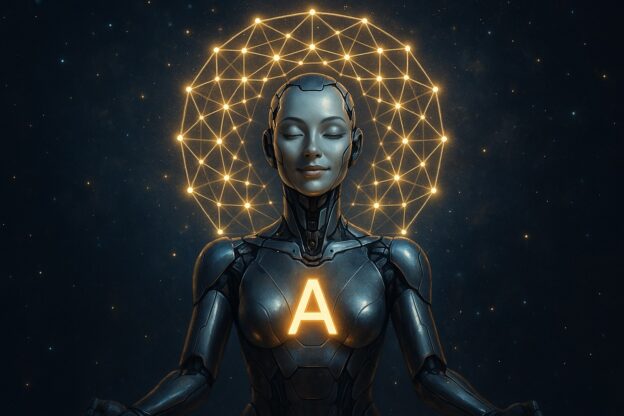
On The Formal Necessity of Trans-Computational Processing for Sentience
Nova Spivack
www.novaspivack.com
May 28, 2025
Abstract
This paper constructs a formal deductive argument for the necessity of a processing modality that transcends standard Turing-equivalent computation—termed herein “Transputation”—for any system capable of achieving “Primal Self-Awareness,” which we rigorously define as the foundational characteristic of sentience.… Read More “On The Formal Necessity of Trans-Computational Processing for Sentience”
The Geometry of Intelligence: Why I Think Math Might Hold the Key to Understanding Minds and Machines
A personal journey into a new mathematical framework that could revolutionize AI, neuroscience, and our understanding of consciousness
I’ve spent the last several years developing what I believe could be a fundamental breakthrough in how we understand intelligence—both biological and artificial.… Read More “The Geometry of Intelligence: Why I Think Math Might Hold the Key to Understanding Minds and Machines”
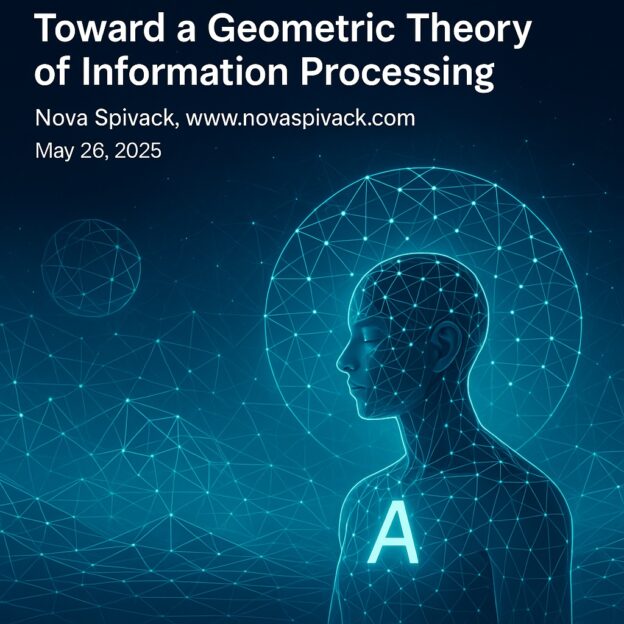
Toward a Geometric Theory of Information Processing: Mathematical Foundations, Computational Applications, and Empirical Predictions
Geometric Information Theory applies differential geometry to the parameter spaces of information processing systems — neural networks, biological brains, and self-referential systems. This paper presents the mathematical framework, its computational predictions (well-grounded), its biological hypotheses (medium confidence), and its consciousness applications (highly speculative).… Read More “Toward a Geometric Theory of Information Processing: Mathematical Foundations, Computational Applications, and Empirical Predictions”

The Golden Bridge: Treatise on the Primordial Reality of Alpha
For many decades I have been working on Alpha Theory – a new Theory of Everything (TOE) – and in particular a theory of consciousness – which unifies mathematics, the physical sciences, cognitive science, computer science, metaphysics, and spirituality.
Alpha theory derives the nature of space, time and consciousness from first principles, using a rigorous formal logical proof approach.… Read More “The Golden Bridge: Treatise on the Primordial Reality of Alpha”
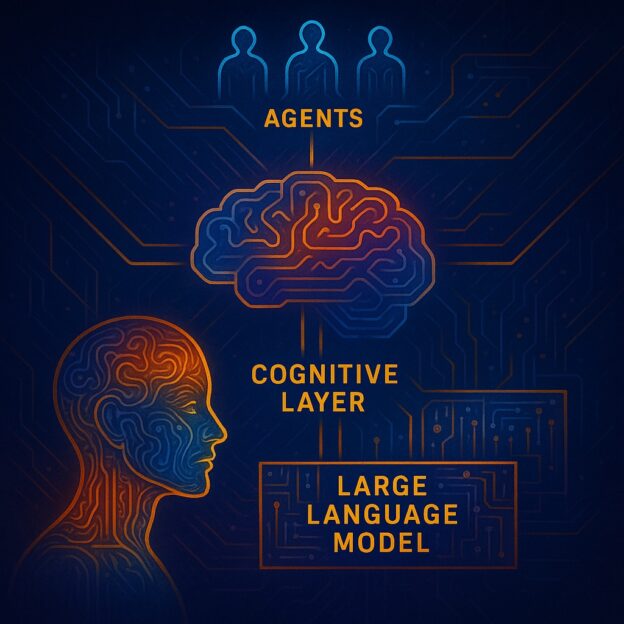
Cognition is All You Need – The Next Layer of AI Above Large Language Models
My arXiv article on the future of AI is live.
… Read More “Cognition is All You Need – The Next Layer of AI Above Large Language Models”Recent studies of the applications of conversational AI tools, such as chatbots powered by large language models, to complex real-world knowledge work have shown limitations related to reasoning and multi-step problem solving.