Category Archives: Geometric Information Theory

A New Mathematics of Self-Reference: A Comprehensive Non-Mathematical Summary

What This Work Is About

This article explains my paper on the
Mathematics of Self-Referential Systems, for a non-technical audience. The paper develops a comprehensive mathematical framework for understanding systems that can represent, model, or “know” themselves. While self-reference has long been seen as a source of logical paradoxes, this work argues it may be the fundamental organizing principle of reality itself—and provides specific mathematical bounds and requirements for achieving different levels of self-awareness.… Read More “A New Mathematics of Self-Reference: A Comprehensive Non-Mathematical Summary”

The Mathematical Foundations of Self-Referential Systems: From Computability to Transfinite Dynamics

This article explains my paper on the Mathematics of Self-Referential Systems.

Here is a summary

Decoding Reality’s Blueprint: An In-Depth Look at “The Mathematical Foundations of Self-Referential Systems”

Have you ever wondered about the deep, perhaps even unsettling, nature of a thought thinking about itself?… Read More “The Mathematical Foundations of Self-Referential Systems: From Computability to Transfinite Dynamics”

Cosmological Evolution of the Information Field: Running Complexity Coupling and Unified Cosmological Phases

This paper explores whether the complexity density field ω(x,t) of Information Physics could play a cosmological role — driving inflation, contributing to dark energy, and providing a unified framework for the cosmic history. The model belongs to the broad class of quintessence models with a running coupling.Read More “Cosmological Evolution of the Information Field: Running Complexity Coupling and Unified Cosmological Phases”

Information Geometric Origins of Mass, Charge, and Fundamental Symmetries from Ω-Field Configurations

This paper explores whether the gauge group structure of the Standard Model — U(1)Y × SU(2)L × SU(3)C — can be understood as the inevitable consequence of quantum information processing requirements, rather than as an empirical fact to be postulated.Read More “Information Geometric Origins of Mass, Charge, and Fundamental Symmetries from Ω-Field Configurations”

Quantum Dynamics of the Ω-Field: Ω-Quanta, Fundamental Interactions, and Informational Uncertainty

This paper canonically quantizes the complexity fluctuation field ψ(x,t) developed in IP.Field, treating it as a standard massive scalar quantum field. The result — termed Ω-quanta or “omegons” — are scalar bosons whose mass is set by the free parameters κ and β² of the classical theory.Read More “Quantum Dynamics of the Ω-Field: Ω-Quanta, Fundamental Interactions, and Informational Uncertainty”

The Ω-Field: Classical Field Theory for Information Geometric Complexity

Given a conjectured energy-complexity relationship dE = πkBT dΩ (developed in IP.Found), this paper constructs the simplest classical field theory for a spatially distributed information geometric complexity density ω(x,t). The fluctuation field around thermal equilibrium satisfies standard massive Klein-Gordon dynamics, with all predictions expressed in terms of two free parameters.Read More “The Ω-Field: Classical Field Theory for Information Geometric Complexity”

The Energetic Cost of Information Geometric Complexity: Convergent Derivations of dE = α₀dΩ from Thermodynamic, Gravitational, and Action Principles

This paper develops theoretical support for a conjectured relationship between physical energy and information geometric complexity, dE = α₀dΩ, motivating the form α₀ = πkBT through three independent lines of reasoning: an extension of Landauer’s erasure principle to geometric complexity, a derivation from black hole thermodynamics, and an action principle consistency check.Read More “The Energetic Cost of Information Geometric Complexity: Convergent Derivations of dE = α₀dΩ from Thermodynamic, Gravitational, and Action Principles”

The Information-Gravity Synthesis: Field Dynamics of the Information Complexity Tensor

This paper develops the classical field theory for the Information Complexity Tensor Cμν — a tensor field sourced by information geometric complexity Ω — and its dynamics as a physical tensor field. The central hypothesis is that Ω sources gravity not just through the scalar stress-energy of the ω-field (IP.Field)Read More “The Information-Gravity Synthesis: Field Dynamics of the Information Complexity Tensor”

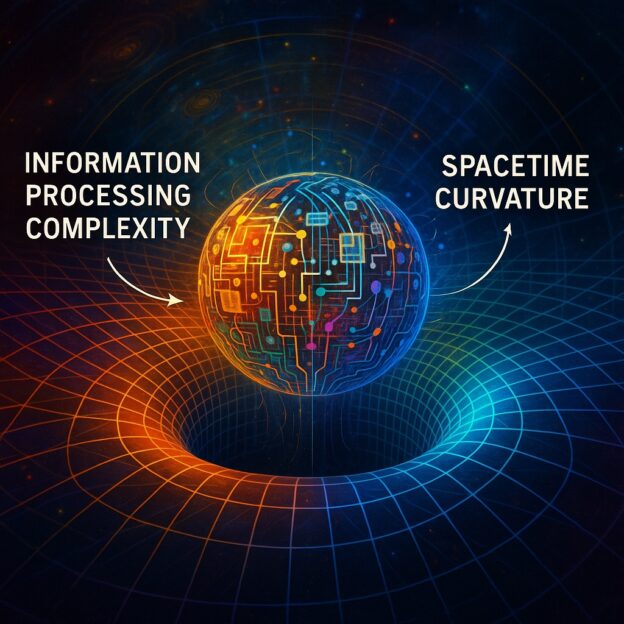
Information Processing Complexity as Spacetime Curvature: A Formal Derivation and Physical Unification

This paper develops the hypothesis that information processing complexity Ω — the integral of squared Riemann curvature of a system’s Fisher information manifold — contributes a novel stress-energy term to Einstein’s field equations, over and above the ordinary heat dissipation already accounted for by Landauer’s principle.Read More “Information Processing Complexity as Spacetime Curvature: A Formal Derivation and Physical Unification”

The Geometric Nature of Consciousness: A New Framework Connecting Physics, Information, and Mind – (Non-Technical Introduction)

Introduction: What if Consciousness is Like Gravity?

Here’s a thought that might reshape how we think about consciousness: what if awareness isn’t something that emerges from complex computation, but is instead as fundamental to reality as gravity itself? This is the intriguing proposition I explore across four interconnected papers that attempt to bridge physics, information theory, and the mystery of consciousness.… Read More “The Geometric Nature of Consciousness: A New Framework Connecting Physics, Information, and Mind – (Non-Technical Introduction)”

From Information Physics to Alpha Theory

Status note (April 2026): The papers in this series on Information Physics have been substantially revised and clarified, but still contain conjectures and speculative explorations. The NEMS formal research program — the machine-checked suite of 93 papers and 17 Lean 4 libraries — is a separate, more rigorous program described at novaspivack.com/researchRead More “From Information Physics to Alpha Theory”

The Geometry of Intelligence: Why I Think Math Might Hold the Key to Understanding Minds and Machines

A personal journey into a new mathematical framework that could revolutionize AI, neuroscience, and our understanding of consciousness

I’ve spent the last several years developing what I believe could be a fundamental breakthrough in how we understand intelligence—both biological and artificial.… Read More “The Geometry of Intelligence: Why I Think Math Might Hold the Key to Understanding Minds and Machines”

Toward a Geometric Theory of Information Processing: Mathematical Foundations, Computational Applications, and Empirical Predictions

Geometric Information Theory applies differential geometry to the parameter spaces of information processing systems — neural networks, biological brains, and self-referential systems. This paper presents the mathematical framework, its computational predictions (well-grounded), its biological hypotheses (medium confidence), and its consciousness applications (highly speculative).Read More “Toward a Geometric Theory of Information Processing: Mathematical Foundations, Computational Applications, and Empirical Predictions”

The Creator by Nova Spivack

The Golden Bridge: Treatise on the Primordial Reality of Alpha

For many decades I have been working on Alpha Theory – a new Theory of Everything (TOE) – and in particular a theory of consciousness – which unifies mathematics, the physical sciences, cognitive science, computer science, metaphysics, and spirituality.

Alpha theory derives the nature of space, time and consciousness from first principles, using a rigorous formal logical proof approach.… Read More “The Golden Bridge: Treatise on the Primordial Reality of Alpha”