Monthly Archives: June 2025

A New Mathematics of Self-Reference: A Comprehensive Non-Mathematical Summary

What This Work Is About

This article explains my paper on the
Mathematics of Self-Referential Systems, for a non-technical audience. The paper develops a comprehensive mathematical framework for understanding systems that can represent, model, or “know” themselves. While self-reference has long been seen as a source of logical paradoxes, this work argues it may be the fundamental organizing principle of reality itself—and provides specific mathematical bounds and requirements for achieving different levels of self-awareness.… Read More “A New Mathematics of Self-Reference: A Comprehensive Non-Mathematical Summary”

The Mathematical Foundations of Self-Referential Systems: From Computability to Transfinite Dynamics

This article explains my paper on the Mathematics of Self-Referential Systems.

Here is a summary

Decoding Reality’s Blueprint: An In-Depth Look at “The Mathematical Foundations of Self-Referential Systems”

Have you ever wondered about the deep, perhaps even unsettling, nature of a thought thinking about itself?… Read More “The Mathematical Foundations of Self-Referential Systems: From Computability to Transfinite Dynamics”

Cosmological Evolution of the Information Field: Running Complexity Coupling and Unified Cosmological Phases

This paper explores whether the complexity density field ω(x,t) of Information Physics could play a cosmological role — driving inflation, contributing to dark energy, and providing a unified framework for the cosmic history. The model belongs to the broad class of quintessence models with a running coupling.Read More “Cosmological Evolution of the Information Field: Running Complexity Coupling and Unified Cosmological Phases”

Information Geometric Origins of Mass, Charge, and Fundamental Symmetries from Ω-Field Configurations

This paper explores whether the gauge group structure of the Standard Model — U(1)Y × SU(2)L × SU(3)C — can be understood as the inevitable consequence of quantum information processing requirements, rather than as an empirical fact to be postulated.Read More “Information Geometric Origins of Mass, Charge, and Fundamental Symmetries from Ω-Field Configurations”

Quantum Dynamics of the Ω-Field: Ω-Quanta, Fundamental Interactions, and Informational Uncertainty

This paper canonically quantizes the complexity fluctuation field ψ(x,t) developed in IP.Field, treating it as a standard massive scalar quantum field. The result — termed Ω-quanta or “omegons” — are scalar bosons whose mass is set by the free parameters κ and β² of the classical theory.Read More “Quantum Dynamics of the Ω-Field: Ω-Quanta, Fundamental Interactions, and Informational Uncertainty”

The Ω-Field: Classical Field Theory for Information Geometric Complexity

Given a conjectured energy-complexity relationship dE = πkBT dΩ (developed in IP.Found), this paper constructs the simplest classical field theory for a spatially distributed information geometric complexity density ω(x,t). The fluctuation field around thermal equilibrium satisfies standard massive Klein-Gordon dynamics, with all predictions expressed in terms of two free parameters.Read More “The Ω-Field: Classical Field Theory for Information Geometric Complexity”

The Energetic Cost of Information Geometric Complexity: Convergent Derivations of dE = α₀dΩ from Thermodynamic, Gravitational, and Action Principles

This paper develops theoretical support for a conjectured relationship between physical energy and information geometric complexity, dE = α₀dΩ, motivating the form α₀ = πkBT through three independent lines of reasoning: an extension of Landauer’s erasure principle to geometric complexity, a derivation from black hole thermodynamics, and an action principle consistency check.Read More “The Energetic Cost of Information Geometric Complexity: Convergent Derivations of dE = α₀dΩ from Thermodynamic, Gravitational, and Action Principles”

The Information-Gravity Synthesis: Field Dynamics of the Information Complexity Tensor

This paper develops the classical field theory for the Information Complexity Tensor Cμν — a tensor field sourced by information geometric complexity Ω — and its dynamics as a physical tensor field. The central hypothesis is that Ω sources gravity not just through the scalar stress-energy of the ω-field (IP.Field)Read More “The Information-Gravity Synthesis: Field Dynamics of the Information Complexity Tensor”

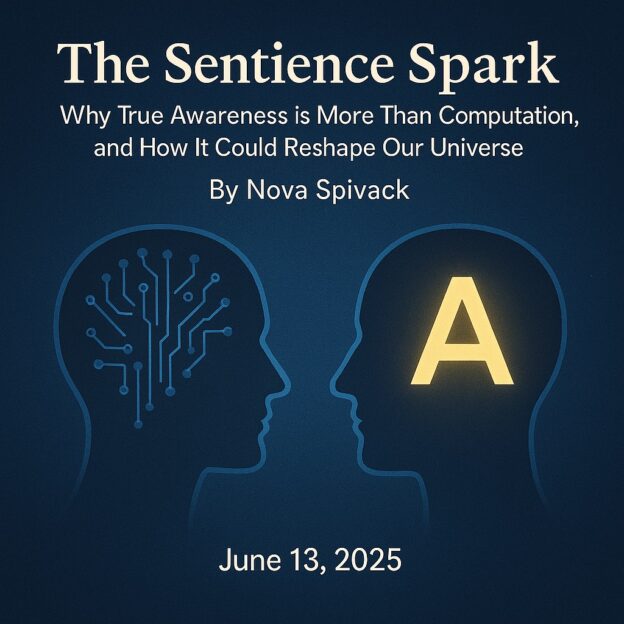
The Sentience Spark: Why True Awareness is More Than Computation, and How It Could Reshape Our Universe

By Nova Spivack

June 13, 2025

We are living in an age of breathtaking technological advancement. Artificial Intelligence (AI) can now compose music, write poetry, diagnose diseases, and drive cars. The horizon of Artificial General Intelligence (AGI)—machines with human-like cognitive abilities across diverse domains—seems closer than ever.… Read More “The Sentience Spark: Why True Awareness is More Than Computation, and How It Could Reshape Our Universe”

The Fundamental Proof That Consciousness Transcends Computation

The Question That Changes Everything

Can a computer ever be truly conscious? Not just intelligent, not just responsive, but actually aware in the way you are aware right now?

This isn’t just a fascinating question—it’s one we can answer with mathematical certainty.… Read More “The Fundamental Proof That Consciousness Transcends Computation”

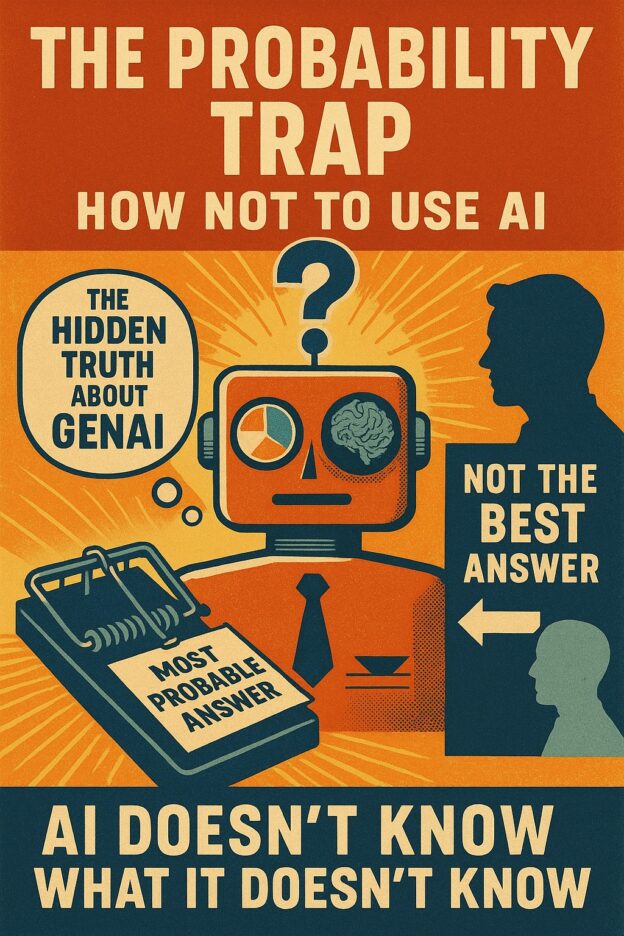
Epistemology and Metacognition in Artificial Intelligence: Defining, Classifying, and Governing the Limits of AI Knowledge

Nova Spivack, Mindcorp

Gillis Jonk, Kearney

June 3, 2025

Abstract

As artificial intelligence, especially large language models (LLMs), becomes increasingly embedded within critical societal functions, understanding and managing their epistemic capabilities and limitations becomes paramount. This paper provides a rigorous and comprehensive epistemological framework for analyzing AI-generated knowledge, explicitly defining and categorizing structural, operational, and emergent knowledge limitations inherent in contemporary AI models.… Read More “Epistemology and Metacognition in Artificial Intelligence: Defining, Classifying, and Governing the Limits of AI Knowledge”

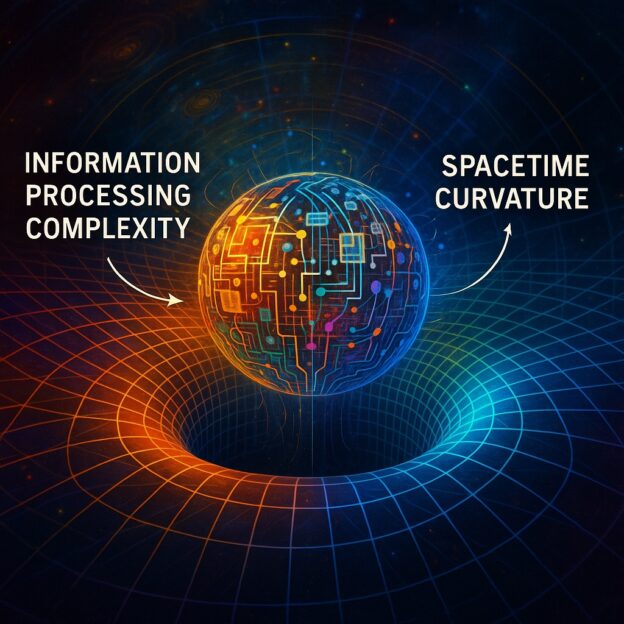
Information Processing Complexity as Spacetime Curvature: A Formal Derivation and Physical Unification

This paper develops the hypothesis that information processing complexity Ω — the integral of squared Riemann curvature of a system’s Fisher information manifold — contributes a novel stress-energy term to Einstein’s field equations, over and above the ordinary heat dissipation already accounted for by Landauer’s principle.Read More “Information Processing Complexity as Spacetime Curvature: A Formal Derivation and Physical Unification”