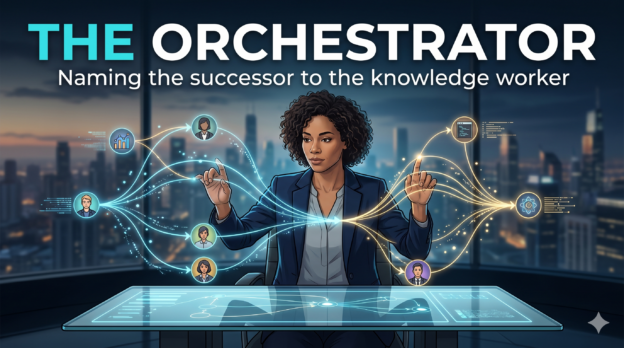
Naming the successor to the knowledge worker.
There is a small and growing group of people who are producing cognitive work at a scale the rest of the world cannot yet perceive. They are doing in months what used to take decades. They are doing alone what used to require institutions. They are not power users of AI tools. They are not AI-augmented professionals. They are something else, and we do not yet have a word for what they are. This essay is an attempt to give them one.
The word matters more than it may appear to. Categories are not labels we attach to phenomena that exist independently of them. Categories make phenomena perceivable. Before a category exists, the work it would describe is invisible — not because nobody is doing it, but because there is no shape in the institutional vocabulary into which the work fits. It registers as anomaly, as exaggeration, as a category error, because the categories we have cannot hold it. Once the category is named, the work becomes legible. It can be hired for, paid for, taught, regulated, compounded.
My grandfather did this once. In the middle of the twentieth century, Peter Drucker named the knowledge worker — the person whose productivity comes from what they know rather than from what they can lift, assemble, or transport. Before he named it, knowledge workers existed; they were doing the work; but the firms employing them could not see them as a category, and so they were managed badly, measured against the wrong instruments, and chronically misunderstood. After he named it, an entire management discipline organized itself around the new unit. The name did not create the workers. The name made them governable.
I think we are at the same moment again. A new unit of cognitive production has emerged. It is not the knowledge worker, and it is not the team. It is the orchestrator and their DAG of agents — a single human at the top of a directed graph of AI sub-processes, holding the vision, routing the context, calibrating the trust, integrating the outputs, and bearing final judgment. I will argue that this configuration is the new atomic unit of cognitive work; that it has properties no prior unit has possessed; that it is currently invisible to the institutions around it because we have no name for it; and that naming it is the first step in building the management discipline of the next several decades.
I am going to call this person the Orchestrator.
I do not claim the naming as an inheritance. Lineage gives one access to a microphone; it does not confer the right to be heard. The right to be heard has to be earned on the substance, and the substance is what the rest of this essay is for. But I will say plainly that I am aware of the move I am making, and aware that the family did it once before, and that I am attempting to do for our era what my grandfather did for his. Whether I have done it well is for the reader to judge. The least I can do is be transparent about the attempt.
The unit of work keeps changing
It helps to remember that the unit of productive work has been changing for centuries, and that each change has required a new name and a new management discipline to make it legible.
In the agricultural era, the unit was the household. A family farm was a productive organism, with its own internal division of labor, its own capital stock, its own intergenerational succession plan. Households were managed, not individuals. Industrial capitalism broke the household apart and reassembled its members into a new unit: the industrial worker, a person whose productivity could be measured in units of output per hour and whose labor could be priced as a commodity. The industrial worker was a creature of the factory floor, and the management discipline that grew around them — Taylorism, time-and-motion study, the assembly line — was built for that environment and that unit.
In the twentieth century, a new unit emerged that the industrial frame could not see. People whose work was thinking — scientists, engineers, analysts, programmers, designers — did not fit the industrial template. Their output could not be timed. Their best hours produced more than their average days. They knew more about their own work than their managers did, which inverted the entire industrial premise. Drucker named this person the knowledge worker, and the act of naming made the category manageable. It took roughly thirty years for the name to fully diffuse, and once it did, the entire organization of the firm — hiring, compensation, performance review, organizational structure, even the architecture of office buildings — reshaped itself around the new unit.
The knowledge worker has been the dominant unit of cognitive production for about sixty years. But in the last three years, something has changed that the knowledge-worker frame cannot accommodate. Knowledge workers, by definition, work with their own knowledge. The new unit works with a swarm of external agents that bring their own quasi-knowledge, and the human’s role is no longer to contain the knowledge but to compose the work across a heterogeneous set of partly-capable processes. The work is no longer happening inside one head, augmented by tools. It is happening across a graph of processes, with one head at the integrating node.
This is a different unit. It has different properties. It needs a different name.
The pair was a transitional form
For a brief window — call it 2023 through early 2025 — the right frame for understanding AI-augmented cognition was the pair: one human, one model, one transcript. The pair was real, and the pair was a genuine advance over the lone knowledge worker. Two operators using the same model on the same problem produced wildly different outputs, which told us that the multiplier did not live in the tool. It lived in the human-tool relationship. The pair was the atomic unit, not the model.
That frame is now too small. The pair assumed a single thread of conversation, a single context window, a single problem under joint attention. The frontier has moved past that. The frontier today is one human composing many threads in parallel, each pursuing a sub-problem decomposed from the parent goal, each running with its own context and its own sub-agents, with the top-level transcript no longer being the work itself but the orchestration layer above the work.
This is a structural change, not a scale change. When the orchestration layer becomes its own object — when the human is no longer thinking through a transcript but about a graph of transcripts — the relevant unit is no longer the pair. It is the orchestrator and the graph. The human is not paired with an agent. The human is at the apex of a small organization of agents, which they manage, route, integrate, and ultimately judge.
The pair was the right frame for the moment when models became capable enough to amplify a human along one axis. The Orchestrator is the right frame for the moment when models became capable enough to be composed in parallel under a human’s direction. We are now in the second moment. The pair frame has not become wrong; it has become a special case of a larger one.
What the new work actually looks like
I will describe the texture of the work briefly, not as a personal flex but because the category cannot be understood without some sense of what its members do. I will try to describe it analytically, the way an ethnographer might describe a practice they had observed and were attempting to characterize.
The Orchestrator begins not with a prompt but with a decomposition. They take a goal — usually large, often vague, sometimes a research program that would conventionally require a team of specialists working over years — and break it into a directed acyclic graph of sub-goals, each tractable to one agent-thread. The decomposition is itself a skill. A poorly decomposed graph produces sub-agents that step on each other, duplicate work, or fail to integrate. A well-decomposed graph produces sub-agents whose outputs combine cleanly. The art is in knowing where the cuts go.
The Orchestrator then routes context to each sub-agent. This is also a skill. Too little context, and the sub-agent produces generic, plausible-sounding output that misses the point. Too much context, and the sub-agent gets confused, anchors on the wrong details, or imports framings that contaminate its reasoning. The right amount of context is task-specific, and the Orchestrator is constantly making these judgments — what does this sub-agent need to know, and what would slow it down or mislead it?
The Orchestrator monitors. The sub-agents run in parallel, and not all of them succeed. Some drift. Some converge on plausible nonsense. Some get stuck. The Orchestrator notices these failures, often before the sub-agent does, and intervenes — re-prompting, redirecting, killing the branch, spawning a replacement, or absorbing the partial output and routing the remaining work elsewhere. This monitoring is continuous and attention-bound. It cannot be delegated.
The Orchestrator integrates. As sub-agents complete, their outputs return to the top-level transcript and must be composed into the larger work. Integration is not concatenation. It requires judgment: which output is right, which is partially right, which is wrong but suggestive, which is wrong and should be discarded. The integration step is where the Orchestrator’s taste lives, and it is the step that determines whether the final output is coherent or merely voluminous.
And the Orchestrator judges. At every level of the graph, decisions are being made about what is true, what is good, what is worth pursuing, and what is a dead end. These judgments are made by the human at the top. The agents can propose; only the Orchestrator disposes. Without this final layer of judgment, the system produces fluent output without meaning.
And then — and this is the part most descriptions of AI-augmented work miss entirely — the Orchestrator is not running one such graph. They are running several at once. In my own practice, I am typically holding three to five distinct projects in active orchestration simultaneously, each with its own DAG of agents, its own context, its own state. Some of the projects are related and cross-fertilize: an insight from a mathematical research thread feeds an architectural decision in a product thread, or a critique developed in one investor document sharpens the framing of another. Some are unrelated, occupying entirely separate domains, and I move between them by moving between windows. The work is not just orchestration within a project. It is also orchestration across a portfolio of projects, with the human consciousness as the integrating layer that holds the entire portfolio coherent.
This is the shape of the work. It looks nothing like what most people picture when they hear “using AI.” It is not chatting with a chatbot. It is not writing prompts. It is running a small, transient organization of cognitive workers — most of them artificial, one of them human, all of them serving a unified vision held in the human’s head — and often running several such organizations at once.
The bell curve nobody is measuring
The public conversation about AI productivity is, almost without exception, a conversation about the middle of the distribution. The studies, the surveys, the McKinsey estimates, the Goldman reports — all of them are measuring something real, and what they are measuring is the experience of the median user. The median user is getting twenty to forty percent productivity gains. They are writing emails faster, drafting documents more easily, generating code with fewer errors. This is a genuine and meaningful change. It is not the change I am writing about.
The change I am writing about is happening on the right tail of the distribution, and the right tail is unmeasurable by the instruments being used. A survey that asks “how much faster do you write emails” cannot see someone who has stopped writing emails because they have absorbed the entire epistolary layer of their work into a sub-agent. A study that asks “how many more lines of code do you produce per day” cannot see someone who has stopped thinking in lines of code because they have moved up the abstraction ladder to think in epics and architectures, with the line-of-code work pushed down to agent threads. The right-tail Orchestrator is producing work whose category is different from the work the median is producing, and the instruments cannot translate between the two.
This is not a small problem. It is the same problem industrial-era management had with the early knowledge workers. Industrial management could not measure knowledge work because it kept trying to count widgets. The widgets-per-hour instrument was wrong for the new unit, and until a new instrument was built, the new unit was invisible to the firm. Drucker’s contribution was partly a measurement contribution: he gave management a vocabulary for what knowledge workers were doing that did not reduce to widgets. The instruments could then be built.
We are in the analogous moment. The current productivity instruments are calibrated for the median experience, and the median experience is real. But the right tail is producing output of a categorically different kind, and the institutional world cannot perceive it because the categories do not exist. I have personally completed research programs in months that would conventionally have required teams of specialists working over years. I am not the only one. When this kind of claim is made, the institutional world reads it in one of three ways: as exaggeration, as a one-off freak event, or as a category error in which the comparison is unfair. None of these readings can perceive what has actually happened, because the category for what has actually happened has not been named.
Compute is becoming abundant. Judgment is becoming scarce.
The variance between the median AI user and the right-tail Orchestrator is not the kind of variance labor markets are built to handle. The best knowledge worker in a discipline was conventionally three to five times the median. The best Orchestrator in a discipline, given current tools and a few years of practice, is plausibly several orders of magnitude past the median — not because they are smarter, but because they are operating a categorically different cognitive organism. This is not a distribution. It is two species sharing a job title.
The primitives of the discipline
Every new unit of work eventually generates its own management discipline, with its own primitives. The industrial worker had time-and-motion study, the assembly line, statistical process control. The knowledge worker had management by objectives, the matrix organization, the performance review. The Orchestrator will have its own primitives, and although it is too early to name them all definitively, I think the shape is becoming visible. I offer the following not as a complete taxonomy but as a sketch, in the hope that others will refine and extend it.
- Project decomposition. The art of taking a fuzzy goal and resolving it into a directed acyclic graph (DAG) of sub-goals, each tractable to a single agent-thread, each composing cleanly into the parent. The skill is in the cuts. The discipline will need to develop heuristics for where good cuts go, what makes a cut brittle, and how to recover when a decomposition fails mid-flight.
- Context management. Orchestration requires coordination, and coordination requires context, which requires memory. The Orchestrator governs how this memory is structured, written, and retrieved. Good orchestration requires obsessive record keeping and governance so that every spec, idea, decision, outcome and artifact is documented and logged in a system that downstream agents can refer to and maintain. Without a system, context decays and agents lose the plot. But doing this effectively and repeatably is itself a new skill.
- Context routing. Where context management is about maintaining the persistent record, context routing is the moment-to-moment judgment of what each sub-agent needs in order to do its work well, and what would slow it down or mislead it. This is non-trivial because the optimal context is task-specific, agent-specific, and dependent on the current state of the larger work. There is no general answer; there is only practiced calibration. The Orchestrator is adept at designing context, assigning it into windows of work, and then ensuring that the results flow back up so other agents can use it too.
- Trust calibration. Knowing which sub-thread can be allowed to run unsupervised and which needs continuous attention. Trust calibration is not a fixed parameter; it varies by task type, by agent type, by the consequence of failure. An Orchestrator who trusts uniformly is naive; one who distrusts uniformly is paralyzed. The skill is in the gradient.
- Integration cadence. The rhythm of pulling sub-agent outputs back into the top-level work without losing the orchestrating thread, without letting any one sub-agent’s frame dominate, and without integrating so often that the parallelism collapses back into a serial workflow. Integration too rarely produces drift; too often produces stall. The cadence is not only about multitasking; it is about when to multitask and when to focus, and how to manage that toggle to drive efficient results.
- DAG hygiene. The discipline of noticing when the graph itself has become incoherent — when two branches have begun to duplicate each other or drift, when a branch has gone stale or needs an intervention, when the original decomposition no longer fits the work that has emerged. Pruning is as important as growing. An Orchestrator who only adds nodes is an Orchestrator whose graph eventually collapses under its own weight.
- Portfolio orchestration. The Orchestrator typically runs not one DAG but several in parallel, across distinct projects, and the management of the portfolio is itself a layer of the discipline. Which project deserves attention right now? Where is one project’s output usefully cross-pollinating another, and where is it contaminating it? When should projects be kept rigorously separate, and when should an insight be deliberately ported across? The Orchestrator is not only the integrating consciousness within a project; they are the integrating consciousness across the portfolio, and the skill of moving cleanly between contexts without losing depth in any of them is its own form of mastery.
- Tool fluency at the speed of change. The orchestration tools themselves are in a Cambrian explosion. Cursor, Claude Code, Codex, OpenCode, and a dozen others are advancing in capability every few months; new orchestration primitives, new ways of spawning and managing sub-agents, new interfaces between human and graph appear faster than most professionals can absorb. Mastering generations of rapidly increasing capability is itself a discipline. The Orchestrator does not merely use tools; they continuously re-learn the tools, port their practice across generations, and develop the meta-skill of recognizing the underlying shape of orchestration tooling regardless of the specific product in front of them. The tool will change; the shape persists. Learning to see the shape is the durable skill.
- Taste under uncertainty. The ability to recognize, in real time, whether a sub-agent’s output is approximately right, subtly wrong, confidently hallucinating, or missing the big idea hiding behind small ideas — and to know which of one’s own intuitions to trust against it. This is the load-bearing skill at the center of the entire practice. It is closer to the skill of a good editor, code reviewer, or investor than to the skill of a good writer or coder. Orchestrators are not primarily generators; they are primarily navigators and judges of generated material, the providers of natural selection that guides the evolution of agentic work product.
These are first sketches. A full discipline of orchestration will have dozens of primitives, named precisely, taught explicitly, refined over decades. Drucker’s first formulations of the knowledge worker were also sketches; the discipline that grew around them took half a century to mature, and is still maturing. The point of naming the primitives now is not to finish the work but to start it.
The limit that cannot be removed
Here I want to make the argument that I believe matters most, and that I have not seen made clearly anywhere else. The Orchestrator does not scale by abstracting away the human. The human is not a removable component. This is the deepest property of the new unit, and almost everything else of importance follows from it.
Consider what would have to be true for the human to be removable. The judgment, the taste, the navigation, the spidey-sense calibration that catches a sub-agent drifting toward confident nonsense, the intuition about which branch of the DAG is generative and which is dead, the felt sense of when integration is premature and when it is overdue — all of these would have to be reproducible by agents. They are not. They are functions of accumulated experience, of taste shaped by long practice, of the human’s stake in the outcome, of priors the agents do not have and cannot easily acquire. The agents can do remarkable work within the constraints the Orchestrator sets, but they cannot set the constraints, because setting the constraints requires being the kind of entity whose judgment the work is ultimately accountable to.
This has two consequences that the discipline will need to absorb.
The first is that orchestration is a sublinearly scaling activity in the human dimension. Adding more agents to the DAG produces gains until the Orchestrator’s judgment bandwidth saturates, and then diminishing returns, and then, past a certain point, negative returns. There is an optimal DAG size for any given Orchestrator on any given task, and it is set by the human’s cognitive ceiling, not by available compute. This is unlike any prior productivity technology. The printing press did not have a “you can only run so many presses before your attention saturates” ceiling. Electricity did not. Software, mostly, did not. The Orchestrator does, and finding that ceiling — and operating just below it — is part of the discipline.
The Orchestrator does not scale by abstracting away the human.
Autonomy without leadership produces volume without judgment
The second consequence is more important, and it cuts against a thesis that is currently consuming a great deal of capital and attention. The dream of the fully autonomous agent — the dream of removing the human from the loop and letting the system run — is the dream of defeating the very limit that makes the system coherent. You can absolutely run agent swarms without a human at the top. What you get is plausible-sounding output that drifts, lacks taste, fails to integrate, and produces volume without judgment. The human judgment node is not a bottleneck to be eliminated. It is the organ that makes the output mean something. Removing it does not unlock a higher mode of production; it dissolves the productive organism into noise.
This is not a sentimental claim about the irreplaceable value of human creativity. It is a structural claim about what the Orchestrator unit actually is. The unit is defined by the relationship between a judging human and a graph of generating agents. Take away the judging human and you do not have an Orchestrator unit with fewer parts; you have a different and weaker unit entirely. The right comparison is to an organism with a nervous system: you cannot remove the nervous system and have a faster organism. You have a corpse.
Compute abundant, judgment scarce
If the human node is constitutive and cannot be removed, then the binding constraint on cognitive production over the next several decades is not what most of the AI discourse assumes. It is not compute. It is not data. It is not algorithms. It is the supply of humans capable of orchestrating well.
Compute is becoming cheap. Models are becoming capable. Agents are becoming reliable enough to delegate to. All of these curves are bending in the direction of abundance. The curve that is not bending — that may never bend in the same way — is the curve of human judgment capacity. There are only so many people in the world who can hold a complex DAG in their head, decompose epics with taste, route context with precision, calibrate trust with discipline, and integrate outputs with judgment. The number is growing, because the skill is teachable. But it is growing far more slowly than the compute curve, and probably slower than the model-capability curve.
This implies an economic configuration that the existing labor market is not prepared for. When compute is abundant and judgment is scarce, the returns to judgment do not behave like ordinary returns to labor. They behave more like returns to capital. An Orchestrator commanding ten million dollars of agent compute and producing one hundred million dollars of output is not a worker in any sense the labor market recognizes. They are closer to a founder, a portfolio manager, or a fund principal — someone whose income reflects not the hours of their effort but the scale of the system they direct. There is no compensation machinery for this. There is no career ladder. There is no credentialing path. There is no procurement category.
The firm itself is implicated. The firm exists, in Coasean terms, because the coordination costs of organizing complex production across markets exceed the coordination costs of organizing it inside a hierarchy. The Orchestrator collapses internal coordination costs to near zero for a wide class of cognitive work, because the entire DAG is held in one head. This does not abolish the firm, but it changes what firms are for. Increasingly, firms will be capital-aggregation, distribution, and credibility vehicles around Orchestrators, rather than coordination vehicles for large numbers of knowledge workers. The shape of the org chart will follow the new unit, just as it followed the knowledge worker before.
What I do not yet know
I want to be honest about the limits of what I am claiming. This is a sketch, not a manual. The discipline of orchestration is pre-paradigmatic. The primitives I have named are first approximations, and a properly developed taxonomy will look different, and better, in five years. The economic implications I have gestured at are extrapolations, and extrapolations break in unexpected ways. The category itself may turn out to need a different name, or to split into several finer categories as the practice matures. I do not know how the category scales — whether Orchestrators remain a frontier role occupied by a small number of unusual operators, or whether the role generalizes the way the knowledge worker did, eventually becoming the median way that cognitive work is done.
I also do not know whether the human ceiling I described is fixed or whether it can be raised by tooling, training, or new forms of human-agent interface. I suspect it can be raised somewhat but not unboundedly, and that the underlying constraint — that judgment requires a coherent, embodied, accountable judge — is durable. But this is a hypothesis, not a result. The next several decades of practice will test it.
What I do feel reasonably confident about is the central claim: that a new unit of cognitive production has emerged, that it is structurally distinct from the knowledge worker, and that until we name it, we will continue to be unable to see it, measure it, manage it, or build the institutions it requires. The first move is the name. The rest follows from the name.
The work ahead
If the category is real, then there is a great deal of work to be done by people who are not me, and most of it is interesting.
Researchers can study what distinguishes good Orchestrators from poor ones — what cognitive habits, what tooling configurations, what training paths, what failure modes. The field needs ethnography before it needs theory. Watch what the frontier operators actually do, in detail, and report it back. The first wave of management theory after Drucker was largely descriptive; the prescriptive part came later. Orchestration needs its descriptive wave now.
Educators can begin asking what an Orchestrator curriculum looks like. It is almost certainly not a curriculum in prompting. It is closer to a curriculum in editorial judgment, in systems thinking, in epistemic calibration under uncertainty, in the management of small distributed teams — taught against a backdrop of fluency with agent tooling. The schools that figure this out first will be educating the principals of the next economic era. The schools that continue to optimize for the knowledge-worker era will find their graduates competing for a shrinking middle.
Firms can begin asking what an Orchestrator-shaped organization looks like. The answer is almost certainly flatter, smaller, more capital-dense per person, with more leverage concentrated in a smaller number of judgment-bearing nodes. The firm of three hundred knowledge workers may become the firm of three Orchestrators with a shared pool of agent compute. This is not a comfortable thought, but it is a thought that should be had explicitly rather than discovered too late.
Policymakers and labor economists can begin asking what it means for a labor market when the variance between top and median in a discipline becomes orders of magnitude rather than multiples. Existing assumptions about wage distributions, taxation, antitrust, and worker protection were calibrated for the knowledge-worker era. They will not survive contact with the Orchestrator era unmodified.
And ordinary people — the median knowledge workers of today — can begin asking the question that matters most to them personally: is this a role I want, and if so, how do I move toward it? The discipline is teachable. The barriers are not principally about access to tools; the tools are widely available. The barriers are about taste, judgment, patience, and the willingness to take responsibility for the output of a system one does not fully control. These are old skills, in some ways the oldest skills, and the people who develop them will find themselves disproportionately valuable in the era ahead.
For those who recognize themselves in this description: use the word. The category becomes real through the act of being named, and that act is collective. If you are orchestrating — composing graphs of agents, holding portfolios of projects in a single integrating consciousness, producing work whose scale your institutional environment cannot yet register — call yourself what you are. The naming has to come from inside the practice before it can travel to the outside.
A closing note
My grandfather used to say that the most important contribution of a management thinker is not to predict the future but to name the present accurately enough that the future becomes visible. The naming is the work. Once a category is named, intelligent people can disagree productively about its boundaries, its primitives, its implications. Before it is named, the same intelligent people talk past each other, because they are not perceiving the same object.
I have tried, in this essay, to name a present that I believe is widely under-perceived. There are people walking around right now, in laboratories and studios and home offices, operating as Orchestrators — composing graphs of agents, producing work at scales their institutional environments cannot register, quietly reshaping what one person can do. They are not yet a recognized class. They will be. The category is coming whether or not anyone names it; naming it now is simply the difference between meeting the future on its terms or on ours.
The knowledge worker had a sixty-year run, and it served us well. The Orchestrator is the next unit. Calling it by its name is the first move. Everything else, including most of the things I have not yet figured out, follows from that.