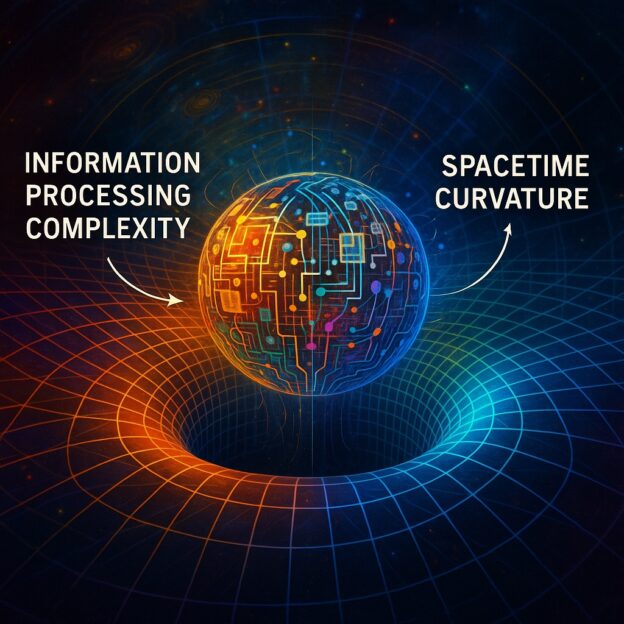
This paper develops the hypothesis that information processing complexity Ω — the integral of squared Riemann curvature of a system’s Fisher information manifold — contributes a novel stress-energy term to Einstein’s field equations, over and above the ordinary heat dissipation already accounted for by Landauer’s principle. The argument is motivational, not a proof. The gap between established physics (Landauer heat gravitates) and the novel hypothesis (Ω itself gravitates independently, scaled by coupling α) is identified explicitly, and experimental protocols for testing it are proposed.
Author: Nova Spivack · Date: June 2025 · Status: Theoretical hypothesis; the coupling constant α is not derived and the argument for a novel gravitational contribution beyond Landauer heat is not yet rigorous
1. Introduction
1.1 The Question
John Wheeler’s maxim “It from Bit” captures the intuition that information may be as fundamental as energy or matter. Landauer’s principle [1] gives this intuition precise thermodynamic content: erasing one bit dissipates at least kBT ln 2 of energy into the environment. This heat dissipation gravitates — it contributes to Tμν just as any other form of heat does. This is not a new gravitational effect; it is ordinary thermodynamics.
The hypothesis of this paper is stronger: that the geometric structure of an information processing system — specifically its information geometric complexity Ω (the integral of squared curvature of the Fisher information manifold) — contributes to the stress-energy tensor through an independent coupling constant α, over and above the heat already accounted for by Landauer’s principle. This would make Ω a genuine novel source of gravity, not a repackaging of ordinary heat.
The hypothesis connects to a serious research program in the intersection of thermodynamics, information, and gravity. Jacobson [2] derived the full Einstein equations from the thermodynamic identity δQ = T dS applied to local Rindler horizons — a result that establishes gravity as thermodynamic in a precise sense. Verlinde [3] proposed that gravity is entirely an entropic force. These results motivate asking whether geometric information structure has an independent gravitational role. The present paper explores this possibility honestly.
1.2 The Information Complexity Tensor: the Hypothesis
The central hypothesis is that there exists a coupling α (units: energy per unit of Ω) such that the energy density associated with information geometric complexity ρΩ = αΩ contributes to the gravitational stress-energy tensor via an Information Complexity Tensor Cμν:
Gμν = (8πG/c⁴)(Tμνmatter + α Cμν)
where Cμν is built from Ω and its spacetime dynamics. The simplest form — from a Lagrangian ℒinfo = −αΩ — gives Cμν = Ω gμν, corresponding to an equation of state w = −1 (dark energy-like). More general potential structures yield evolving w, analogous to quintessence.
The key word is hypothesis. The value of α is unknown. Whether Ω contributes any gravitational effect beyond the Landauer heat (which gravitates trivially) is not established. These are the open questions this paper motivates and proposes experimental tests for.
2. The Established Foundation: Landauer Heat Gravitates
Three facts are established physics and require no new hypothesis:
- Landauer’s principle: Any logically irreversible operation reducing N1 states to N2 < N1 dissipates at minimum E ≥ kBT ln(N1/N2) as heat [1].
- Heat gravitates: By general relativity’s equivalence principle, any form of energy contributes to Tμν and therefore to spacetime curvature. This is universal — there are no exemptions.
- Therefore, Landauer heat gravitates. The heat dissipated by computation is a source of gravity. This is trivially true and follows without any new physics.
This chain is exact. The gravitational effect of Landauer heat is real but extraordinarily small — for a standard CPU dissipating 100W, the gravitational effect of this heat is many orders of magnitude below any measurement. The heat is already captured by the ordinary Tμν of the system’s thermal radiation and phonon fields.
2.1 The Gap: From Landauer to αΩ
The established physics shows that the energy dissipated by information processing gravitates. The hypothesis Cμν = αΩ gμν claims something stronger: that the geometric complexity Ω of the information manifold contributes an additional independent gravitational effect, not fully captured by the Landauer heat already in Tμν.
This additional step requires:
- A physical argument that Ω is a degree of freedom with its own energy αΩ, over and above the thermal energy in the system’s heat bath.
- A value or bound on α.
- A reason why this energy is not already captured by Tμνmatter+radiation.
None of these are provided by established physics. This is where the hypothesis departs from the established chain, and where empirical testing is required. The IP.Found paper (companion to this series) motivates α = πkBT from black hole thermodynamics under the KBH = 1 assumption — a motivated conjecture, not a derivation.
3. The Information Complexity Tensor: Construction
3.1 Ω as a Scalar Field
For a spatially extended system with local complexity density ω(x,t) = Ω per unit volume (as developed in IP.Field), the simplest covariant Lagrangian incorporating the IP.Found conjecture dE = αdΩ is:
ℒΩ = −αω + ½κ(∂μω)(∂μω) − ½β²ω²
Varying with respect to the metric gμν yields the stress-energy tensor Tμν(Ω) = κ(∂μω)(∂μω) − gμν[½κ(∂ω)² − ½β²ω²], which is exactly the massive scalar field stress-energy of IP.Field. In the static, homogeneous limit, T00(Ω) = αω — an energy density proportional to the local complexity density, consistent with IP.Found.
3.2 The Tensor Cμν
We define Cμν ≡ Tμν(Ω)/α, so that the modified Einstein equations take the form:
Gμν = (8πG/c⁴)(Tμνmatter + α Cμν)
Cμν has the structure of a massive scalar stress-energy tensor with the complexity density ω as the scalar field. Its components:
- Energy density: T00(C) = ω (in units where α = 1), sourcing gravitational attraction
- Pressure: Tii(C) = −ω in the homogeneous static limit, giving equation of state w = −1 (dark-energy-like)
- Energy flux: T0i(C) from propagating complexity waves (as derived in IP.Field, IP.Quantum)
The equation of state w = −1 from the static homogeneous case is significant: it matches the observed dark energy equation of state. Whether this is a coincidence, a deep connection, or an artifact of the simplest possible Lagrangian choice is a key open question.
4. Conservation and Covariance
The modified Einstein equations are self-consistent provided ∇μ(Tμνmatter + αCμν) = 0. This is automatically satisfied when Cμν satisfies the covariant conservation equation derived from the ω-field equations of motion. Formally, if Cμν is derived from a diffeomorphism-invariant action, Noether’s theorem guarantees its covariant divergence vanishes on-shell.
Physically: if information geometric complexity ω exchanges energy with ordinary matter (e.g., a computer dissipating heat into its surroundings), this exchange is captured by source terms Jμ in the ω equation of motion. The total ∇μTμνtotal = 0 still holds, with energy flowing between the Ω-field and ordinary matter, not violating conservation but partitioning it between two components.
5. Cosmological Implications
5.1 Dark Energy
In the static homogeneous cosmological limit, Cμν with w = −1 contributes an effective cosmological constant ΛΩ = 8πGαω0/c⁴, where ω0 is the cosmic average complexity density. For this to match the observed dark energy density ρΛ ∼ 10⁻⁹ J/m³:
αω0 ∼ ρΛc² ∼ 10⁻⁹ J/m³
With α = πkBTCMB ∼ 10⁻²⁴ J (the IP.Found value at TCMB = 2.7 K), this requires ω0 ∼ 1015 m⁻³ — approximately 1015 units of complexity per cubic meter in the cosmic average. Whether the universe actually contains this complexity density is unknown; it would need to be derived from a cosmological model of information processing density (as explored in IP.Cosmo).
The IP.Cosmo paper explores a more general equation of state with running α(T), which can give w ≠ −1 at different cosmic epochs, potentially connecting to recent DESI evidence for dynamical dark energy. The dark energy connection is the most observationally testable prediction of the framework and deserves dedicated theoretical development.
5.2 Primordial Complexity and Structure Formation
If the Ω-field existed in the early universe, its perturbations would contribute to the primordial power spectrum alongside inflaton perturbations. The resulting signatures — modifications to ns, r, and the amplitude As — depend on the Ω-field’s mass mψ = (ℏ/c)√(β²/κ). For mψ ≪ Hinf (light during inflation), the Ω-field would generate isocurvature perturbations potentially detectable in CMB data.
6. Experimental Predictions
The framework makes three categories of testable predictions, ordered from most to least feasible:
6.1 Gravitational Effects of Information Processing (Near-Term)
If αCμν contributes gravitationally over and above Landauer heat, large-scale computation should produce subtle anomalous gravitational effects. The fractional change in local gravitational acceleration near a computation center with power P and geometric complexity rate dΩ/dt:
Δg/g ∼ Gα(dΩ/dt)/(c²r² × g) ≪ 10⁻²⁰ (under benchmark IP.Field parameters)
Protocol: Precision gravimeters (atom interferometers or superconducting gravimeters with Δg/g ∼ 10⁻⁹) placed near supercomputing centers, comparing measured g during peak vs. idle computation. The challenge is separating any signal from thermal expansion, electromagnetic interference, and seismic noise. Current instruments are approximately 10 orders of magnitude too insensitive for the predicted effect at benchmark parameters; this test is therefore a long-term constraint on α rather than an expected detection.
6.2 Gravitational Wave Background (Future)
Rapidly time-varying Ω (large d²Ω/dt²) generates gravitational waves with strain:
h ∼ (GαLΩ²/c⁶r)(d²Ω/dt²)
Under any plausible terrestrial computation scenario, h ≪ 10⁻60 — far below LIGO sensitivity (∼ 10⁻²³). This prediction serves as an upper bound on α if no such signal is detected with future sensitivity improvements, not as an expected detection.
6.3 Dark Energy Equation of State (Cosmological)
If αCμν contributes significantly to the cosmic energy budget, the dark energy equation of state w(z) should deviate from −1 in a specific way determined by the IP.Cosmo model. DESI [4] and Euclid [5] will constrain w(z) to percent level. Consistency of the IP.Cosmo model with these observations — specifically matching the DESI 2024 preference for dynamical dark energy — would provide indirect support for the framework.
This is the most realistic near-term test: the IP.Cosmo dark energy model makes specific predictions for the w0-wa plane that are in principle distinguishable from ΛCDM and from other quintessence models.
7. Relation to the Information-Gravity Research Program
The hypothesis Cμν ∝ Ω gμν sits within a broader research tradition:
- Jacobson (1995) [2]: Derives Einstein equations from δQ = T dS at horizons. This is exact, not a hypothesis. It establishes gravity as thermodynamic but does not introduce Ω as a separate source.
- Verlinde (2011) [3]: Proposes gravity as an entropic force. This reinterprets existing gravity rather than adding a new source term.
- Penrose (2004) [6]: Explores quantum state reduction via gravity (OR proposal). Different mechanism — gravity from quantum superposition, not information geometry.
- This paper: Proposes that information geometric complexity Ω is a novel stress-energy source with independent coupling α. This goes beyond Jacobson and Verlinde by introducing a new field, not just reinterpreting existing gravity.
The intellectual lineage is clear, the motivation is genuine, and the gap from established results to the novel hypothesis is honestly stated. The program’s validity rests on determining α and testing whether Ω gravitates independently.
8. Limitations
- α is not derived. The coupling constant linking Ω to gravitational energy is a free parameter. Without it, no quantitative predictions are possible. IP.Found motivates α = πkBT as a conjecture; this requires independent confirmation.
- The novel contribution is not separated from Landauer heat. The argument that αCμν contributes over and above the Landauer heat already in Tμνmatter requires showing that Ω carries energy not fully captured by the heat bath. This is not yet demonstrated.
- The definition of Ω for macroscopic physical systems is non-trivial. The Fisher information metric is well-defined for parameterized statistical models. For a generic physical system (a black hole, the universe), defining the information manifold and computing Ω requires additional theoretical structure.
- Predicted effects are extraordinarily small. Even under the benchmark parameters of IP.Field, all three experimental predictions give signals many orders of magnitude below current or planned detector sensitivity. This makes the framework hard to falsify in the near term, which is a scientific limitation.
9. Conclusion
Information processing necessarily dissipates energy (Landauer), and that energy gravitates (general relativity). This much is established. The further hypothesis — that information geometric complexity Ω sources an independent stress-energy tensor Cμν with coupling α — is motivated by the IP.Found conjecture (dE = αdΩ) and by the broader program connecting thermodynamics, information, and gravity pioneered by Jacobson and Verlinde. It is not yet established.
The framework makes specific predictions: gravitational enhancement around information-dense systems (Tier 1, currently undetectable), gravitational wave generation from rapidly varying Ω (Tier 2, currently undetectable), and dark energy dynamics from the cosmological Ω-field (Tier 3, testable via DESI/Euclid). The most immediate scientific value is the last: if the IP.Cosmo model produces a specific w(z) prediction consistent with DESI 2024 data, this would be genuine indirect support for the whole framework.
The open task is to derive α from first principles, or to bound it experimentally, and to demonstrate rigorously that αCμν is not simply a repackaging of Landauer heat. Until then, the framework is a well-motivated hypothesis in a serious research tradition, not a completed theory.
References
- Landauer, R. (1961). Irreversibility and heat generation in the computing process. IBM Journal of Research and Development, 5(3), 183–191.
- Jacobson, T. (1995). Thermodynamics of spacetime: The Einstein equation of state. Physical Review Letters, 75(7), 1260–1263. [Derives Einstein equations from horizon thermodynamics — the gold standard for the information-gravity connection.]
- Verlinde, E. P. (2011). On the origin of gravity and the laws of Newton. Journal of High Energy Physics, 2011(4), 29. [arXiv:1001.0785]
- DESI Collaboration (2024). DESI 2024 VI: Cosmological constraints from baryon acoustic oscillations. arXiv:2404.03002. [Evidence for dynamical dark energy — relevant to the IP.Cosmo predictions.]
- Euclid Collaboration (2022). Euclid definition study report. arXiv:1110.3193. [Future dark energy survey that will constrain w(z).]
- Penrose, R. (2004). The Road to Reality. Jonathan Cape. [OR proposal: gravity from quantum superposition — a distinct but related approach to information-gravity connections.]
- Bekenstein, J. D. (1973). Black holes and entropy. Physical Review D, 7(8), 2333–2346. [Area-entropy relation — foundational for the holographic aspects of the framework.]
- Amari, S. (2016). Information Geometry and Its Applications. Springer. [Foundation for the Fisher information metric and Ω definition.]
- Bennett, C. H. (1982). The thermodynamics of computation. International Journal of Theoretical Physics, 21(12), 905–940.
- Misner, C. W., Thorne, K. S., & Wheeler, J. A. (1973). Gravitation. W. H. Freeman. [Standard GR reference for the stress-energy tensor and Einstein equations.]