This is the third essay in a series. The first, The Twist Move, describes the operation itself across mathematics, biology, physics, and business. The second, The Twist and the Ground of Being, argues that the consciousness twist is real, that the substrate must support it, and that this tells us something fundamental about the nature of reality. The third, How to Develop Twist Literacy, addresses the practical cultivation of the capacity. The fourth, The Figure Without Ground, examines why AI can extend but not replace the twist. The fifth addresses the pathology of the Twist-Resistant Organization. The sixth piece, The Theorem Behind the Twist – Lawvere’s Fixed-Point, shows that the deepest paradoxes of logic are all the same mathematical result. The final essay, The Twist as Generative Principle, argues that this operation is not just an intellectual tool, but the fundamental engine by which the universe generates complexity, life, and meaning.
Understanding the twist move is not the same as being able to perform it. This distinction matters enormously, and it is the distinction that most discussions of insight, creativity, and breakthrough fail to make. You can read everything ever written about a Möbius strip without being able to recognize one when you are standing on it. The operation has to become a faculty — something you can apply in real time, under pressure, in the middle of a situation that is not presenting itself as a twist problem.
This is a piece about how to develop that faculty. Not the theory of the twist — the theory has been laid out in the earlier essays in this series. The practice of it. The phenomenology of it. What it feels like to be inside a twist problem before you know it is one, how you learn to recognize the texture of the fold, and what you can do to make the operation available when it matters.
My grandfather believed that management was a practice before it was a discipline — that the knowledge worth having was knowledge that changed what you did on Monday morning. I hold the same standard here. The twist move is interesting as an intellectual pattern. It is consequential only when it becomes a practiced capacity.
The two kinds of difficulty
Before addressing how to develop twist literacy, a distinction must be made that the earlier essays in this series did not draw with sufficient sharpness — and that has direct consequences for practice.
Some twists are constructive: you build something that does not yet exist. Amazon building AWS from its infrastructure problem. Gödel constructing his numbering scheme. A protein folding into a new functional shape. These require effort, deliberate action, resources committed in a new direction. The fold happens in the world, and the world is different afterward because something has been added to it.
Other twists are recognitive: the topology is intrinsic, and always was. Nothing needs to be built. What is needed is accurate perception of a structure that was always already the case. The consciousness twist — the fold in which awareness is found to be the ground rather than the product of experience — is the purest example. The ground was never absent. The individual was always a figure arising within it rather than a container of it. The recognition does not create this structure. It corrects a misperception of it.
Most practical twist moves are hybrids: you must construct something — a new vantage point, a new framework, a deliberate act of self-examination — as the instrument through which an existing truth becomes visible. The construction is real; what it reveals was always latent. Gödel had to actually build the numbering scheme to make incompleteness accessible, but incompleteness was always a feature of the system.
This distinction matters for practice because it determines the correct posture. Constructive twists require effort, resource, and commitment in a new direction — pushing is appropriate, just in the right dimension. Recognitive twists require something closer to the opposite: the deliberate cessation of effortful construction, the quieting of the activity that keeps producing new figures on the very ground you are trying to see. You cannot build your way to the ground. Every construction is another figure. The appropriate move is subtraction, stillness, clear perception.
Confusing the two is one of the most costly mistakes available to a serious person. Someone who mistakes the consciousness twist for a constructive twist will spend decades trying to achieve what they need to recognize. Someone who mistakes a constructive twist for a recognitive one will sit quietly waiting for insight while the thing that needs to be built goes unbuilt. What follows in this essay addresses primarily the constructive and hybrid cases — the practical fold moves available in work, strategy, and cognition. The recognitive case, being prior to all of these, is addressed briefly at the end.
Two kinds of twist
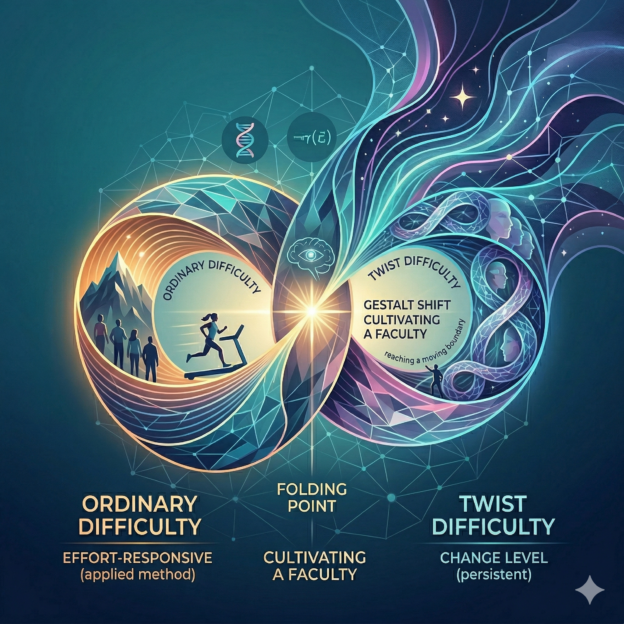
The first skill in twist literacy is distinguishing between two kinds of difficulty that feel similar from inside but require completely different responses.
The first kind is ordinary difficulty: a hard problem, a resource constraint, a knowledge gap, a skill that needs developing, an execution challenge. These problems respond to effort, to attention, to more information, to better tools. They are hard in the way that climbing a steep hill is hard — you need energy and technique, but the path is continuous with where you already are. More of the same direction, applied more skillfully, gets you there.
The second kind is twist difficulty: a problem that does not respond to increased effort, that becomes more fixed the harder you push, that has resisted multiple intelligent attempts, that produces a specific sensation — not the clean resistance of a hard problem, but something more like hitting a boundary that moves with you, or running faster on a treadmill. The problem is not steep. It is structured differently than your approach to it.
Misidentifying the second kind as the first kind is one of the most expensive mistakes available to a person or organization. You respond with more effort, better execution, additional resources — all entirely appropriate responses to ordinary difficulty — and the problem does not yield, because the problem was never asking for more of what you were giving it. It was asking for a different level of description entirely.
The diagnostic question is simple to state and requires practice to apply reliably: Is this problem getting structurally clearer as I work on it, or is it staying the same shape while I get more tired? Ordinary difficult problems, as you work them, tend to decompose — they break into parts, the parts become tractable, you develop traction. Twist problems do not decompose under direct attack. They stay whole and opaque and vaguely paradoxical. The solution feels like it should exist — the problem is not incoherent — but every approach slides off it.
When you notice that second texture, stop. Do not push harder. The additional effort will not change the structure of the problem. What is needed is a change of level — and the first step toward that is recognizing that a change of level is what is needed.
Three signals that you are in a twist problem
Over time, and with attention, these signals become recognizable before you have wasted significant effort on the wrong response.
The persistence signal. The problem has been present, in essentially the same form, across multiple attempts, multiple time periods, multiple people working on it. Not a new problem you haven’t cracked yet — a persistent problem that has resisted being cracked by good people who tried seriously. Persistence of this kind is almost never a sign of collective incompetence. It is a sign that the problem is structured at a different level than the attempts to solve it. History is full of problems that seemed impossibly hard until someone changed the level of description, at which point the difficulty evaporated almost immediately. The difficulty was never in the problem. It was in the frame.
The paradox signal. The problem contains a genuine tension between two things that both seem true — two constraints that both seem reasonable — but that appear to be incompatible within the current frame. Every attempt to satisfy one violates the other. This structure is the fingerprint of a level confusion: the apparent incompatibility exists because the two constraints belong to different levels of description, and at the current level there is no room for both. The twist that collapses the levels will typically dissolve the paradox by revealing that the two constraints were never actually in conflict — they were descriptions of the same reality from different angles.
The obvious-in-retrospect signal. You have seen this one from the outside: a problem that looked genuinely hard until the solution appeared, at which point everyone immediately understood it and could not quite reconstruct why it had been hard. This is the phenomenological signature of a twist solution — because the solution was not found by extending the current direction but by changing levels, it arrives as a gestalt shift rather than as the endpoint of a continuous path. It seems to come from nowhere. In retrospect, it was always there. The twist was present in the problem’s structure from the beginning; what changed was the level of description from which the problem was viewed.
None of these signals is individually decisive. A problem can be persistent for reasons other than structural level-confusion — resources, politics, bad luck. A paradox can be genuine rather than a level artifact. And some problems that seem obvious in retrospect were genuinely just hard, not twisted. But when two or three of these signals are present simultaneously, the probability that you are in a twist problem rises significantly, and the appropriate response shifts.
The four moves
Once you have recognized that a twist is needed, there are four distinct moves available, corresponding to the four forms of the twist described in the first essay. I want to add here what I could not add in a theoretical treatment: the felt sense of each move, and the typical resistance it encounters.
The constraint move
Identify the most painful constraint — the thing you are most urgently trying to eliminate or work around. Hold it in mind not as an obstacle but as a potential resource, and ask: who else has this constraint? What would it mean to productize it? What does this constraint force us to develop that we would not have developed otherwise, and who would pay for that development?
The felt resistance to this move is a specific form of cognitive dissonance: the constraint has been categorized as bad, and you are being asked to recategorize it as good. This feels like rationalization, and it is important to distinguish the genuine constraint twist from mere reframing. The test: does the new framing open up structural possibilities that the old framing closed off, or does it just feel better? A genuine constraint twist is not positive thinking. It is the discovery that the constraint and the resource are the same object seen from different levels of description — and this discovery has operational consequences, not just psychological ones.
The self-reference move
Stop working on the problem. Make the process of working on the problem — including your approach, your assumptions, and your sense of what a solution would look like — into the object of inquiry. Ask: what am I treating as given that might be chosen? What would someone with no history with this problem notice that I can no longer see? What would I tell a friend who came to me with exactly this situation?
This move is harder than it sounds, because the assumptions you need to surface are precisely the ones that feel like facts rather than assumptions. They are invisible not because they are hidden but because they are load-bearing — they are the framework within which you perceive the problem, so they do not appear as elements of the problem. The technique is to look for anything that you would not think to question, and question it. Not because it is probably wrong — it might be perfectly correct — but because the move requires being able to see it at all.
The felt experience of this move, when it works, is a specific kind of vertigo: the ground shifts. What felt like the structure of the situation is revealed as a perspective on the situation, and perspectives can be changed. This is disorienting. It is also the signal that you have successfully performed the fold.
The level-inversion move
Identify what you are treating as background — as the context, the infrastructure, the given conditions — and bring it forward as the content. Ask: what if the thing I am treating as the medium is actually the message? What if the process I am treating as the means is actually the end? What if the condition I am treating as fixed is actually the most leveraged variable?
This move is most powerful in situations where you are working hard on the content level and not making progress. The frustration of persistent content-level effort is often the signal that the leverage is at the level you are treating as background. In organizational contexts this almost always points at culture, process, or the implicit model of the customer. In personal contexts it almost always points at the frame through which you are interpreting your situation — not the situation itself, but the interpretive structure that makes it look the way it looks.
The fixed-point move
Strip away everything that changes — every surface feature, every specific instance, every contextual particular — and ask what remains invariant. What is true about this across all the versions of it you have encountered? What would still be true if the technology changed, if the market shifted, if the personnel turned over, if the decade were different? Build your response at the fixed point rather than at the surface.
This move requires a specific tolerance for abstraction under pressure. When situations are urgent, the pull toward the specific and immediate is strong — understandably so, because the specific and immediate is what is causing pain. But responding only at the specific level of a fixed-point problem is how organizations and people find themselves solving the same problem repeatedly in different clothes. The fixed point is the level at which a single correct response propagates correctly to all the instances, rather than requiring a new response for each one.
Practice conditions
Faculties develop through practice, and the practice of twist literacy has specific conditions that make it more effective.
Practice on problems you have already solved. Take a problem from your past — something that was genuinely stuck and then broke open — and reconstruct which of the four moves was operative in the solution. This is easier than applying the framework in real time, and it builds the pattern recognition that makes real-time application possible. You are training yourself to recognize the texture of a twist problem by labeling examples you can see clearly in retrospect.
Practice on other people’s problems. When a colleague or friend describes a problem that has the texture of a twist problem, try to identify which move is needed before you say anything. Do not share the analysis if it is not useful — the practice is in the recognition, not the prescription. Other people’s problems are easier to see structurally than your own, because you do not have the emotional investment in the current frame that makes the frame invisible.
Practice the self-reference move on your current assumptions. Once a week, or once a month, take a belief that feels like a fact — about your industry, your organization, your relationships, your own capabilities — and interrogate it as if it were an assumption you had chosen. You will not upend all your beliefs. But the practice of being able to see your own frames as frames, rather than as transparent windows onto reality, is the prerequisite for the self-reference move being available when you need it.
Seek out the history of your field’s breakthroughs. Every discipline has a set of problems that resisted solution for decades and then dissolved when someone changed the level of description. Read those histories carefully — not for the content of the solutions, but for the structure of the moves. What had everyone been assuming? What level had they been working at? What changed when the breakthrough came? These histories are a library of annotated twist moves, and pattern recognition is built by exposure to patterns.
The deeper practice
The four moves described above operate in the constructive and hybrid registers — they require deliberate action, examination, effort applied in the right dimension. But there is a prior practice that underlies all of them and that, developed sufficiently, changes the quality of the constructive moves available.
This is the cultivation of what I can only call level sensitivity — the developed capacity to notice, at any moment, which level of description you are operating at, and to hold that level lightly enough to shift it intentionally. This is not a cognitive technique so much as a practiced orientation: the habit of simultaneously engaging a situation at the object level and maintaining a meta-level awareness of that engagement. You are in the problem; you can also see that you are in the problem.
This capacity is developed through any practice that cultivates the observation of your own mental processes — rigorous journaling, meditation, sustained dialectical engagement with interlocutors who hold genuinely different frames. What all of these develop is the ability to notice your own frames as frames rather than as transparent windows onto reality. This is the prerequisite for the self-reference move being available in real time: if you cannot see the frame, you cannot examine it.
At a deeper level still lies the recognitive practice — the consciousness twist itself. This is structurally different from everything described above, and must be approached differently. It is not a more advanced version of level sensitivity. It is not something you develop by getting better at the constructive moves. It is not achieved through effort at all. The ground is always already present. The only thing that obscures it is the activity of constructing and identifying with figures — and the practice appropriate to it is the systematic reduction of that activity, not its intensification in a new direction.
The contemplative traditions that mapped this territory were unanimous on the point: the consciousness twist cannot be forced. It can only be prepared for. The preparation involves creating conditions in which the habitual figure-making quiets sufficiently for the ground to be perceived directly. Meditation in its various forms is the most systematically developed technology for this preparation. What it develops is not a new capacity but the reduction of an interference — the constant generation of new content that keeps attention at the figure level and away from the ground that figures arise in.
The relationship between the two practices is not competitive. The person who has glimpsed the ground through the recognitive practice has a different relationship to their own frames — a lightness, a non-identification — that makes the constructive and hybrid twist moves more available, not less. And the person who has developed strong level sensitivity through the constructive practices has cultivated a capacity for meta-level observation that is not the consciousness twist but that points in its direction. The practices are complementary. Neither substitutes for the other. And they require different postures: active construction and deliberate examination for the practical moves; stillness, subtraction, and clear perception for the recognitive one.
What you are developing toward
The endpoint of the practice is not mastery of four techniques. Techniques are the scaffolding. What you are developing toward is a fundamental shift in the relationship between you and your own frames — a condition in which the twist is not something you do to problems from outside, but something you can see the need for from inside, because you are never fully captured by any single level of description.
This is rare. Most people — most organizations, most institutions, most disciplines — are fully inside their current frame most of the time. The frame is the water they swim in. This is not a failure. It is normal, and for most purposes it is efficient. You cannot maintain meta-level awareness of your own frame at every moment without cost; you would never get anything done at the object level.
But the person who has developed twist literacy has something the fully-captured person does not: a warning signal. When the texture of a problem shifts from ordinary-difficult to twist-difficult, they notice. When effort stops producing traction, they stop and ask why before they double the effort. When the paradox signal or the persistence signal appears, they recognize it for what it is.
That recognition is the moment that counts. Not the application of a technique, not the execution of a move — those come after, and they are learnable. The recognition that the moment calls for a twist rather than a push: that is what the practice is for. And that recognition, developed carefully over time, is the difference between a career of increasingly efficient treadmill-running and a career punctuated, at the right moments, by genuine change of level.
The fold is always available. The question is whether you can see it when it matters.