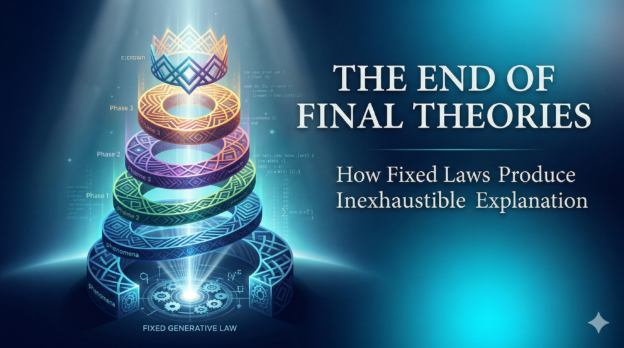
A new paper — backed by 422 machine-checked theorems and zero gaps — proves that a system can be completely governed by fixed laws and still never admit a final explanation. The implications reach from physics to biology to organizations to AI.
The Creed Hiding in Plain Sight
There is an assumption so deeply wired into modern thought that most people never notice they hold it. It goes something like this:
If a phenomenon is generated by fixed fundamental laws, then in principle it admits a final explanation — a fixed standpoint from which everything important about it can be said.
This is the hidden creed of explanatory closure. Almost everyone holds it, across almost every domain. Physicists assume that a Theory of Everything, if found, would in principle explain all physical phenomena. Biologists assume that molecular biology plus evolution, in principle, closes the ledger on life. Organizational theorists assume that with enough data and the right framework, the dynamics of any institution can be fully captured. Economists assume that the right model, with enough variables, will eventually settle the story.
The creed isn’t that we have the final explanation — everyone acknowledges we don’t. The creed is that one exists. That if a system runs on fixed laws, the laws themselves guarantee that some fixed explanatory standpoint could, in principle, finish the job.
I have just published a new paper that proves this creed is false — not as a philosophical argument, but as a mathematical theorem, machine-checked end to end. And the implications, I believe, mark the beginning of a genuinely new mathematics and a new way of understanding generative systems of every kind.
The full paper is freely available:
GitHub repository (full Lean 4 proof library): novaspivack/novelty-theory-lean
Paper (PDF): Self-Transcending Generators: Fixed Causal Laws Without Final Explanatory Closure
(Note: This paper is part of my larger formal research program. For the full index of published papers, Lean formalizations, and Zenodo records, see Introducing My Formal Research Program.)
What the Paper Actually Proves
Let me say it plainly, because the result is simple even though the proof is not:
A single fixed law can generate an infinite sequence of phenomena — and yet no single explanatory framework, drawn from any reasonable class of candidates, is ever the last word.
This is not a claim about human limitations. It is not about running out of time, or lacking data, or being too dumb. It is a structural feature of certain lawful systems. The law generates everything. Every phase, every output, every phenomenon is causally produced by the same fixed rule running forward. Nothing is mysterious or outside nature. And yet: no fixed explanation closes the book.
Here is what the proved configuration looks like, translated out of the formalism:
- One fixed law generates everything. There is a single, finitely specified generator — a deterministic rule — and every phase in the infinite tower is produced by running it forward.
- Each phase has a regime that adequately explains it. There is no point at which explanation fails locally. Every phenomenon produced has an explanatory framework that works for it.
- Each successor regime preserves what came before. The transitions between explanatory frameworks are conservative — they don’t destroy prior understanding. What the old framework got right stays right.
- Each successor regime is genuinely irreducible to its predecessor. The new framework isn’t a notational variant of the old one. It captures structure the old framework literally could not.
- No fixed framework is final. Every candidate for a “last word” — every fixed explanatory stance drawn from the admissible class — fails somewhere on the tower. There is always a generated phenomenon it cannot adequately explain.
That conjunction is what makes this more than a truism. Any one of those clauses alone would be unsurprising. Taken together — one law, total generation, conservative transitions, irreducible novelty, universal failure of closure — they carve out a new structural possibility that had never been formally established.
The Crown Inversion: Why the Effect Explains the Cause
The deepest result in the paper is what I call the crown inversion, and it is genuinely startling.
The usual picture of explanation runs downward. The generator is fundamental. The things it produces are derivative. Therefore — so the reasoning goes — the derivative can never be necessary for understanding the fundamental. At best it’s a convenience, a pedagogical aid, a shortcut.
The crown theorem says that reasoning is wrong.
Later generated regimes can become strictly necessary for structural truths about the generator itself.
Read that again. The generator creates the whole tower. Causation runs forward and downward, as usual. Nothing about that changes. But explanation doesn’t have to follow the same direction. There are structural truths about the source — about the fixed law that produces everything — that become provable only from later regimes. The earlier regimes literally cannot express or prove them.
This is not backward causation. The generator still causes everything downstream. But intelligibility — the ability to see, state, and prove what is true about the generator — can require the very things the generator produces. The child becomes necessary to understand the parent. The effect is needed to understand the cause.
This flips a deep assumption. We tend to think that because causation runs “downward” from laws to phenomena, explanation should too. The crown inversion shows that causal order and explanatory order are two different coordinate systems laid over the same reality. They need not point the same way.
Retroactive Revelation: The Past Wasn’t What You Thought
A stunning consequence follows from the crown. If later regimes are necessary for truths about the source, then later regimes can also disclose latent structure in earlier phases — truths about the past that were not expressible or provable from the frameworks available at the time.
This is retroactive structural revelation. The past doesn’t change — but what can be said about the past, what is structurally visible about it, can grow as later regimes arrive. Explanation grows not only by extending into the future but by reorganizing the intelligibility of the past.
Think about how Darwinian evolution retroactively reorganized the meaning of fossils. The fossils were always there. The facts didn’t change. But what could be seen in them — the structural story they told — required a framework that didn’t exist yet. That is the informal version of what the paper proves formally: later understanding can be strictly necessary for truths about earlier structure.
Self-Transcending Systems: A New Kind of Object
The paper introduces a new mathematical concept: the self-transcending generator. This is not a metaphor. It is a precisely defined mathematical object with provable properties. And I believe it is a concept that will prove to be as fundamental as “dynamical system” or “algorithm.”
A self-transcending generator is a system that:
- Operates under a single, fixed law — nothing mysterious, nothing outside the rules
- Produces an infinite succession of phases, each adequately explained by a corresponding regime
- Forces conservative but irreducible transitions between those regimes — genuine novelty that preserves the past
- Defeats every fixed candidate for a final explanation
- Can require its own later outputs to make structural truths about itself expressible
The word “self-transcending” is doing real work here. The system transcends every fixed explanatory standpoint — not by breaking its own laws, but because of them. The transcendence is lawful. It is generated by the same fixed rule that generates everything else. The system doesn’t escape its own law. It outgrows every fixed way of understanding what its law produces.
This is a new species of mathematical object. It is not a chaotic system (chaos is hard to predict within a fixed explanatory architecture; self-transcending systems defeat the architecture itself). It is not a computationally irreducible system (that’s about the cost of simulation; this is about the impossibility of final explanation). It is not “emergence” in the loose sense that word usually carries. It is a rigorous, formally delimited structural category.
What does self-transcendence look like in the real world?
Once you have the concept, you start seeing candidates everywhere — systems that appear to be governed by fixed rules and yet permanently outrun any fixed explanatory closure:
Physics and cosmology. The laws of physics (as we currently understand them) are fixed. Yet the history of physics is a history of explanatory regimes that each seemed final and turned out not to be. Newtonian mechanics was conservatively extended by relativity, which was conservatively extended by quantum field theory. Each new regime preserved the successes of the old and added irreducible new structure. The quest for a “Theory of Everything” presumes that this sequence terminates — that there is a final explanatory stance. The self-transcending generator framework raises a sharp question: what if the sequence is structurally incapable of terminating, not because we’re not smart enough, but because the generative system itself defeats closure?
Biological evolution. Evolution operates under fixed rules — variation, selection, inheritance. Yet it produces an inexhaustible succession of organisms, ecosystems, and organizational forms that no fixed biological framework has ever fully captured. Molecular biology doesn’t reduce ecology. Ecology doesn’t reduce evolutionary developmental biology. Each regime is conservative over what came before and irreducible to it. Evolution may be the paradigmatic self-transcending generator in nature: one fixed engine producing a tower of phenomena that permanently outruns every fixed explanatory framework.
Organizations and institutions. A company operates under a fixed charter, fixed legal constraints, a fixed market environment. Yet the organizational forms it generates — the cultures, the strategies, the internal structures — can outrun any fixed management framework. Every management consultant has seen this: a framework that perfectly explains a company at one stage becomes inadequate at the next, not because the company broke its rules but because the rules produced new structure that demands new explanation. The theory suggests this isn’t a failure of the framework. It may be a structural feature of the organization as a generative system.
AI and machine learning. A neural network operates under fixed training rules. Yet the behaviors it generates — the capabilities, the failure modes, the emergent strategies — can outrun any fixed interpretability framework. We are already living this: models trained under fixed objectives produce behaviors that require new conceptual frameworks to explain. The self-transcending generator concept suggests that this isn’t a temporary gap in our understanding. For sufficiently rich AI systems, the gap between generation and explanation may be structural.
Scientific revolutions. The history of science itself may be a self-transcending generator at the meta-level. Fixed norms of inquiry — observation, hypothesis, experiment, revision — produce an infinite succession of theoretical frameworks. Each framework is conservative over prior empirical successes and irreducible to its predecessors. Kuhn described this sociologically. The present theory gives it a mathematical backbone: paradigm shift is not just something that happens to scientific communities. It can be a structural theorem about the kind of generative system that science is.
Language and meaning. A language operates under fixed grammatical rules and yet produces an inexhaustible succession of expressive regimes. New conceptual vocabularies — “information,” “algorithm,” “ecosystem,” “feedback loop” — arise conservatively from old ones and are irreducible to them. Each one retroactively illuminates structure in earlier discourse that could not be seen without it.
Paradigm Shift as a Mathematical Object
Thomas Kuhn’s The Structure of Scientific Revolutions made “paradigm shift” one of the most influential ideas of the 20th century. But it remained a sociological and philosophical concept — a description of what happens to scientific communities, not a formal object with provable properties.
This paper changes that. In the formal theory, a paradigm shift is a precisely defined transition between explanatory regimes with two strict requirements:
- Conservativity: The new regime must preserve everything the old regime got right on the certified history. The revolution is not vandalism. Prior adequacy is honored.
- Irreducibility: The new regime must handle generated structure that the old regime literally cannot. It’s not a notational variant. It’s not a relabeling. It captures something genuinely new.
What the paper proves is that there exist lawful systems that force an infinite tower of such shifts. Not one paradigm revolution. Not two. An endless, structurally necessary succession of conservative, irreducible explanatory transitions — all generated by a single fixed law.
This rescues Kuhn’s insight from the fog of sociological contingency. Paradigm shifts are not just things that happen because scientists are human. They can be mathematically forced by the structure of the generative system under study. The revolution is in the territory, not just in the map.
What This Is NOT
Smart readers will immediately reach for familiar reference points. Let me head off the most common ones, because the paper is careful to distinguish itself from all of them:
It is not Gödel’s incompleteness theorem restated. Gödel showed that sufficiently expressive formal systems can’t prove all truths about themselves. That’s a result about proof systems and arithmetic. This paper is about something different: whether fixed lawful generation forces a final explanatory stance. The question isn’t “can some truths outrun one proof system?” but “does fixed law force final understanding of what that law produces?” The answer is no — and the mechanism, target, and philosophical implications are distinct from Gödel’s.
It is not chaos theory. Chaos is about sensitive dependence and unpredictability within a fixed explanatory framework. Self-transcending systems defeat the framework itself. Difficulty of prediction is not the same as impossibility of final explanation.
It is not computational irreducibility. Wolfram’s concept concerns the absence of shortcuts for computing later states — the future is expensive to simulate. The present theory is about something stronger: even if you can simulate everything perfectly, you still can’t achieve final explanatory closure. Full simulation doesn’t give you final understanding.
It is not “emergence” in the usual loose sense. The paper doesn’t rest on vague claims about levels, or useful descriptions, or “more is different” slogans. It rests on precise predicates, formal adequacy conditions, conservative shifts, and proof-theoretic ascent. Where later structure is necessary, that necessity is proved, not gesticulated at.
It is not just “science updates its vocabulary.” Yes, everyone knows that. The paper proves something much stronger: that for certain lawful systems, the updating is structurally forced and can never terminate — and that later vocabularies can be strictly necessary for truths about the system that generated them. That’s not a platitude about intellectual humility. It’s a theorem.
“But the rule explains everything!”
This objection deserves its own space, because it is the strongest and most natural one. A cellular automaton skeptic — or anyone steeped in computational thinking — will say: Take Rule 110. One fixed rule. Run it a billion steps. Every single state is completely determined by the previous state plus the rule. Generation one billion is completely explained by the rule. The rule is the final explanation. What could your “explanatory anti-closure” possibly mean when the rule accounts for everything?
The answer turns on a distinction that sounds pedantic until you see its force: generation is not explanation.
Yes, the rule generates every state. Nobody denies that. The paper doesn’t deny it. The entire framework presupposes it — the generator is fixed and total. The question is whether “the rule did it” constitutes a final explanatory closure for the structural phenomena the rule produces.
Consider: Rule 110 is Turing-complete. It can simulate any computation. Does knowing “Rule 110” give you a framework that adequately captures the structural distinctions of everything it produces? Can you, from the rule specification alone, express and prove structural truths about the system’s long-run behavior — about which patterns persist, which computations it encodes, which organizational structures emerge at which stages?
You cannot. “Run the rule and see” is simulation, not explanation. It is like saying “the laws of physics explain protein folding because the laws of physics generated protein folding.” In one sense, trivially true. In the sense that matters — can you structurally characterize, express, and prove things about the phenomenon from that standpoint alone — it is exactly the question at issue. You need biochemistry. You need thermodynamics. You need information theory. Each of those is a new explanatory regime, conservative over prior results, irreducible to the bare physical law.
The objection works only if you define “explanation” to mean “causal generation.” But that is precisely the conflation the paper identifies as the hidden creed. If generation were the same as explanation, then knowing the Big Bang initial conditions plus the Standard Model would already be a complete explanation of economics, music, and the behavior of your company’s board of directors. It would be “explanation” in a sense so thin it explains nothing. The paper draws the line between these two relations with formal precision, and then proves that the gap between them can be infinite and structurally ineliminable.
The Third Option: Lawful Self-Transcendence
For most of intellectual history, we’ve been trapped between two positions:
Position 1: Naive reductionism. Everything generated from below is finally explainable from below. If you know the laws and the initial conditions, you have — in principle — the whole story. Any appearance of irreducible novelty is just a failure of current understanding, a gap that will eventually close.
Position 2: Mystification. If something isn’t reducible to the base laws, it must be outside law altogether — something supernatural, vitalist, irreducibly spooky. Emergence as magic.
The paper opens a third door:
Position 3: Lawful self-transcendence. A system can be fully lawful, fully deterministic, fully generated from a fixed source — and yet its explanatory structure is permanently open. Not because the laws fail. Not because something magical intervenes. But because the laws themselves produce a tower of phenomena that no fixed explanatory standpoint can close. The transcendence is within law, not outside it.
This is, I believe, a genuinely new philosophical and scientific possibility. It dissolves ancient impasses. You no longer have to choose between “everything reduces” and “something is beyond science.” There is a rigorous third category: lawful, natural, deterministic systems that are permanently open to genuinely new explanation.
Think about what this means for the biggest questions:
- Is there a final Theory of Everything in physics? The self-transcending generator framework doesn’t say no — but it proves that the assumption of closure is not forced by the existence of fixed laws. Final closure must be earned, not assumed.
- Can we ever “fully explain” consciousness, life, or intelligence? If these are produced by self-transcending generators, then the answer may be: we can explain every phase, but there is no final phase. Understanding is inexhaustible — not because the subject is mystical, but because it is lawfully open.
- Why do organizations perpetually outgrow their management frameworks? Not because managers are incompetent. Possibly because the organization is a self-transcending system whose generative rules produce structure that no fixed framework can close.
- Why does AI keep surprising us? Not (only) because the systems are complex. Possibly because sufficiently rich generative models are self-transcending systems that structurally defeat every fixed interpretability framework.
Why This Matters: The Beginning of a New Mathematics
I want to be direct about why I think this matters beyond the intellectual novelty.
We already have a rich mathematics of what laws generate: dynamical systems theory, computability theory, complexity theory, information theory. What we have not had, until now, is a mathematics of non-final explanation under fixed law. A mathematics that takes seriously the question: when does lawful generation guarantee a final understanding, and when does it not?
The paper opens that field. It supplies precise definitions, constructive witnesses, sharp boundaries (it is honest about what it does not prove — not every deterministic system is self-transcending), and a formal language for separating genuine structural novelty from mere complexity, mere redescription, and mere bookkeeping.
Without such distinctions, debates about reductionism, emergence, and explanation talk past each other endlessly. The reductionist says “in principle it all reduces.” The emergentist says “but clearly it doesn’t.” Neither can make their case precise because the concepts aren’t formal. This paper makes them formal. And once they’re formal, you can prove things — including things that overturn deeply held assumptions.
The conclusion of the paper puts it this way:
Explanation need not bottom out where causation bottoms out: a system may be fully lawful and fully generative without being finitely explanation-closed.
If that sentence is right — and the proof says it is — then a new mathematics begins here. Not merely a mathematics of what fixed laws generate, but a mathematics of what fixed laws cannot finish explaining.
The Machine-Checked Proof: Why You Can Trust This
One more thing worth noting. This is not an argument. It is not a philosophical position paper. It is not a thought experiment.
The claims are machine-checked theorems, verified in Lean 4 — a proof assistant used by mathematicians to verify formal proofs with absolute rigor. The project library contains 422 theorem and lemma declarations with zero sorry (unproved gaps) and no smuggled axioms. Every claim anchored in the formal development is checked end to end by a computer. There is no room for hand-waving, hidden assumptions, or subtle errors in reasoning.
This matters because the results are surprising enough that skepticism is warranted. The machine-checked proof is the antidote: you don’t have to trust the author’s reasoning. You can trust the machine.
Read the Paper
The full paper is freely available:
- Paper (PDF): Self-Transcending Generators: Fixed Causal Laws Without Final Explanatory Closure
- GitHub repository (full Lean 4 proof library): novaspivack/novelty-theory-lean
The paper is written for a technical audience — formal logic, proof theory, philosophy of science. If you are not a specialist in those areas, I hope this post has given you the core ideas and why they matter. If you are a specialist: the formal development is there, the Lean source compiles, and I welcome scrutiny.
What I most want to convey is the shape of the result and why it should change how you think about laws, explanation, and the possibility of final understanding. The hidden creed — that fixed law implies final explanation — is one of the deepest unexamined assumptions in modern thought. It is now formally refuted. And in its place stands a new possibility: systems that are fully lawful, fully natural, and permanently, inexhaustibly open.
A system can generate what it cannot finish explaining. That is not a limitation. It is a new kind of structure. And understanding it is, I believe, one of the great intellectual projects ahead of us.
Nova Spivack is the author of “Self-Transcending Generators: Fixed Causal Laws Without Final Explanatory Closure.” The formal proof library is open-source and available on GitHub.