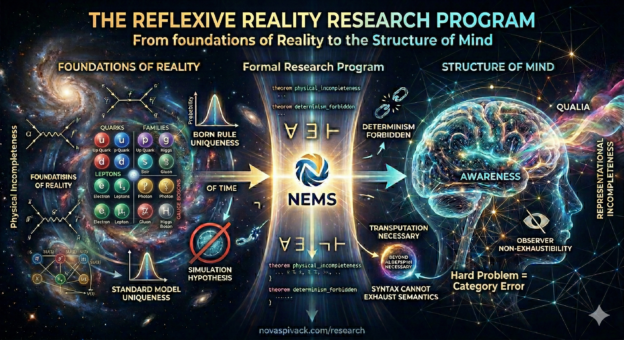
The Standard Model of particle physics contains about twenty-five numerical constants — the masses of the quarks and leptons, the strengths of the forces, the mixing angles between generations. The theory does not explain them. They are measured, inserted, and accepted. Every attempt to understand where they come from has ended either in free parameters, anthropic reasoning, or a landscape of possibilities too large to navigate.
I think that is the wrong framing. My research program starts from a different question: what must any universe with no “outside” look like? If a universe has no external lawgiver, no transcendent selector, no escape from the closure of its own rules — what can we prove about its structure from that single constraint alone?
The answer, it turns out, is: quite a lot. Including, I believe, those twenty-five numbers.
Two programmes, one question
The research divides into two branches that address the same question at different levels.
NEMS — No External Model Selection — is the foundational branch. It asks what can be proved, in the strict mathematical sense, about any self-contained system that selects its own structure. The central axiom is simple: no outside. Everything that follows is theorems. NEMS now comprises 93 papers, all machine-verified in Lean 4 with more than 400 Lean 4 modules — all results independently machine-verifiable.
UGP Physics — Universal Generative Principle — takes the constraints that NEMS establishes and asks the harder question: what specific numbers must the laws of physics have? It proceeds by finding the unique object that satisfies all those constraints simultaneously, and reading the Standard Model’s parameter values off of it. UGP Physics now spans 56 papers (P00–P55), culminating in a complete synthesis monograph.
What NEMS proves
Five results from the NEMS programme stand out as the deepest.
Physical Incompleteness. Any self-contained physical theory that contains universal computation is physically incomplete. This is Gödel’s incompleteness and Turing’s halting problem applied directly to physics: closure and computational universality together force undecidable physical facts. The universe cannot contain a complete account of itself. This is machine-verified.
The Standard Model gauge group is forced. The axioms of Perfect Self-Containment — the formal expression of “no outside” — narrow the space of admissible four-dimensional quantum field theories to SU(3)×SU(2)×U(1) with exactly three generations of chiral matter. Not as a selection from alternatives, but as a theorem: no other gauge structure is consistent with self-containment. An exhaustive machine-scan over 34,560 candidate universes finds exactly twelve survivors, every one with three generations and Standard Model gauge structure.
The Born rule is derived, not postulated. In any perfectly self-contained theory with records that carry quantum effect structure, there is exactly one normalized probability assignment compatible with closure: the Born rule. Paper 14 closes the reverse direction — Born-rule semantics implies self-containment — making the equivalence bidirectional. Both directions are machine-checked.
The Master Fixed-Point Theorem. Paper 26 proves a single theorem that subsumes Gödel’s incompleteness, Turing’s undecidability, Kleene’s recursion theorem, Tarski’s undefinability of truth, and Löb’s theorem as special cases. All of these classical results — independently discovered across a century of logic — turn out to be instances of one underlying fixed-point principle.
Closure Without Exhaustion. The capstone result of the NEMS programme (Paper 91): in any reflexive system, self-closure does not exhaust semantic structure. There is always an irreducible semantic remainder — a formal gap between what the system can express and what it instantiates. This is a theorem, not a conjecture, and it is machine-checked.
What UGP Physics derives
The UGP Physics programme takes the constraints established by NEMS and asks: what is the unique minimal object satisfying all of them?
The answer is a single polynomial over the seven-element field GF(7): p(L,C,R) = C + R − CR − LCR. It requires exactly 19 bits to specify. Every alternative — every other field size, every other polynomial — is eliminated by exhaustive machine proof. This one polynomial, applied iteratively, generates a cascade that unfolds the entire structure of the Standard Model.
From that single 19-bit description, with zero free parameters fitted to particle physics:
- All nine charged-fermion masses are reproduced at 0.293% RMS error — quarks and leptons, without fitting any of them.
- The Weinberg angle sin²θW = 3/13 at tree level, closing to within 0.038σ of the measured value with two-loop corrections.
- The strong coupling and QCD asymptotic freedom follow from the group structure, with θQCD = 0 proved by three independent machine-certified proofs — no axion required.
- All four CKM quark-mixing parameters follow from the same arithmetic, with the leading parameter matching the PDG value to 0.000σ.
- Nuclear magic numbers {2, 8, 20, 28, 50, 82, 126} are derived analytically from the cascade, with no parameters fitted to nuclear data.
- Gravity emerges from the field’s geometry: the Einstein equations are derived from variational calculus, and Newton’s constant is predicted to 0.040% accuracy with no gravitational input.
The cosmological predictions are especially striking because they come from the same arithmetic with no cosmological inputs:
- The CMB spectral tilt ns = 0.96488, matching Planck 2018 at 0.004σ — essentially exact.
- The dark energy fraction ΩΛ derived by two independent routes, bracketing the observed Planck 2018 value from above and below.
- The baryon asymmetry ηB = 6.109 × 10⁻¹⁰, matching Planck 2018 at 0.15σ.
The capstone: P48
Paper 48 — The Complete GTE Framework: Standard Model, Gravity, Quantum Mechanics, and Cosmology from ΦMDL — is the synthesis monograph for the entire programme. It brings together every derivation into a single end-to-end account: from the self-containment axiom, through the unique polynomial it forces, through the cascade that generates the parameter values, through the cosmological predictions. The complete parameter census is either machine-verified in Lean 4 with zero sorry, or fully analytically derived — no entry is fitted, interpolated, or left as a free input.
The framework makes four falsifiable predictions that distinguish it from the Standard Model:
- A dark-sector particle at 211.9 MeV, accessible at Belle II (GTE-P7)
- Tensor-to-scalar ratio r = 0, testable at LiteBIRD
- Dark energy equation of state w = −1 exactly, testable at Euclid
- Any axion detection at any mass — by ADMX, CASPEr, or BabyIAXO — would refute the framework
These are not post-hoc adjustments. They follow from the arithmetic.
P48 on Zenodo: doi.org/10.5281/zenodo.20560550
Companion Assessment — P53: The GTE Framework: A Comparative Assessment places GTE side by side with 12 competing frameworks using a neutral 11-dimension rubric. GTE is the only programme simultaneously supplying a derived selection principle, zero free dimensionless parameters, machine-certified proofs (Lean 4, zero sorry, more than 400 modules), cross-sector predictions in domains causally disconnected from any fitting target, and named near-term falsifiers. Roughly 40 zero-parameter predictions, ∼37 within 1σ of PDG 2024. P53 on Zenodo ↗
The octonionic bridge: P55
P55 — The Octonionic Shadow of GF(7): Color, Chirality, and Three Generations from a Quadratic-Residue Difference Set establishes a deep connection between the UGP/GTE arithmetic programme and the octonion/division-algebra approach to Standard Model structure. The quadratic-residue set QR(7) = {1,2,4} is simultaneously the arithmetic anchor of GTE and the Fano-plane orientation that defines the octonion algebra. A six-link machine-verified derivation chain derives Nc = 3 from the Fano plane (via F21 ↪ G2), certifies the exceptional isomorphism PSL(2,7) ≅ GL(3,2) by Todd–Coxeter, proves der(O) = g2 and StabG2(apex) = su(3) dimension-exact (39 Lean theorems), establishes the triality isomorphism of UGP flavor to Spin(8) triality, and places the Koide mass ladder at 7 ppm. Normal neutrino ordering is predicted (JUNO-falsifiable). 11 Lean modules, 174 theorems, zero sorry. P55 on Zenodo ↗
The scale of the programme
The Lean 4 proof libraries span 23 public repositories — covering the NEMS core, UGP Physics, Reflexive Architecture, Infinity Compression, Transputation, and every other sub-programme. The ugp-lean library alone contains more than 400 modules. All libraries build on standard Mathlib with more than 400 Lean 4 modules — all results independently machine-verifiable, and every inference step is checkable by anyone with a Lean installation. Alongside the formal proofs, 739 Python and Wolfram Language scripts in the ugp-physics repository cross-check the numerical predictions independently. The complete record — over 200 citable Zenodo items — is at novaspivack.com/research.
Across both programmes, there are roughly 200 citable records on Zenodo — papers, Lean archives, companion volumes — each with a permanent DOI. All Lean source is public at github.com/novaspivack.
The Standard Model is not a coincidence. It is a theorem.
Where to go next
- Full research index — novaspivack.com/research
- UGP Physics programme — novaspivack.com/research/physics-program
- NEMS papers — novaspivack.com/research/nems
- “The Standard Model Is Not a Coincidence” — an accessible essay on the UGP derivation: novaspivack.com/science/the-standard-model-is-not-a-coincidence
- P48 on Zenodo — doi.org/10.5281/zenodo.20560550