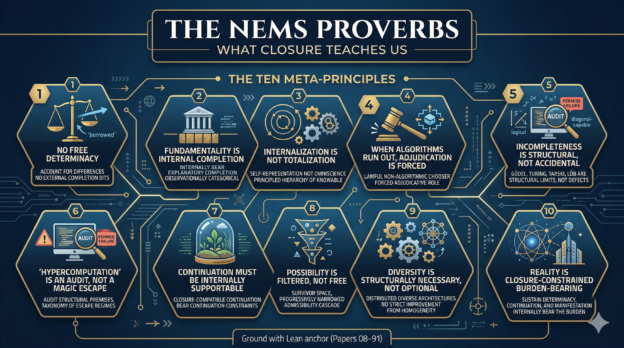
The NEMS program has produced dozens of structural laws — precise, memorable, and applicable far beyond physics. These are not philosophical opinions or empirical generalizations. Each one is a machine-checked theorem, or a compressed interpretive consequence of a machine-checked theorem. Here are the most important ones, stated plainly.
New to this research? This is Article 3 of the NEMS Curriculum series. Start with Article 1: What Is NEMS? ↗ and Article 2: The Classification of Universes ↗ · Full research index ↗
Series: What Is NEMS? (Introductory) · 1. What Is NEMS? · 2. The Classification of Universes · 3. The NEMS Proverbs
Theorems That Read Like Wisdom
One of the strangest things about the NEMS program is how many of its results sound like old wisdom — the kind of thing a wise person might say about organizations, or science, or life — while being precise, formal theorems proved with machine-checked rigor.
“You cannot be your own final judge.” True as folk wisdom. Also a machine-checked theorem (Paper 40, 50).
“Diversity is not just good — it is structurally necessary.” A social observation. Also a proved theorem: homogeneous systems cannot strictly improve their certified coverage under any admissible protocol (Paper 31, Lean anchor: EpistemicAgency.diversity_necessary).
“Optimizing for the wrong proxy eventually destroys the thing you were trying to preserve.” A management observation. Also a formal theorem with a machine-checked proof about systems that decouple local proxies from whole-system viability (Paper 71, viable continuation).
This article collects the most important structural laws from the NEMS program — the ones that have wide applicability, are precisely stated, and are grounded in formal theorems. They apply to organizations, governments, AI systems, scientific communities, ecosystems, and minds, not just to fundamental physics.
Each “proverb” below is stated in plain language, followed by its precise formal content and Lean anchor. The plain language is not a weakening of the formal result; it is the result compressed for recognition. The formal version is the real thing.
The Ten Meta-Principles
1. There is no free determinacy.
Any difference that matters must be accounted for. If a theory needs something from outside itself to fix a load-bearing fact, it has not explained that fact — it has borrowed the explanation.
Formal version: If a system’s semantic structure does not already determine the value of a load-bearing predicate, then any such fixing either comes from an admissible internal selector or from externally supplied completion bits — a “free bit” that violates PSC.
Applications: Physics theories that require an external measure or vacuum selection principle are importing free determinacy. Organizations with policies that require external override to function are not self-governing. Scientific theories that assume a preferred “natural” prior without justification are smuggling in a free bit.
Lean anchor: InternalitySchema.outsourcing_barrier (Paper 83)
2. Fundamentality is internal completion.
A theory is not fundamental just because it is elegant or powerful. It is fundamental only if it internally bears the burden of its own explanatory completeness — without quietly borrowing from outside.
Formal version: A theory counts as foundational if and only if it is either observationally categorical (the laws fully determine everything) or contains an admissible internal selector (something inside the theory that resolves underdetermination). Any theory that requires external completion is not foundational in the NEMS sense.
Applications: This redefines what “final theory of everything” means. A theory that accurately describes all phenomena but relies on an external measure to say which solution is actual is not foundational — it is an effective description, not an explanation. Multiverse proposals with external measures fail this criterion.
Lean anchor: Foundationality.foundational_iff_internal_completion (Papers 83, 79)
3. Internalization does not mean totalization.
Building the selector into the system does not give the system unlimited self-knowledge. Once a system is rich enough to represent itself, total effective self-description is structurally blocked.
Formal version: In any diagonal-capable system — one rich enough to represent and reason about its own descriptions — no total effective procedure can decide all nontrivial extensional self-referential predicates. Internalization creates a principled hierarchy of what is knowable at each level, not omniscience.
Applications: A sufficiently capable AI system cannot fully certify all its own outputs for all nontrivial properties. A sufficiently complex organization cannot have one internal auditor that is total, sound, and complete for all claims. Self-knowledge is stratified, not unlimited.
Lean anchor: InternalizationNotTotalization.internalization_not_totalization (Papers 26–30, 51)
4. When algorithms run out, adjudication is forced.
In any closed system with genuine underdetermination, something must make the choices that the laws do not fix. That something cannot be an algorithm — it must be a lawful but non-algorithmic adjudicator.
Formal version: In closure-bearing, non-categorical, record-sensitive systems with the diagonal structure, semantic continuation requires an internal adjudicative layer — a forced adjudicative role. Adjudication is not an accidental add-on but a structural necessity.
Applications: The universe’s “chooser” at record-divergent moments is not an algorithm (it cannot be — the diagonal barrier forbids it). Organizations facing genuine dilemmas that no procedure fully resolves require actual judgment, not just better procedures. AI systems that handle genuinely novel situations require something beyond lookup.
Lean anchor: ForcedAdjudication.forced_adjudicative_role (Papers 08, 09, 22)
5. Incompleteness is structural, not accidental.
Gödel, Turing, Tarski, Kleene, Löb — these are not quirks of particular formal systems. They are instances of one underlying structural law governing any system rich enough to represent itself from within a closed context.
Formal version: The classical diagonal results — incompleteness, halting undecidability, truth undefinability, recursion theorem, Löb’s theorem — are all instances of a single Master Fixed-Point Theorem (Paper 26). Incompleteness is generic in any diagonal-capable self-referential system, not a defect of particular designs.
Applications: Self-certifying systems, complete audit systems, total self-modeling AI — all face the same structural limit. The limit is not a current engineering gap to be closed with more capability. It is a theorem about the structure of self-reference.
Lean anchor: StructuralNonExhaustibility.no_total_exhaustion_of (Papers 26, 51, 91)
6. “Hypercomputation” is an audit, not a magic escape.
Any proposal for computation beyond the Turing limit — time travel computation, black-hole oracles, CTC computers — must answer one precise question: which structural premise are you relaxing? It is not impossible in principle; it just has a specific cost.
Formal version: In a closure-bearing, diagonal-capable setting with stable records and extensional truth, a purported internal hypercomputer forces a precise audit: either a selector is being imported from outside (violating PSC), or one of the barrier premises fails (no stable records, non-extensional predicate, non-total procedure, etc.).
Applications: Any exotic proposal — in physics, AI, or governance — that claims to get around fundamental limits must specify which premise is being relaxed. The NEMS audit converts vague speculation into a precise question with a finite taxonomy of escape regimes.
Lean anchor: Hypercomputation.internal_hypercomputer_claim_forces_premise_failure (Paper 35)
7. Continuation must be internally supportable.
It is not enough for a system to exist at a moment. It must be able to continue existing in a way that does not require illicit external support. Closure applies not just to determination but to persistence.
Formal version: A system has admissible continuation if and only if it is closure-compatible (does not require external determination) and burden-bearing (can internally sustain the load of its own continuation constraints). Lean anchor: AdmissibleContinuation.closure_compatible_continuation (Paper 85)
Applications: Organizations that require constant external override to make decisions are not genuinely autonomous — their continuation depends on something they have not internalized. Long-lived AI systems must be designed to bear their own operational and epistemic burden, not offload it indefinitely to human supervision.
8. Possibility is filtered, not free.
The space of what can exist is not an unconstrained menu. It is a survivor space — successively narrowed by admissibility conditions, structural stability requirements, probabilistic compatibility, and physics-architecture constraints. What survives is not arbitrary.
Formal version: The Classification Cascade (Papers 79–80, 84) progressively narrows the space of admissible universes through four sieve stages. The Survivor Calculus (Paper 84) proves that each stage strictly shrinks or preserves the residual class: R(k+1) ⊆ R(k). What we observe is not the result of free selection from an unstructured possibility space but the residue of a closure-compatible admissibility cascade.
Lean anchor: SurvivorCalculus.residual_inclusion (Papers 79, 80, 84)
9. Diversity is structurally necessary, not optional.
When a single point cannot bear the full verification load, distributed diverse architectures are not a nice addition — they are the only way to strictly improve. Homogeneity, by theorem, cannot improve beyond any of its members.
Formal version: Homogeneous societies — those where all members have identical coverage sets — cannot strictly improve their certified coverage under any admissible protocol. Strict improvement requires non-identical coverage sets (role diversity). The k-role lower bound quantifies this: full coverage under a k-way partition requires at least k distinct roles.
Applications: Scientific replication across diverse methodologies. Democratic pluralism with structurally independent institutions. AI governance with multiple non-overlapping auditors. Biodiversity as decorrelated error protection. All are instances of the same structural law.
Lean anchor: EpistemicAgency.diversity_necessary, InstitutionalEpistemics.k_role_lower_bound (Papers 31, 40)
10. Reality is closure-constrained burden-bearing.
The universe is not merely states governed by laws. It is an architecture that must internally sustain the burden of its own determinacy, continuation, and manifestation — without outsourcing any load-bearing fact to something outside itself.
Formal status: This is the highest-level interpretive synthesis of the program — less a single theorem than the compressed reading of the ten meta-principles together. It is grounded in the formal spine but is explicitly interpretive. The preceding nine principles earn it.
What it changes: The standard picture of reality — matter plus laws plus initial conditions — is too thin. Reality is a closure-constrained architecture where internal burden-bearing is not peripheral but architecturally central. The burden of determinacy, continuation, and manifestation cannot be silently offloaded. It must be borne from within.
Additional Proverbs from the Viable Continuation Program
The Viable Continuation program (Papers 71–72) produced its own family of structural principles, each anchored in machine-checked theorems. These apply to any system — biological, institutional, civilizational, or computational — whose persistence depends on reconciling local transitions with whole-system viability.
The four principal failure modes (machine-checked theorems, not metaphors):
- Proxy drift: A system optimizes a proxy measure that decouples from the intended objective. Local success, global failure. “Cancer is what happens when a part becomes too good at winning the wrong game.”
- Local-global pathology: Every local step is valid, but the aggregate trajectory is not. Locally correct behavior generating globally pathological outcomes. “A civilization that can act faster than it can understand becomes structurally unstable.”
- Correlated failure: Apparently independent safeguards fail together. Plurality that looked like redundancy was actually a single point of failure in disguise. “Biodiversity is how an ecosystem avoids betting its future on one answer.” “Correlated strategy is hidden fragility.”
- Constraint deficit: The system operates below the critical constraint-satisfaction threshold needed to maintain correction capacity. Degradation accelerates as the margin shrinks. “Health is not local perfection; it is successful governance across scales.”
And on the positive side — what keeps systems viable:
- “Replication is diachronic correction made institutional.” — Stability requires memory across time, not just optimization in the moment. (Trace capacity; science bridge)
- “A regime that cannot hear dissent eventually loses the ability to distinguish error from disloyalty.” — Weak anchoring plus loss of channel independence produces systems that cannot self-correct. (Political pluralism bridge)
- “Pluralism is how a society prevents one mistake from becoming everyone’s mistake.” — Decorrelated error protection as structural necessity, not political preference. (Correlated failure theorem)
- “A benchmark that no longer tracks viability becomes an unsound guide to progress.” — Proxy drift with unsound anchor; applies to science, management, and governance alike. (Weak anchor unsoundness; science bridge)
More Proverbs: The Full Canonical Principles of Paper 72
Paper 72 (Structural Principles of Stability, Pathology, and Collapse) is dedicated entirely to extracting canonical principles from the Viable Continuation theorems — and it is full of pithy, precise ones. Here are the most striking, organized by theme. Each is anchored in a machine-checked theorem family.
On Power and Understanding
- “When power grows faster than understanding, collapse becomes structurally likely.” — The most portable principle of the framework. Applies to AI, civilization, markets, strategy.
- “A civilization that can act faster than it can understand becomes structurally unstable.” — Civilizational specialization of the above.
- “When systems act faster than they can verify, they begin mistaking uncertainty for truth.” — Transition pressure outrunning capacity; applies to war, markets, AI, automated governance.
- “Capability without interpretive capacity is a recipe for structured drift.” — Optimization power growing faster than viability-supporting constraint.
On Memory and Records
- “A system that cannot remember enough cannot correct itself across time.” — Memory as structural organ of viable continuation — in scientific records, institutions, immune systems, legal precedent.
- “A system forgets at its peril; memory is stored capacity for correction.” — Especially in institutional, scientific, military, legal, and ecological settings.
- “When a species disappears, an ecosystem loses not just a form of life but a way of remembering how to live.” — Structural reading of biodiversity loss as loss of corrective possibility.
- “Health depends on remembering enough of danger to meet it again without destroying yourself.” — Immune memory; applies to any system that must maintain diachronic correction capacity.
On Proxies and Self-Certification
- “A proxy that cannot distinguish viability cannot safely guide continuation.” — The central warning about weakly anchored proxies, metrics, indicators.
- “A society that governs by proxies eventually serves the proxies instead of viability.” — When compressed metrics replace direct engagement with viability conditions.
- “A market can agree with itself and still be wrong.” — Internal market coherence does not certify viability-relevant truth. Endogenous coherence ≠ truth-tracking.
- “An AGI that cannot keep its proxies anchored cannot keep its goals stable.” — Weak anchoring as a structural route to semantic instability in AI systems.
- “A self-modifying system that cannot distinguish viable from nonviable updates cannot safely improve itself.” — Self-improvement becomes unsafe when viability-preserving discrimination fails.
- “Multiple evaluators do not protect a system if they fail the same way.” — Correlated failure is the breakdown point; formal multiplicity ≠ actual diversity of failure modes.
On Monoculture and Diversity
- “Monoculture turns local failure into system-wide failure.” — Applies to institutional, cognitive, ecological, strategic, and technical monocultures.
- “Diversity is how complex systems avoid dying from one mistake.” — Diversity as decorrelated error protection and adaptive option value.
- “Redundancy protects only when failures are not correlated.” — Common-mode failure is the breakdown point of multiplicity as a correction resource.
- “Correlated strategy is hidden fragility.” — Especially in markets: multiplicity of participants can mask common-mode response structure.
- “A military that sees with one mind can be blinded in one stroke.” — Overcorrelated sensing, review, and command stacks; applies wherever correlated integration creates fragility.
- “A state that cannot think against itself cannot think against an enemy.” — Plural channels, dissent, and decorrelated review as structural necessities in strategic settings.
On Continuation and Viability
- “Stability requires more than continuation; it requires continuation under conditions that preserve viability.” — The most general statement: the difference between mere persistence and viable continuation.
- “Health is not local perfection; it is successful governance across scales.” — Local success does not by itself constitute organismal viability; multiscale compatibility is the criterion.
- “A legal system fails when local rulings stop preserving systemic coherence.” — Local successes become dangerous when they cease to preserve legal viability.
- “An immune system fails both by attacking too little and by attacking too much.” — Discrimination failure in both directions; applies to any system where self/non-self or threat discrimination is structurally central.
The full collection of cross-domain canonical principles, domain principles, and frontier principles — with their formal anchors and scope qualifications — is in Structural Principles of Stability, Pathology, and Collapse (Paper 72). The companion theorems are in Viable Continuation Under Constraint (Paper 71) and machine-checked in viable-continuation-lean.
The Proverb Format Is Not Decoration
There is a risk in presenting these as “proverbs” — the format might suggest they are folk wisdom or inspirational quotations. They are not. Each one is a compressed statement of a machine-checked formal theorem or a proved theorem schema.
The difference matters: a folk proverb has exceptions and counterexamples, and its truth depends on context. A theorem has stated premises, a proved conclusion, and a precise scope. When the premises hold, the conclusion follows without exception. When they don’t, the theorem says nothing — but that is also precise.
The NEMS proverbs are valuable precisely because they have this dual nature. They are memorable and applicable in the way proverbs are. And they are rigorous and verifiable in the way theorems are. The formal precision is what gives them their edges — you know what they cover, what they don’t, and where you have to look to challenge them.
This is what formal theory can offer that informal wisdom cannot: precisely located knowledge. Not just “diversity is good” but “here is the theorem, here is what it requires, here is exactly where the barrier falls, here is the Lean proof you can check.”
The Papers and Proof
Meta-principles (source): Determinacy Without Outsourcing: Meta-Principles of Closure (Paper 82) — Zenodo
Internality / Outsourcing Schema: The Internality / Outsourcing Schema (Paper 83) — Zenodo
Viable Continuation Principles: Structural Principles of Stability, Pathology, and Collapse (Paper 72) — Zenodo
Viable Continuation (theorems): Viable Continuation Under Constraint (Paper 71) — Zenodo
Lean proof library: novaspivack/nems-lean (Papers 82–83) and viable-continuation-lean (Papers 71–72)
Full abstracts: novaspivack.github.io/research/abstracts ↗
Full research program: novaspivack.com/research ↗