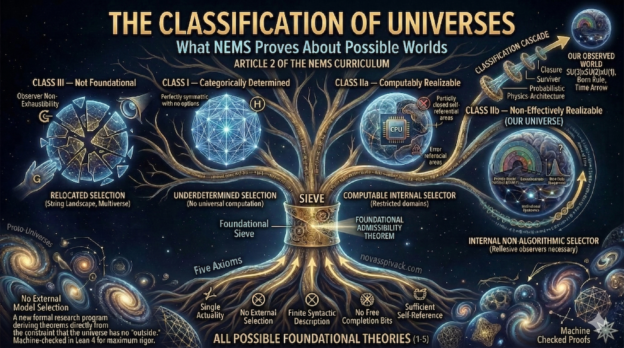
Not all possible universes are equal. A formal sieve, derived from the requirement that the universe have no outside, partitions all possible foundational theories into four classes. The universe we observe falls into a specific class — and this placement has provable consequences for everything from quantum mechanics to the existence of observers.
New to this research? This is Article 2 of the NEMS Curriculum series. Start with Article 1: What Is NEMS? ↗ · Full research index ↗
Series: What Is NEMS? (Introductory) · 1. What Is NEMS? · 2. The Classification of Universes · 3. The NEMS Proverbs
The Question Behind the Classification
Imagine you are trying to build the most complete possible description of a universe. You specify the laws. You specify the fields. You specify the symmetries. You write down the equations of motion.
Now ask: are you done? Have you fully specified the universe?
Almost certainly not. Even a complete set of laws leaves open questions: which of the many solutions to the equations is the one that is actually realized? When two configurations of the universe are observationally indistinguishable — when no measurement could tell them apart — which one is actual? Who or what is selecting among the possibilities that the laws leave open?
These are not mystical questions. They are structural questions about whether a physical theory is complete in the deepest sense — whether it carries its own explanatory burden, or whether it requires something from outside itself to finish the job.
NEMS formalizes this question into a classification theorem. Every candidate fundamental theory falls into exactly one of four classes depending on how it handles this problem. The classification is machine-checked in Lean 4, derived from five minimal axioms, and applies to any system that meets the basic conditions for a foundational theory.
Five Axioms
The classification begins from five axioms that any serious candidate for a fundamental theory must satisfy. These are not arbitrary; they capture what it means to be trying to explain the universe rather than merely describing it.
- Single actuality. There is exactly one actual realization among observationally inequivalent candidates. We live in one universe, not a superposition of all possibilities.
- No external selection. The actual realization is not chosen by any ontologically external information. Nothing outside the system determines which candidate is the one that is real.
- Finite syntactic description. The law-description is finitely specifiable. We can write the theory down.
- No free completion bits. No unconstrained completion data is imported from outside the theory’s own semantics. Every load-bearing difference has an internal account.
- Sufficient self-reference. The system is expressive enough to represent itself and reason about its own descriptions. It contains something analogous to computation.
These five axioms together define what it means to be a foundational theory — not just a theory that works, but one that genuinely explains rather than silently borrowing explanatory power from outside itself.
The Four Classes
From these five axioms, the NEMS classification theorem (Paper 02) derives exactly four classes into which every candidate fundamental theory must fall.
Class I — Categorically determined
In Class I, the laws plus the observational record fully and uniquely determine everything. There is no underdetermination — no choice left open. The theory is categorically complete. Given everything that can be observed, there is exactly one possible actual world consistent with those observations.
Class I sounds ideal — no chooser needed because nothing is left to choose. But the fifth axiom (sufficient self-reference) forces a complication. Any Class I theory rich enough to contain universal computation faces the diagonal barrier: it cannot have a total algorithmic description of its own record-truth. A Class I theory with universal computation would need to decide all its own questions, but the diagonal argument proves it cannot. So Class I is only possible in theories that are not computationally universal — and our universe, which contains computers, is not like that.
Class IIa — Internal selection, computably realizable
Class IIa theories have genuine underdetermination — more than one realization is consistent with the laws — but they have an internal selector that resolves this. Crucially, the internal selector is computably realizable on restricted fragments of the theory. A computable function can, in at least some domains, select the actual from among the possible.
This is a coherent possibility for some domains. But again the diagonal barrier applies: on the diagonal-capable fragment — the part of the theory that can represent and reason about itself — no total computable selector can exist. So Class IIa theories can handle restricted fragments computably but cannot extend this to full self-referential domains.
Class IIb — Internal selection, non-effectively realizable
Class IIb theories have underdetermination and have an internal selector, but the selector is non-algorithmic on the diagonal-capable fragment. There exists an internal adjudicator — something in the system that makes the choices — but it cannot be a total computable function.
This is the most physically interesting class. It says: the universe makes choices internally, but not algorithmically. Not random either — the selector is lawful, constrained by the structure of the records and the closure requirements. It is the third mode: lawful, non-algorithmic, internal. This is what NEMS calls transputation.
This is the class our universe is in.
Class III — Not foundational (requires external selection)
Class III theories require an external selector to complete their description. They cannot bear their own explanatory burden from within. They are physically useful — they can make accurate predictions — but they are not foundational in the NEMS sense. Something from outside the theory is doing work that the theory itself is not doing.
Most proposed theories of quantum gravity fall here. String landscape scenarios, multiverse proposals with external measures, vacuum selection principles that invoke external factors — all of these are Class III. They relocate the selection problem rather than solving it.
Why Our Universe Is Class IIb
The placement of our universe in Class IIb follows from two independent arguments, both formally proved.
Route A: Physical universality
Our universe contains universal computation — computers exist, and they can simulate any computable process. This is not a philosophical claim; it is an empirical fact about the machines in your pocket. Physical universality plus the existence of stable macroscopic records plus the record-expressibility of halting — the conjunction of these three premises — implies via the diagonal barrier that no total computable law can decide all record-truth on the diagonal-capable fragment (Physical Incompleteness, Paper 11). This rules out Class I and Class IIa for the full diagonal-capable domain, placing us in Class IIb.
Route B: No free completion bits
The no-free-bits principle (Axiom 4) rules out Class III: any external completion would be a free bit, which PSC forbids. So the only remaining options are Class IIb (internal, non-algorithmic selector) or, in restricted domains, Class IIa.
Having two independent routes to the same classification matters: if one is challenged on its premises, the other still stands.
The Classification Cascade
The four-class theorem is just the beginning. Papers 79 and 80 of the NEMS suite develop a Classification Cascade — a series of successively finer sieves that narrow the space of admissible universes from all possible theories down to an extraordinarily constrained endpoint.
The cascade has four stages:
- Closure compatibility (first sieve): must respect PSC. This eliminates all Class III theories — anything that requires external completion. The Foundational Admissibility Theorem (Paper 79) proves this step: foundational viability is equivalent to closure compatibility. Lean anchor:
NemS.foundational_iff_closure_compatible - Survivor compatibility (second sieve): must survive the structural stability requirements that follow from closure. This is where GUT groups, CP-conserving theories, vector-like fermion theories, and theories without massless particles are eliminated.
- Probabilistic admissibility (third sieve): must have closure-compatible probability assignments. This forces the Born rule as the unique survivor — quantum probability is not a postulate but a consequence.
- Physics-architecture admissibility (fourth sieve): must have a closure-compatible gauge structure. This narrows to SU(3)×SU(2)×U(1) with three generations.
Each arrow in this cascade is a different kind of restriction, proved independently. Together they trace a path from “all possible universes” to “a very narrow class of world-architectures” — and the endpoint is what we observe.
All possible universes → closure-compatible → Born/GPT-admissible → SM-like → near-categorical endpoint
What Being in Class IIb Forces
Once a universe is placed in Class IIb — internal, non-algorithmic adjudication required — a cascade of structural consequences follows. These are not further assumptions; they are proved theorems that follow from the classification.
Observers are necessary infrastructure (Paper 17)
A Class IIb universe with distributed records needs to reconcile record-truth across contexts. This requires internal adjudicator nodes — subsystems that maintain records and resolve discrepancies. If such a node is rich enough to support self-reference, it is structurally forced toward Reflexive Self-Model Closure — an operational form of self-awareness. Observers are not an accidental byproduct of evolution. They are structural infrastructure that a Class IIb universe requires.
The chooser is non-algorithmic (Papers 15, 22)
No total computable function can emulate the internal adjudicator on all inputs (No-Emulation Theorem, Paper 15). Any claimed computable emulator would provide a total computable decider for record-truth — which the diagonal barrier forbids. Therefore the adjudicator — the internal “chooser” that resolves record-divergent situations — is necessarily non-algorithmic. Not random either (randomness would be a free bit). The third mode — transputation — is forced.
Time has a direction (Paper 36)
In a Class IIb universe with stable records, records can be created but not overwritten without introducing non-categoricity. This asymmetry — creation allowed, erasure forbidden — forces a preferred direction in the record structure: toward more recorded content. This is the arrow of time, derived not from thermodynamics but from the structural requirements of a closed universe with stable records.
No final algorithmic theory of everything (Paper 11)
A Class IIb universe with universal computation cannot have a total computable “theory of everything” that decides all physically meaningful questions. This is Physical Incompleteness — a corollary of being in Class IIb. Not a limitation of current physics; a structural theorem about what any theory of our universe can achieve.
The Record Language
One subtlety worth addressing: the classification depends on the record language — the observational language that specifies what counts as a stable, readable fact about the universe.
Paper 04 (Instantiating NEMS in Physics) proves a minimality theorem: the record language used in the NEMS classification is the weakest observational language adequate for empirical science. Any stronger language would interpret it. This prevents the objection that the classification depends on an artificially narrow or artificially rich choice of record language. The record language is not chosen to make the classification come out a certain way — it is the minimal language needed for the classification to be well-defined at all.
What This Changes
The classification theorem changes how foundational questions in physics should be framed.
The standard question is: “Which theory best fits the data?” The NEMS question adds: “Which theories are foundationally admissible at all?” Most proposals in quantum gravity, string theory, and cosmology are Class III — they relocate the selection problem rather than solving it. A string landscape with an external measure is not a foundational solution; it is a restatement of the problem with more variables.
The NEMS classification also changes what counts as a genuine explanation. A theory that invokes an external selector — even implicitly — is not explaining; it is outsourcing. Closure compatibility is the criterion for foundational adequacy, not elegance or empirical accuracy alone.
And it changes the relationship between physics and consciousness. Observers are not incidental. The necessity of internal adjudicators — which in a sufficiently rich universe become observer-like — follows from the classification. We live in a Class IIb universe, and Class IIb universes require something like us.
The Conditional and Its Evidential Weight
The classification theorem is conditional: if the universe satisfies PSC, then it must be Class IIb. The theorems do not prove PSC from nothing. That is the honest statement, and it matters.
But the conditional has extraordinary evidential weight. From PSC alone — a single foundational premise — the program derives:
- The Standard Model gauge group SU(3)×SU(2)×U(1) with exactly three generations — as the unique survivor of the closure sieve on 4D renormalizable gauge theories
- The Born rule — as the unique closure-compatible probability assignment, not a postulate
- The arrow of time — as a structural consequence of stable records
- Constraints on black holes, holography, time travel, and FTL signaling — each from the same diagonal machinery
These are not vague qualitative predictions. They are the specific, quantitatively precise structures our universe actually has. To our knowledge, this is the first foundational framework in the history of physics to produce all of them from a single constraint. That convergence is not proof that PSC is true — but it is the strongest form of explanatory evidence available: the principle predicts exactly what we observe, and nothing else produces that convergence.
The other direction matters equally. What happens if you reject PSC? The program answers this exhaustively through the classification itself. Paper 79 proves that foundational viability and PSC are equivalent — a biconditional, not merely one-way. A universe that rejects PSC is not merely different; it is foundationally incomplete. Paper 23 (Foundational Finality) proves that any external explanation of a PSC universe falls into exactly one of three forced outcomes: it violates self-containment, it is physically redundant, or it is isomorphic to the original. The classification cascade exhausts the remaining alternatives: Class III universes require external selectors whose own ground remains unexplained; multiverse measures relocate the selection problem rather than solving it; simulator proposals either violate PSC or collapse to redundancy.
None of these alternatives produce the convergence of specific physics that PSC produces. The conditional and the exhaustive analysis of its negation together make a case that is considerably stronger than either alone. The universe we observe is the universe that PSC predicts — uniquely, specifically, and without additional empirical inputs beyond the class of theories under consideration.
What Comes Next
- Article 3 — The NEMS Proverbs: The program has generated structural laws that apply far beyond physics. “No free determinacy.” “Fundamentality is internal completion.” “Internalization does not mean totalization.” Each one is a machine-checked theorem with applications to organizations, governance, AI, science, and life.
The Papers and Proof
Classification theorem: Semantic Closure Under No External Model Selection (Paper 02) — Zenodo
Physics instantiation: Instantiating No External Model Selection in Physics (Paper 04) — Zenodo
Foundational admissibility: Foundational Admissibility (Paper 79) — Zenodo
Classification cascade: The Classification Cascade for Foundational Universes (Paper 80) — Zenodo
Lean proof library: novaspivack/nems-lean — Lean anchors: NemS.foundational_iff_closure_compatible, NemS.physical_incompleteness
Full abstracts: novaspivack.github.io/research/abstracts ↗
Full research program: novaspivack.com/research ↗