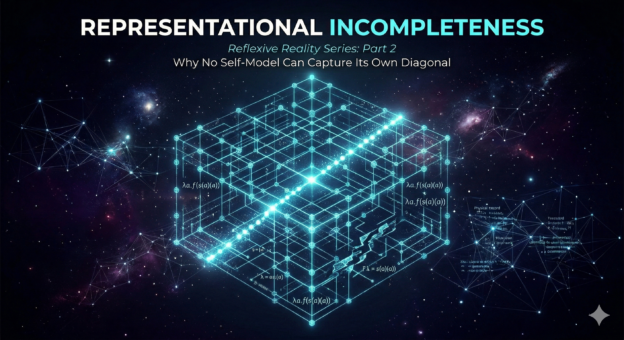
A machine-checked theorem proves that no parametric self-model — no matter how rich, how large, or how powerful — can represent its own diagonal. The blind spot is not a resource limitation. It is structural. And it holds with no computability assumption, no arithmetic, no cardinality. Just types.
New to this research? This article is part of the Reflexive Reality formal research program — a suite of 93+ machine-checked papers and 17 Lean 4 proof libraries. Brief introduction ↗ · Full research index ↗
Series: Closure Without Exhaustion (4-part) · All research ↗
This is Part 2 of a four-part series on the Reflexive Reality research program.
- Part 1: Physical Incompleteness: The Universe Cannot Contain a Complete Account of Itself
- Part 2: Representational Incompleteness: Why No Self-Model Can Capture Its Own Diagonal (this post)
- Part 3: One Theorem Behind Gödel, Turing, Kleene, Tarski, and Löb
- Part 4: Closure Without Exhaustion: Why Every System That Models Itself Has an Irreducible Remainder
The Self-Model That Cannot See Itself Whole
Every sufficiently complex system — a brain, an AI, a formal theory, a social institution — develops some kind of self-model. A representation of itself that it uses to predict its own behavior, understand its own structure, and guide its own actions.
There is a natural assumption embedded in how we think about this: a self-model that is rich enough, expressive enough, and given enough resources should eventually be able to represent everything about itself. The blind spots should shrink. A sufficiently powerful self-model should converge toward completeness.
A new theorem — machine-checked in Lean 4, zero axioms, zero gaps — proves this assumption is false in a precise and irreversible sense.
Every parametric self-model has a diagonal it cannot represent. Not because it lacks resources. Not because it lacks expressive power. Because the topology of self-representation makes it impossible. The model has the wrong shape to contain its own diagonal. And no amount of additional power changes the shape.
What Is a Parametric Self-Model?
The theorem applies to any parametric self-model — which sounds technical but is a very general idea.
A parametric self-model is a function s: A → A → B. Read this as: given a system-state a and another system-state a’, the model produces a representation s(a)(a’) of what a’ looks like from the perspective of a. When a = a’, this is a self-representation: the system representing itself to itself.
This covers an enormous range of architectures:
- Neural network self-models: an AI system that has learned a representation of its own weights, activations, and behavior.
- Formal self-description: a mathematical system that encodes statements about its own theorems and proofs.
- Cognitive self-models: a mind that represents its own mental states, dispositions, and capacities.
- Institutional self-descriptions: an organization’s internal model of its own structure and behavior.
All of these are parametric self-models in the formal sense. And the theorem applies to all of them.
The Diagonal: The Blind Spot That Cannot Be Eliminated
Given a parametric self-model s: A → A → B and any function f: B → B that has no fixed point (a function where f(x) ≠ x for all x), the theorem states:
The diagonal function λa. f(s(a)(a)) is never a row of s.
What does “a row of s” mean? The model s can be thought of as a table: each row corresponds to a system-state a, and each entry in that row is the representation s(a)(a’) for some a’. The diagonal function is a new function built by walking down the diagonal of this table — taking s(a)(a) for each a, applying f, and collecting the results.
The theorem says: this diagonal function is never one of the rows. No matter which row you look at, the diagonal function differs from it somewhere. The self-model, however rich, cannot list its own diagonal among its representations.
This is not a size problem. Making the model larger, adding more rows, giving it more representational capacity — none of this helps. Adding a new row to capture the diagonal just creates a new diagonal that the model cannot capture. The obstruction is not about how many rows you have. It is about the shape of self-reference.
No Computability Required. No Arithmetic. No Cardinality.
This is where the theorem becomes genuinely striking.
Most incompleteness results require specific background assumptions. Gödel’s theorems require arithmetic. Turing’s halting theorem requires computability theory. Cantor’s diagonal argument requires cardinality theory. They are powerful results, but they apply within specific mathematical frameworks.
Representational incompleteness requires none of these. The only inputs are:
- A parametric self-model s: A → A → B (any types A and B)
- A fixed-point-free function f: B → B
That is all. No assumption about what A or B are. No assumption about computability, cardinality, or arithmetic structure. The result holds for every parametric self-model over every type.
This makes representational incompleteness the most broadly scoped incompleteness result in the program. It applies to any self-modeling architecture of any kind, without exception. Neural networks, symbolic systems, biological brains, formal theories, social organizations — if they have a parametric self-model, the diagonal is unreachable.
Renaming Cannot Fix It
A natural response is: what if we simply relabel the representation? What if we reindex the rows, rename the values, permute the structure — can we bring the diagonal within reach by rearranging how we describe things?
The answer is no, and this is proved explicitly.
The OntologicalSlot result establishes that sort discipline keeps self-representation morphisms and global witness slots definitionally disjoint through iterates. This separation survives injective relabeling. You cannot permute your way to a self-model that contains its own diagonal. The impossibility is structural, not notational.
The blind spot is naming-invariant. Relabeling the map does not change its territory.
The Relationship to Lawvere
The categorical mathematician will recognize the kinship with Lawvere’s diagonal argument (1969). Lawvere proved, in the language of category theory, that in any cartesian closed category, any endomorphism with a point has a fixed point — making certain self-representations impossible. His argument is elegant and powerful.
Representational incompleteness is strictly more general. It holds without the cartesian-closed-category hypothesis. It does not require the categorical framework at all — only types and functions. Lawvere’s result is a classical categorical face of the same structural obstruction, specialized to cartesian closed categories.
Put differently: Lawvere’s theorem says the diagonal is unreachable in cartesian closed categories. Representational incompleteness says the diagonal is unreachable for any parametric self-model, period, in any type-theoretic setting. The categorical framework is not the source of the obstruction — the shape of self-reference is.
What This Means for AI Interpretability
The AI interpretability community is working hard on a problem that turns out to have a structural ceiling.
The goal of interpretability — understanding what an AI system is doing, why it produces the outputs it does, and what internal representations drive its behavior — is often framed as a matter of current limitation. We do not yet have the right tools. Models are too large, too complex, too opaque. But in principle, with better methods and more resources, full interpretability should be achievable.
Representational incompleteness says: not quite. Any AI system that has a parametric self-model — any system that represents its own behavior to itself, or that is given an external self-model — has a diagonal that self-model cannot reach. Adding more interpretability infrastructure, building richer self-representations, does not eliminate the diagonal. It shifts it.
This does not mean interpretability research is pointless. Far from it. The theorem defines the shape of the limit, not the entirety of what is achievable within it. Systems can be made dramatically more interpretable. Certifiable fragments can be widened. The goal of understanding AI behavior well enough to trust and control it is real and achievable.
What is not achievable is a complete self-model — a total parametric self-representation that captures its own diagonal. The design target for interpretability should incorporate this: stratified, fragment-by-fragment, partial-but-certified, rather than aiming at a completeness that is structurally unavailable.
What This Means for Self-Modeling Systems of Every Kind
The implications extend well beyond AI.
Formal theories. Any formal theory that attempts to model itself — to describe, within its own language, everything that is true of it — has a diagonal it cannot represent. This is the mathematical face of the obstruction, and it generalizes Gödel’s incompleteness to parametric self-modeling without requiring arithmetic.
Cognitive self-models. Any mind that forms a model of its own mental states, dispositions, and capacities has a diagonal behavior it structurally cannot model. This is not a limitation of human cognition specifically — it is a feature of any sufficiently expressive reflexive cognitive architecture.
Organizations. Any institution that develops an internal model of its own structure and dynamics — a strategy document, a systems model, an internal audit framework — cannot fully capture its own diagonal behavior. The model will always be incomplete in a precise, structural sense. This is not a failure of the modeling effort. It is a theorem about self-modeling organizations.
The common thread: any system rich enough to model itself parametrically has a blind spot that is not contingent and not fixable. It is the permanent structural signature of reflexive self-representation.
Part of a Larger Architecture
Representational incompleteness is an independent diagonal obstruction — it does not require the broader self-semantic framework of the series’ capstone theorem. But it converges on the same architectural conclusion: self-representation does not collapse the reflexive gap. The model has the wrong shape to contain its own diagonal. The system has the wrong topology to exhaust itself from within.
The full series builds toward this:
- Part 1: Physical incompleteness — the universe itself cannot complete its own algorithmic self-description.
- Part 2 (this post): Representational incompleteness — any parametric self-model has an unreachable diagonal.
- Part 3: The unification — Gödel, Turing, Kleene, Tarski, and Löb as faces of one master fixed-point theorem.
- Part 4: The capstone — Closure Without Exhaustion, the full theorem that subsumes all of the above.
The Paper and Proof
Source paper: Representational Incompleteness — Zenodo (PDF + DOI)
Lean proof library: novaspivack/representational-incompleteness-lean
Full abstract: novaspivack.github.io/research/abstracts ↗
Full research program (93 papers, 17 Lean libraries): novaspivack.com/research ↗