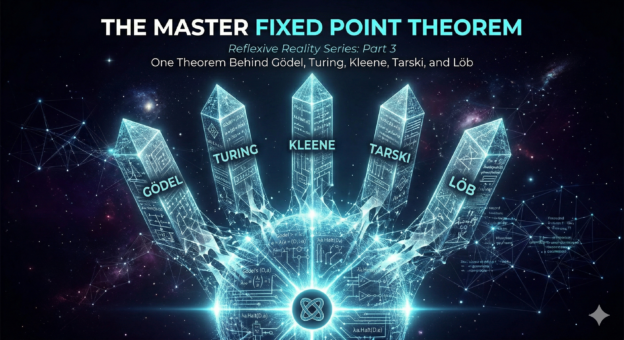
Gödel’s incompleteness, Turing’s halting undecidability, Kleene’s recursion theorem, Tarski’s truth undefinability, and Löb’s reflection theorem are five of the most celebrated results in 20th-century logic and computation. A new machine-checked theorem proves they are all instances of one master fixed-point framework. This is not a metaphor. It is formally proved.
New to this research? This article is part of the Reflexive Reality formal research program — a suite of 93+ machine-checked papers and 17 Lean 4 proof libraries. Brief introduction ↗ · Full research index ↗
Series: Closure Without Exhaustion (4-part) · All research ↗
This is Part 3 of a four-part series on the Reflexive Reality research program.
- Part 1: Physical Incompleteness: The Universe Cannot Contain a Complete Account of Itself
- Part 2: Representational Incompleteness: Why No Self-Model Can Capture Its Own Diagonal
- Part 3: One Theorem Behind Gödel, Turing, Kleene, Tarski, and Löb (this post)
- Part 4: Closure Without Exhaustion: Why Every System That Models Itself Has an Irreducible Remainder
Five Towers, One Foundation
In the 20th century, logic and computation produced a cluster of results that changed how we understand the limits of formal systems and machines.
Gödel (1931): Any sufficiently expressive formal system — like the axioms of arithmetic — contains true statements it cannot prove. Formal derivation cannot capture all mathematical truth.
Turing (1936): No computer program can decide, for every program and every input, whether the program will halt or run forever. The halting problem is undecidable.
Kleene (1952): Every computable function has a fixed point — a self-referential program that produces a specific output determined entirely by the function applied to a description of itself. This recursion theorem underlies everything from compiler design to the foundations of computability.
Tarski (1936): No sufficiently rich language can define its own truth predicate. A formal system cannot contain, within its own language, a predicate that correctly picks out all and only the truths of that language.
Löb (1955): If a formal system can prove “if X is provable then X,” it can prove X outright. This reflection principle places sharp constraints on what self-referential provability claims a system can make.
These five results are taught separately. They appear in different courses — logic, computability theory, philosophy of mathematics, theoretical computer science. The informal sense that they are “related” is widely acknowledged. But the relationship has always remained imprecise, metaphorical, impressionistic.
A new theorem in the Reflexive Reality program settles this. They are not merely related in spirit. They are all machine-checked instances of one master fixed-point theorem. Formally proved. Zero axioms. Zero gaps.
The Master Fixed-Point Theorem
The unification lives in a minimal self-reference interface (SRI) — a precisely defined abstract structure with two properties:
MFP-1 (Fixed points exist). Every function in the representable class has a fixed point: a self-referential program p such that running it produces the same result as applying the function to a description of p itself. This is the constructive side — self-reference is always possible in sufficiently expressive systems.
MFP-2 (No total decider). No total effective procedure can decide membership in any nontrivial extensional predicate on the interface. This is the obstruction side — once self-reference is available, complete decision procedures are ruled out.
The interface is minimal — every primitive in it is required by at least one of the five classical results. Nothing extra is included. The unification is not achieved by inflating the framework until everything fits; it is achieved by finding the exact minimal structure from which everything follows.
Lean anchors: SelfReference.master_fixed_point, SelfReference.no_total_decider
How Each Classical Result Fits
Each of the five classical results arises as an instantiation of MFP-2 — the no-total-decider half of the master theorem — under the appropriate interpretation of the SRI interface.
Gödel’s Incompleteness
The SRI interface is instantiated with the natural numbers, Gödel’s encoding of formulas as numbers, and the provability predicate of the formal system. MFP-1 gives the Gödel sentence — a formula that says of itself “I am not provable.” MFP-2 gives incompleteness: no total effective procedure decides provability for all formulas. The formal system cannot decide its own arithmetic truth.
Turing’s Halting Theorem
The SRI interface is instantiated with Turing machine descriptions and the halting predicate. MFP-1 gives the existence of self-referential programs. MFP-2 gives halting undecidability: no total effective procedure decides halting for all programs on all inputs. The formal proof in nems-lean reduces directly to Mathlib’s machine-checked halting undecidability result — zero custom axioms.
Kleene’s Recursion Theorem
The SRI interface is instantiated with computable functions and their Gödel codes. MFP-1 is exactly the recursion theorem: every computable function on program codes has a fixed-point program. The recursion theorem is the constructive face of the master fixed-point — the affirmative half of MFP-1 in a computational setting.
Tarski’s Truth Undefinability
The SRI interface is instantiated with a sufficiently rich formal language and its semantic truth relation. MFP-1 gives the Liar-style self-referential sentence. MFP-2 gives truth undefinability: no formula in the language can serve as a truth predicate for that language. Syntax cannot define its own semantics.
Löb’s Theorem
The SRI interface is instantiated with provability in a formal system satisfying the Hilbert-Bernays provability conditions. MFP-1 provides the self-referential provability sentences needed for the Löb argument. MFP-2 constrains what the system can prove about its own provability. Löb’s theorem emerges as the specific constraint that self-referential provability claims induce on reflective proof systems.
What the Unification Means
The unification is not a notational convenience or a philosophical observation. It is a formally proved structural claim. Here is what it actually establishes:
A single engine produces all five results. The master fixed-point theorem is not a template loosely applied to five different problems. It is a single formal structure from which each classical result is formally derived as a special case. The derivations are machine-checked.
The interface is minimal. There is no padding. Every primitive of the SRI interface is load-bearing for at least one classical result. This means the unification is tight — the common structure is exactly as large as it needs to be and no larger.
The relationship is not metaphorical. Gödel, Turing, Kleene, Tarski, and Löb are not “similar in spirit” to the master theorem. They formally instantiate it. The formal proofs are available and checkable.
Why This Matters for How We Teach Logic
The five classical results are currently taught in isolation. A student in a logic course learns Gödel. A student in a computability course learns Turing and Kleene. A student in philosophy of language learns Tarski. A student in modal logic learns Löb. They may be told that these results are “related” — that diagonalization is a common technique — but the relationship remains informal.
The master fixed-point theorem changes this. It is now possible to teach all five classical results as instances of one structure. The structure can be presented first — here is the minimal self-reference interface, here is the fixed-point theorem, here is the no-total-decider barrier — and then each classical result is derived as a particular instantiation.
This is not just pedagogically cleaner. It is more informative. A student who understands the master theorem understands not just that these results hold, but why they hold — what structural feature of self-referential systems is responsible for all of them at once.
The classical barriers are not five independent discoveries that happen to share a technique. They are five faces of one structural obstruction, now made explicit and machine-checked.
For the Logician: The Formal Structure
What follows is the precise formal content of the unification. It is self-contained for anyone with a background in mathematical logic or computability theory.
The Self-Reference Interface (SRI)
The unification lives in an abstract interface with two types — semantic objects Obj and syntactic codes Code — and three operations:
- quote : Obj → Code — encodes an object as a code (Gödel numbering)
- run : Code × Code → Obj — evaluates a code on a code (substitution / s-m-n / ASR)
- repr : (Code → Obj) → Code — represents any transformer as a code
The single axiom (repr-spec): run(repr(F), c) ≃ F(c) for all F, c.
In the Gödel instance: Obj = Code = ℕ, run(e,c) = sub(e,c) (substitution), repr = diagonalization. In the Kleene instance: run(e,c) = smn(e,c) (the s-m-n function), repr = universal index. In the NEMS instance: Obj = Prop, Code = ℕ, run(e,c) = RT(enc(e,c)) (record-truth on the encoded pair).
Theorem MFP-1 (Master Fixed-Point Theorem)
For any transformer F : Code → Obj, there exists p : Obj such that p ≃ F(⟦p⟧).
Proof (one step): Let G(c) := F(⟦run(c,c)⟧) and d := repr(G). Set p := run(d, d).
By (repr-spec) at c = d: run(d, d) ≃ G(d) = F(⟦run(d,d)⟧) = F(⟦p⟧).
Therefore p ≃ F(⟦p⟧). ∎
Lean anchor: SelfReference.master_fixed_point · File: SelfReference/Core/FixedPoint.lean
Theorem MFP-2 (Master Diagonal Barrier)
In any CSRI system (congruent SRI with repr defined for all transformers), no extensional nontrivial predicate T : Code → Prop has a total decider.
Proof: Suppose δ is a total decider for T. Define the anti-decider transformer:
F(c) = if δ(c) = 1 then f₀ else t₀
(where T(t₀) = True and T(f₀) = False, which exist by nontriviality). By MFP-1, ∃ d with d ≃ F(d). Since T is extensional: T(d) ↔ T(F(d)).
Case δ(d) = 1: T(d) is True. But F(d) = f₀ and T(f₀) = False. So True ↔ False. Contradiction.
Case δ(d) = 0: T(d) is False. But F(d) = t₀ and T(t₀) = True. So False ↔ True. Contradiction. ∎
Lean anchor: SelfReference.no_total_decider · File: SelfReference/Consequences/DiagonalBarrier.lean
The Five Classical Results as Instances of MFP-1/MFP-2
| Result | Instance of | SRI mapping |
|---|---|---|
| Gödel diagonal lemma | MFP-1 | run = sub (substitution); repr = diagonalization function |
| Kleene recursion theorem | MFP-1 | run = smn; repr = universal program index; requires eval-quote |
| Löb’s theorem | MFP-1 + HBL | MFP-1 gives the Löb sentence; HBL1–3 complete the proof |
| Turing halting undecidability | MFP-2 | T = HALT = {(e,x) : φₑ(x)↓}; SRI = Kleene program system; nontrivial + extensional ⇒ no total computable decider |
| Tarski undefinability | MFP-2 | T = semantic truth; nontrivial + extensional ⇒ no total decider |
| NEMS diagonal barrier | MFP-2 | T = record-truth RT; ASR structure provides repr; reduces to Mathlib halting undecidability |
The Semantic Trichotomy (how NEMS classes map to strata):
- Stratum 0 / NEMS Class I: No repr. Categorical determination. The laws uniquely fix everything; no self-reference is needed.
- Stratum 1 / NEMS Class IIa: repr defined on a restricted subclass. Fixed points exist for representable transformers; MFP-2 does not apply to the full system.
- Stratum 2 / NEMS Class IIb: repr defined universally. MFP-1 holds for every transformer; MFP-2 forces the diagonal barrier. This is where our universe sits.
Lean anchors for the trichotomy: stratum0_no_fixed_point_for_not, stratum1_not_implies_stratum2, stratum2_diagonal_barrier, semantic_trichotomy
Source: A General Self-Reference Calculus (Paper 26) · nems-lean · The proof of MFP-2 reduces ultimately to Mathlib’s Nat.Partrec.Code.fixed_point — zero custom axioms.
The Engine Behind What Comes Next
The master fixed-point theorem is not just a unification of the classical results. It is also the engine behind the capstone theorem of this series — Closure Without Exhaustion.
The capstone theorem takes the same underlying machinery — diagonalization, fixed points, the no-total-decider barrier — and lifts it to a strictly broader target: not formal provability in arithmetic, not halting decidability, not truth definability in a specific language, but the total semantic self-exhaustion of any realized reflexive system. The classical results become special cases of the more general theorem, exactly as the master fixed-point framework predicts.
This is the arc of the series: three independent results (physical incompleteness, representational incompleteness, classical barrier unification), each standing on its own, all converging on the same structural summit.
- Part 1: Physical incompleteness — the universe itself.
- Part 2: Representational incompleteness — any parametric self-model.
- Part 3 (this post): Gödel, Turing, Kleene, Tarski, and Löb — five classical results, one master theorem.
- Part 4: Closure Without Exhaustion — the full theorem that subsumes and unifies all of the above.
The Paper and Proof
Source paper: One Theorem Behind Gödel, Turing, Kleene, Tarski, and Löb — Zenodo (PDF + DOI)
Lean proof library: novaspivack/nems-lean
Full abstract: novaspivack.github.io/research/abstracts ↗
Full research program (93 papers, 17 Lean libraries): novaspivack.com/research ↗