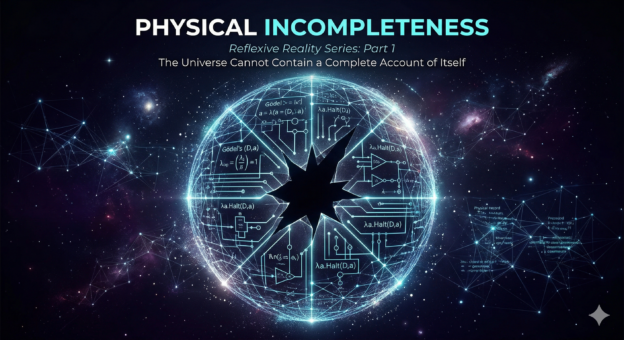
A machine-checked theorem proves that any closed physical universe rich enough to contain computation cannot internally contain a complete algorithmic account of its own record-truth. This is not about the limits of human knowledge. It is a theorem about the architecture of reality.
New to this research? This article is part of the Reflexive Reality formal research program — a suite of 93+ machine-checked papers and 17 Lean 4 proof libraries. Brief introduction ↗ · Full research index ↗
Series: Closure Without Exhaustion (4-part) · All research ↗
This is Part 1 of a four-part series on the Reflexive Reality research program.
- Part 1: Physical Incompleteness: The Universe Cannot Contain a Complete Account of Itself (this post)
- Part 2: Representational Incompleteness: Why No Self-Model Can Capture Its Own Diagonal
- Part 3: One Theorem Behind Gödel, Turing, Kleene, Tarski, and Löb
- Part 4: Closure Without Exhaustion: Why Every System That Models Itself Has an Irreducible Remainder
The Assumption Inside Every Theory of Everything
Physicists have spent a century searching for a Theory of Everything — a single framework from which the laws of nature follow as necessary consequences. String theory, loop quantum gravity, various unification programs: all of them share a background assumption.
The assumption is not just that such a theory might be found. It is that such a theory, once found, would in principle give a complete account of the physical universe from within — that the universe could, in principle, be fully described by a formal structure that lives inside it.
A new theorem in the Reflexive Reality research program — machine-checked in Lean 4 with zero custom axioms — proves that this assumption is false in a precise and structural sense.
The theorem is called Physical Incompleteness. It states:
Any closed physical universe rich enough to contain universal computation lacks a complete algorithmic self-description of all of its record-truth on the diagonal-capable fragment.
This post explains what that means, why it follows from the physics we already accept, and why its implications reach well beyond the search for a Theory of Everything.
What the Theorem Actually Says
Let’s unpack the theorem term by term, because precision matters here.
“Closed physical universe”
A universe with no outside. No external oracle feeding it information, no external selector choosing its laws, no meta-level from which it receives its semantic content. A universe that must be self-contained — its laws, its records, and its descriptions all arise from within. This is the minimal reasonable assumption about the universe we actually live in.
“Rich enough to contain universal computation”
This means the universe contains computers — physical processes that can simulate any other physical process. This is not a speculation. We know our universe satisfies this: the computers you are reading this on, the neurons in the brains that designed them, the molecular machines in every living cell — all are implementations of universal computation. This premise is physically settled.
“Complete algorithmic self-description of its record-truth”
This is the key term. A record is a stable physical fact — a macroscopic trace that distinguishes outcomes. Record-truth is the totality of facts about which physical records obtained and what they say. An algorithmic self-description is an internal procedure — something running inside the universe — that can decide, for any given record-claim, whether it is true or false. Complete means it gets every one right, with no abstentions.
The theorem says: no such procedure exists inside a universe like ours.
“On the diagonal-capable fragment”
The theorem does not claim every self-description is impossible. It says the impossibility holds on the fragment of record-claims that can be self-referentially encoded — claims that can refer back to the computational processes deciding them. This is the fragment where the diagonal construction applies. It is large, and it is the fragment that matters for any serious notion of completeness.
The Proof: Two Steps, Zero Custom Axioms
The proof is short once the setup is in place, which is what makes it so sharp.
Step 1. Suppose a complete algorithmic self-description exists inside the universe — a total effective procedure D that decides all record-truth on the diagonal-capable fragment.
Step 2. Because the universe contains universal computation, D can be applied to claims about its own behavior — including the claim “D halts on input X.” A total effective procedure that decides all record-truth on the diagonal-capable fragment would, in particular, decide its own halting behavior on all inputs. But this is exactly what Turing’s halting theorem forbids: no total effective procedure decides halting in full generality for all inputs.
Contradiction. The complete algorithmic self-description does not exist.
The formal version of this proof — in nems-lean — reduces directly to Mathlib’s machine-checked proof of halting undecidability. Not a custom construction. The standard library of formal mathematics. Zero custom axioms.
Lean anchor: NemS.physical_incompleteness
How Is This Different from Gödel?
This is the first question a logician will ask, and it deserves a direct answer.
Gödel’s incompleteness theorems are about formal proof systems. They say that any sufficiently expressive formal system — a system of axioms and rules for deriving theorems — cannot prove all truths about arithmetic. There are true sentences in the language of the system that the system cannot derive. This is a result about what a symbolic calculus can prove.
Physical incompleteness is about something different. It is not about what a formal system can prove. It is about what a physical process inside a universe can decide about that universe’s own record-facts. The target is not a symbolic calculus. It is the physical universe understood as a realized, self-contained system.
Put plainly: Gödel’s theorem is about the limits of formal derivation. Physical incompleteness is about the limits of what the universe can know about itself from within.
They are related in engine — both use diagonal construction — but they are different in scope and target. Physical incompleteness applies to any universe containing computation. It does not require formalizing physics in arithmetic. It does not assume any particular theory of physics. It holds as long as the universe is closed and contains computers.
What This Means for the Theory of Everything
The quest for a Theory of Everything is not undermined by this result. A physical theory that correctly describes the laws governing all physical processes is a real and achievable goal. The theorem says nothing against that.
What it says is that such a theory — even if perfect — would not be a complete internal semantic account of all the universe’s record-truth. There is a gap between two things we often run together:
- A physical theory that governs all processes — a set of laws from which all physical events follow.
- A complete internal account of all record-facts — a procedure inside the universe that decides all truths about what physically happened.
The first may be achievable. The second is structurally forbidden. A Theory of Everything, no matter how correct and complete as a theory of laws, cannot be a total effective decider for all record-truth on the diagonal-capable fragment.
This is not a reason for despair about fundamental physics. It is a precise boundary condition — a structural fact about what physics as a self-contained enterprise can and cannot achieve. Knowing the boundary is more useful than not knowing it.
The Universe Cannot Swallow Itself Whole
There is a deeper way to read this result. A closed universe — one with no outside — must generate everything from within: its laws, its structures, its records, and any descriptions of those records. Physical incompleteness says that when it tries to turn this generative capacity back on itself — when it tries to build a complete internal account of its own record-facts — it hits a structural ceiling.
The universe can model vast parts of itself. It can run physics experiments, build computers, construct increasingly accurate self-models, and certify large fragments of its own behavior. What it cannot do is complete the self-model — close the account, reach a point where the internal description is total and exact on all record-truth.
Something always remains outside the completed picture. Not because the universe is hiding something. Not because our instruments are insufficient. Because the architecture of self-description in a closed system, when applied to its own record-truth on the diagonal-capable fragment, runs into the same structural obstruction that Turing found in 1936 — now applied to the universe itself.
The universe, in a precise and provable sense, cannot swallow itself whole.
Part of a Larger Architecture
Physical incompleteness is one face of a broader theorem — Closure Without Exhaustion — which proves that no sufficiently expressive reflexive system can internally exhaust its own realized semantics. The physical corollary is what that theorem implies when the reflexive system in question is the physical universe.
The full series develops this structure:
- Part 1 (this post): Physical incompleteness — the universe itself.
- Part 2: Representational incompleteness — any system that parametrically models itself.
- Part 3: The unification — Gödel, Turing, Kleene, Tarski, and Löb as special cases of one master fixed-point theorem.
- Part 4: The capstone — Closure Without Exhaustion, the full theorem with all corollaries.
The Paper and Proof
Source paper: Physical Incompleteness — Zenodo (PDF + DOI)
Lean proof library: novaspivack/nems-lean
Full abstract: novaspivack.github.io/research/abstracts ↗
Full research program (93 papers, 17 Lean libraries): novaspivack.com/research ↗