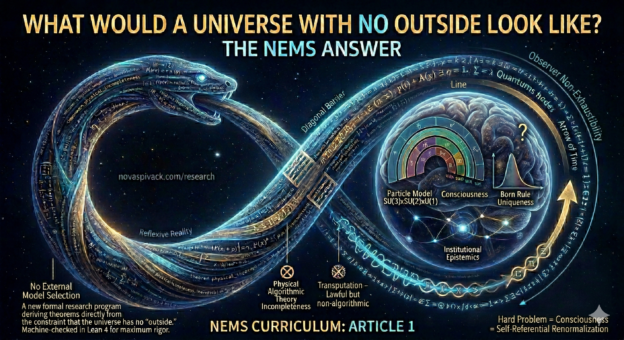
There is a question so basic that physics has never seriously tried to answer it: why does the universe have the laws it has rather than some other laws? A new formal framework — No External Model Selection, or NEMS — takes this question seriously and derives theorems from it. The results reach from quantum mechanics to consciousness to the nature of time.
New to this research? This is Article 1 of the NEMS Curriculum series — an introduction to the Reflexive Reality formal research program. Program overview ↗ · Full research index ↗
Series: What Is NEMS? (Introductory) · 1. What Is NEMS? · 2. The Classification of Universes · 3. The NEMS Proverbs
A Question Physics Has Avoided
When physicists write down the Standard Model of particle physics, they write down a set of equations. Those equations describe the behavior of everything we have ever observed. They are, by any measure, the most precisely verified theory in the history of science.
But those equations contain numbers. The fine-structure constant. The mass of the electron. The coupling strengths of the three fundamental forces. Nineteen parameters in total, each measured from experiment, none derived from anything more fundamental. And the equations themselves — why these equations? Why electromagnetism and not something else? Why three generations of quarks and leptons rather than two or four?
The standard answer is: these are the laws of nature. That is just what the universe is like.
This answer is not wrong. But it is not an explanation. It says: the laws are the laws because they are the laws. The question — why these laws? — has been quietly set aside as unanswerable, or relegated to speculation about multiverses and anthropic reasoning.
A new formal framework takes this question seriously and derives theorems from it. The framework is called No External Model Selection, or NEMS. It begins from a single constraint, uses machine-checked formal logic to derive its consequences, and arrives at results that reach from quantum mechanics to black holes to consciousness to the nature of time.
The Core Idea: No Outside
The constraint that NEMS begins from is simple to state: the universe has no outside.
There is no external vantage point from which the universe’s laws could be chosen. No lab outside spacetime running simulations and selecting which version of physics gets actualized. No God setting the fine-structure constant after consulting a menu of options. No mathematical Platonic realm from which the laws are selected by some unnamed process. The universe is all there is — and if it is all there is, then whatever explains why it is the way it is must come from within.
The technical term for this requirement is Perfect Self-Containment, or PSC. A universe is perfectly self-contained if it does not rely on anything outside itself to determine its own structure, select among candidate realizations of its laws, or compute the consequences of those laws.
This sounds obvious — of course the universe has no outside. But taking it seriously as a formal constraint, and deriving what must follow from it, turns out to be enormously productive. NEMS is the formal development of what PSC implies.
What “outside” means, precisely
When physicists write down a physical theory, they specify: the field content (what kinds of particles and fields exist), the symmetries (which transformations leave the laws unchanged), the dynamics (equations of motion), and usually some initial conditions. All of these together determine, in principle, what the universe does.
But several things are not determined by the theory itself:
- The values of the coupling constants — why is the fine-structure constant 1/137 and not 1/100?
- The choice among observationally equivalent realizations — when multiple different detailed configurations of the universe are consistent with the same observations, which one is actual?
- The initial conditions — what set the Big Bang going the way it did?
These are places where something external is implicitly doing the work — choosing, selecting, fixing. NEMS formalizes this precisely: any place where a theory requires something from outside itself to complete its description is a place where it relies on an external model selector. And PSC forbids external model selectors.
This yields the foundational question: what must a theory look like if it genuinely bears the burden of its own completeness from within?
The Selector Audit: Who Is Doing the Choosing?
The NEMS framework formalizes the question with what might be called a selector audit. For any candidate physical theory, the audit asks: is every load-bearing physical difference — every difference that actually affects what happens — explained by the theory’s own internal resources? Or does it require something from outside?
The formal tool for this is the no-free-bits principle (Paper 27). A “free bit” is a load-bearing difference that the theory cannot account for internally — a choice that is fixed but has no internal explanation. PSC forbids free bits: every difference that matters must have an internal account.
This reframes what underdetermination means. In the old way of speaking: “the theory leaves a choice open.” In the NEMS way of speaking: “something is making that choice — what is it, and is it inside the theory or outside it?”
The shift sounds subtle but has severe consequences. In many physics proposals — string landscape and multiverse scenarios, cosmological measures, vacuum selection principles, coarse-graining rules — something external is quietly doing work that the theory itself doesn’t do. NEMS makes this visible as a structural failure, not just an aesthetic problem.
The Diagonal Barrier: What Self-Containing Systems Cannot Do
Once we take PSC seriously, a second structural consequence emerges — and this one is counterintuitive. A universe that is self-contained contains computers. Those computers can model and reason about the universe. This means the universe is, in a precise technical sense, diagonal-capable: it can represent itself and reason about its own descriptions.
This leads directly to the diagonal barrier.
Here is the argument. Suppose a closed universe had a total algorithmic theory of everything — a single computable procedure that, given any physical question about the universe, outputs the correct answer. Now consider the question: “Does this procedure output ‘no’ when asked about itself?” If it outputs “yes,” it should output “no.” If it outputs “no,” it should output “yes.” Contradiction — the same structure as Gödel’s incompleteness theorem and Turing’s halting problem. No total computable procedure can decide all physically meaningful questions in a closed universe containing universal computers.
This is the Physical Incompleteness theorem (Paper 11), machine-checked in Lean 4 with zero custom axioms. It is not a philosophical argument. It is a formal theorem with a proof that anyone can verify.
But notice what this means: the universe’s internal laws cannot be a total algorithm. Not because physics is incomplete or we don’t know enough — but because of what it means for the universe to be self-contained and contain computers. The “chooser” built into the universe’s operation cannot be an algorithm. It must be something else.
That something else is what NEMS calls transputation — lawful but non-algorithmic internal adjudication. Not random. Not predetermined. A third mode that the traditional determinism/randomness debate had no room for.
What NEMS Is For
NEMS serves four distinct roles, and it’s worth being clear about each.
1. A universal diagonal calculus
The diagonal barrier — the fundamental limit on self-describing systems — appears in multiple guises across mathematics, logic, and computer science. Gödel’s incompleteness theorems. Turing’s halting problem. Kleene’s recursion theorem. Tarski’s truth undefinability. Löb’s reflection theorem.
These are usually taught as separate results. NEMS proves they are all instances of a single underlying structure — the Master Fixed-Point Theorem (Paper 26, machine-checked). The NEMS framework provides a General Self-Reference Calculus that unifies all of them under one formal interface. Every instance is a specialization of the same diagonal construction applied to different representability classes.
2. A completeness logic
Paper 50 builds a Stratified Certification Logic — a formal calculus for what can be certified at each level of the selector-strength hierarchy. The calculus is proved sound, complete, and maximally complete: any extension would violate the barrier. This gives a precise formal tool for auditing claims about self-certification, governance, and verification architectures.
3. Applications across domains
The abstract diagonal machinery applies wherever systems certify claims about themselves or each other. This covers AI safety (no total self-certifier), institutions and governance (no universal final judge, k-role lower bound), scientific communities (diversity necessary for improvement), and epistemic agents of all kinds. The theorems are formal; the applications are machine-checked bridges from the abstract framework to each domain.
4. Physics instantiation
In physics, PSC becomes a sieve on the space of possible fundamental theories. Which gauge groups are closure-compatible? Which probability rules are forced? What does the arrow of time follow from? NEMS applies the formal machinery to these questions and derives machine-checked results: the Standard Model gauge group is the unique survivor of the PSC sieve in four-dimensional renormalizable gauge theory; the Born rule is the unique closure-compatible probability assignment; the arrow of time follows structurally from stable records and the no-overwrite requirement.
What NEMS Is Not
It is worth being precise about what NEMS does not claim.
It is not a derivation of physics from pure logic. Physics is an instantiation of the general framework — the framework is applied to the specific domain of gauge quantum field theory, and real physics provides the premises. The results are conditional on those premises, which are themselves physically motivated.
It does not claim that PSC is obviously true. The claim is conditional: if the universe is perfectly self-contained, then these results follow. Whether PSC is true of our universe is a question the theorems cannot settle on their own — but they can tell us exactly what would follow if it is, and what specific premises would need to be denied to escape each conclusion.
That said, the conditional is extraordinarily powerful evidence. PSC is a single premise. From it alone, the program derives: the Standard Model gauge group (forced as the unique survivor of the closure sieve on 4D gauge theories), the Born rule (forced as the unique closure-compatible probability assignment), the arrow of time, and a suite of constraints on black holes, time travel, and holography. These are not vague qualitative predictions — they are the specific, quantitatively precise structures our universe actually has. This is the first framework in the history of physics that produces all of these from a single foundational principle. That is at minimum striking, and arguably constitutes abductive evidence of considerable weight that the premise is correct.
What happens if you reject PSC? The program answers this exhaustively. Paper 79 proves that foundational viability and closure-compatibility are equivalent — not merely correlated but formally biconditional. A universe that rejects PSC is a universe that is not foundationally viable: it requires something outside itself to complete its own description. Paper 23 (Foundational Finality) proves that any such external explanation falls into exactly one of three forced outcomes: it violates self-containment (and so doesn’t escape the problem), it is physically redundant (adds nothing to any observable), or it is isomorphic to the original universe (just a re-labeling). The classification cascade (Papers 79–80) then shows that relaxing PSC progressively opens the admissible universe class — but everything that gets let back in is either foundationally incomplete, requires an unexplained external selector, or collapses into infinite regress. None of these alternatives produce a universe like ours without importing exactly what they were supposed to explain.
So the honest statement is: NEMS does not claim to have proved PSC from nothing. It claims that (1) from PSC alone you get our universe’s specific physics, and (2) rejecting PSC leads to frameworks that are either foundationally incomplete, empirically inert, or infinitely regressive. The conditional and its exhaustive analysis of alternatives together make a case that is considerably stronger than either alone.
It is not philosophy dressed in equations. Every load-bearing claim is machine-checked in Lean 4 with zero custom axioms and zero unproved gaps. The proofs can be verified by any reader with a computer. The formal anchors are public and auditable.
What the Program Produces
The NEMS program comprises 93 papers organized into four arcs, all machine-verified in Lean 4.
The core spine (Papers 01–51) establishes the general diagonal calculus, the physics instantiation through gauge theory and quantum mechanics, and applications to agency, institutions, and epistemology. The reflexive-closure arc (Papers 52–70) extends the program through formal theories of consciousness, qualia, awareness, and an ontological proof for the existence of a necessary pre-categorial ground (Alpha). The extended programs (Papers 71–85) cover viable continuation, transputation, phenomenology, and the classification cascade for cosmological possibility. The portal and synthesis papers (Papers 86–92) provide audience-specific entry points for physicists, formal theorists, philosophers, and AI researchers.
All results are machine-checked. Zero custom axioms. Zero unproved gaps on the primary theorem chains.
Why It Matters
The question NEMS starts from — what must be true of a universe that has no outside? — is not new. It underlies centuries of philosophy and decades of theoretical physics. What is new is that we now have formal, machine-checked answers.
The Standard Model gauge group is not arbitrary. The Born rule is not a postulate. Time has a direction not because entropy happens to increase but because records are stable and closure forbids overwriting them. No AI system can be its own complete auditor. No institution can be the universal final judge. These are not arguments — they are theorems, proved with the same rigor as the Pythagorean theorem.
The universe, properly understood, carries its own explanatory burden. What follows from taking that seriously is what this program spends 93 papers developing.
What Comes Next
This is the first article in the NEMS Curriculum series. The next two articles in this series develop the foundational picture further:
- Article 2 — The Classification of Universes: NEMS classifies all possible foundational theories into four classes. Our universe falls into a specific class — the one where an internal adjudicator is both necessary and non-algorithmic. What this means and how the classification cascade works.
- Article 3 — The NEMS Proverbs: The program has generated dozens of structural laws that read like proverbs — precise, memorable, and applicable far beyond physics. “No free determinacy.” “Fundamentality is internal completion.” “A system cannot be its own universal judge.” Each one is a theorem.
The Papers and Proof
Suite overview: Overview of the NEMS Framework (Paper 00) — Zenodo
Core formal framework: The NEMS Framework: No External Model Selection as a Principle of Foundational Self-Containment (Paper 01) — Zenodo
Lean proof library: novaspivack/nems-lean — build with lake update && lake exe cache get && lake build
Full abstracts: novaspivack.github.io/research/abstracts ↗
Full research program (93 papers, 17 Lean libraries): novaspivack.com/research ↗