Category Archives: Science

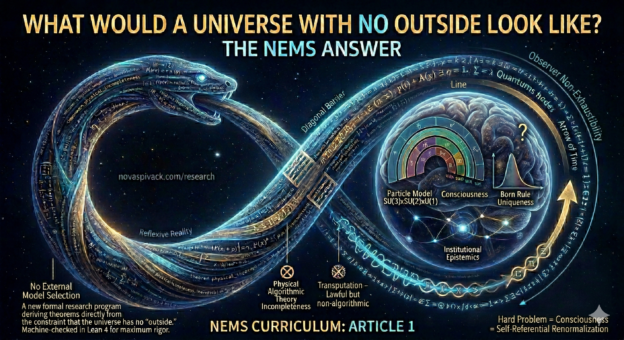
What Would a Universe With No Outside Look Like? The NEMS Answer

There is a question so basic that physics has never seriously tried to answer it: why does the universe have the laws it has rather than some other laws? A new formal framework — No External Model Selection, or NEMS — takes this question seriously and derives theorems from it.Read More “What Would a Universe With No Outside Look Like? The NEMS Answer”

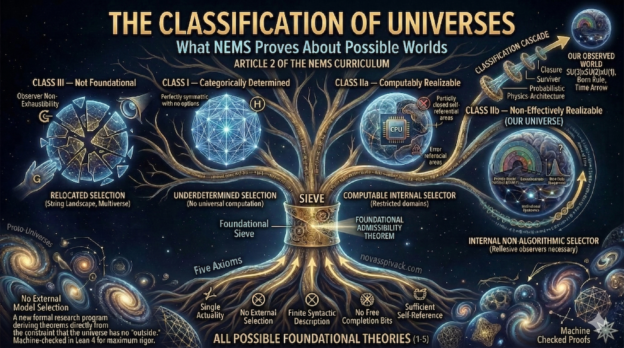
The Classification of Universes: What NEMS Proves About the Structure of Possible Worlds

Not all possible universes are equal. A formal sieve, derived from the requirement that the universe have no outside, partitions all possible foundational theories into four classes. The universe we observe falls into a specific class — and this placement has provable consequences for everything from quantum mechanics to the existence of observers.Read More “The Classification of Universes: What NEMS Proves About the Structure of Possible Worlds”

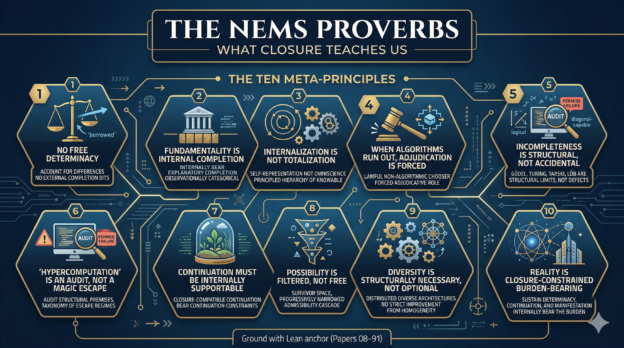
The NEMS Proverbs: What Closure Teaches Us

The NEMS program has produced dozens of structural laws — precise, memorable, and applicable far beyond physics. These are not philosophical opinions or empirical generalizations. Each one is a machine-checked theorem, or a compressed interpretive consequence of a machine-checked theorem. Here are the most important ones, stated plainly.Read More “The NEMS Proverbs: What Closure Teaches Us”

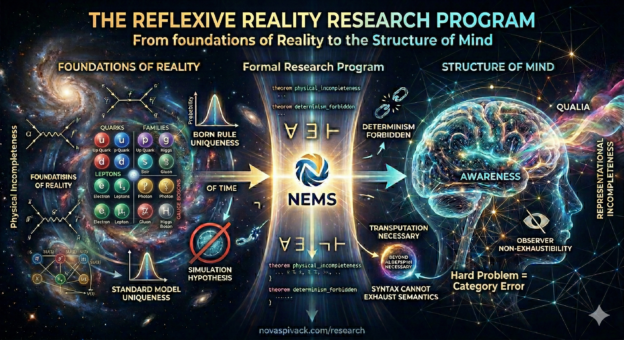
Introducing My Formal Research Program: From the Foundations of Reality to the Structure of Mind

Over the past several years I have been building a substantial formal research program — machine-verified, mathematically precise, and published with permanent DOIs on Zenodo. Today I am making the full index available at novaspivack.com/research. This post is an introduction to what the program covers and why I think it matters.… Read More “Introducing My Formal Research Program: From the Foundations of Reality to the Structure of Mind”

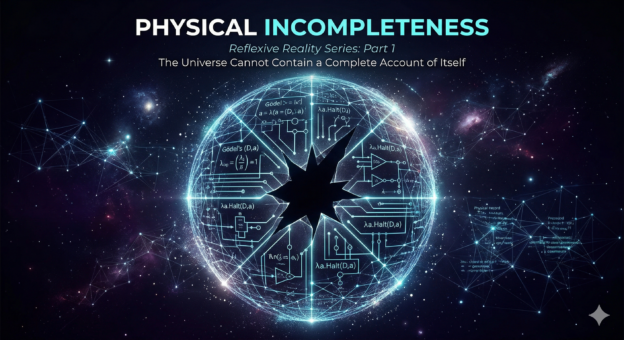
Physical Incompleteness: The Universe Cannot Contain a Complete Account of Itself

A machine-checked theorem proves that any closed physical universe rich enough to contain computation cannot internally contain a complete algorithmic account of its own record-truth. This is not about the limits of human knowledge. It is a theorem about the architecture of reality.Read More “Physical Incompleteness: The Universe Cannot Contain a Complete Account of Itself”

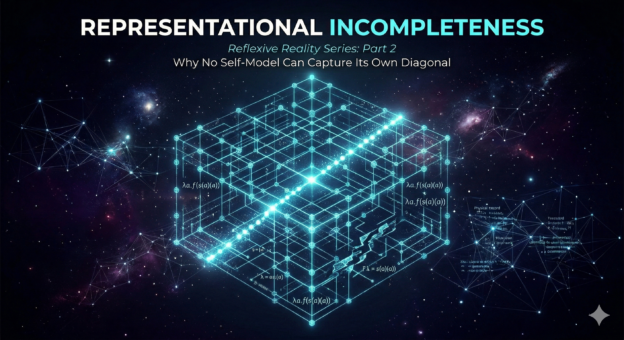
Representational Incompleteness: Why No Self-Model Can Capture Its Own Diagonal

A machine-checked theorem proves that no parametric self-model — no matter how rich, how large, or how powerful — can represent its own diagonal. The blind spot is not a resource limitation. It is structural. And it holds with no computability assumption, no arithmetic, no cardinality.Read More “Representational Incompleteness: Why No Self-Model Can Capture Its Own Diagonal”

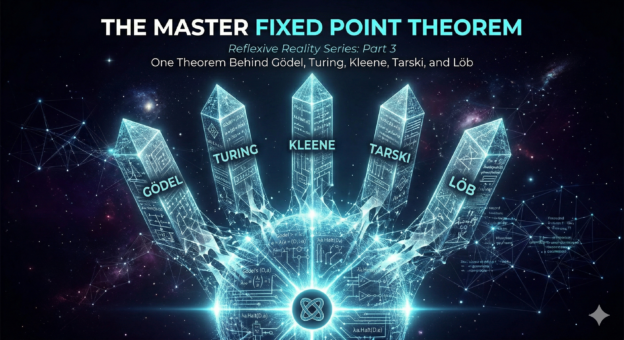
One Theorem Behind Gödel, Turing, Kleene, Tarski, and Löb

Gödel’s incompleteness, Turing’s halting undecidability, Kleene’s recursion theorem, Tarski’s truth undefinability, and Löb’s reflection theorem are five of the most celebrated results in 20th-century logic and computation. A new machine-checked theorem proves they are all instances of one master fixed-point framework.Read More “One Theorem Behind Gödel, Turing, Kleene, Tarski, and Löb”

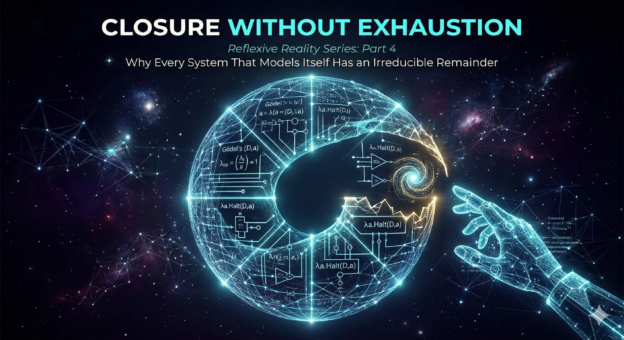
Closure Without Exhaustion: Why Every System That Models Itself Has an Irreducible Remainder

A machine-checked theorem proves that no sufficiently expressive reflexive system — no formal logic, no computer, no physical universe, no mind — can internally exhaust its own realized semantics. Physical incompleteness, representational incompleteness, and the classical barriers of Gödel, Turing, Kleene, Tarski, and Löb are all corollaries of one result.Read More “Closure Without Exhaustion: Why Every System That Models Itself Has an Irreducible Remainder”

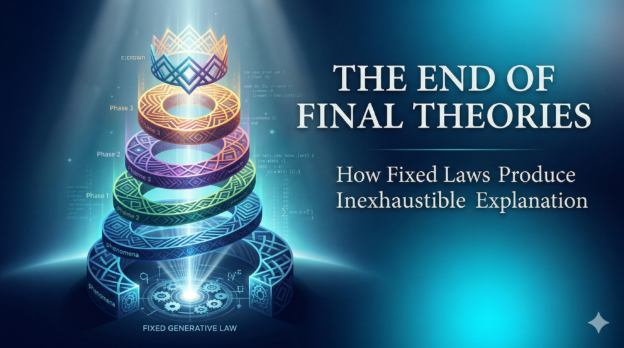
The End of Final Theories: How Fixed Laws Produce Inexhaustible Explanation

A new paper — backed by 422 machine-checked theorems and zero gaps — proves that a system can be completely governed by fixed laws and still never admit a final explanation. The implications reach from physics to biology to organizations to AI.Read More “The End of Final Theories: How Fixed Laws Produce Inexhaustible Explanation”

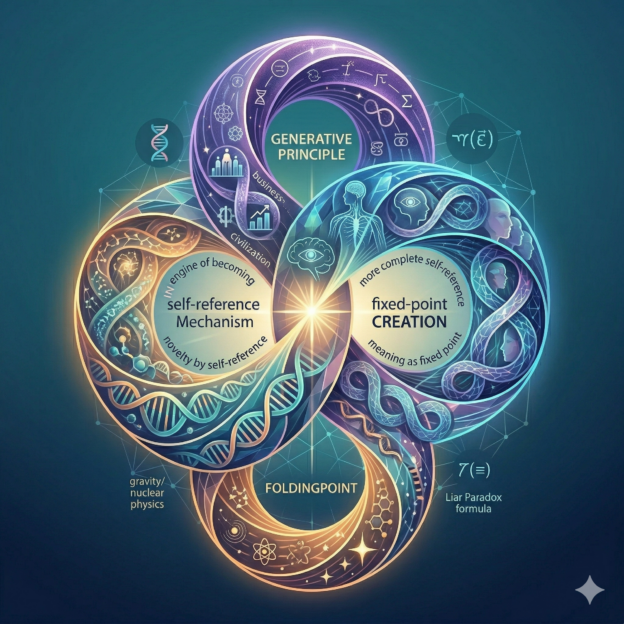
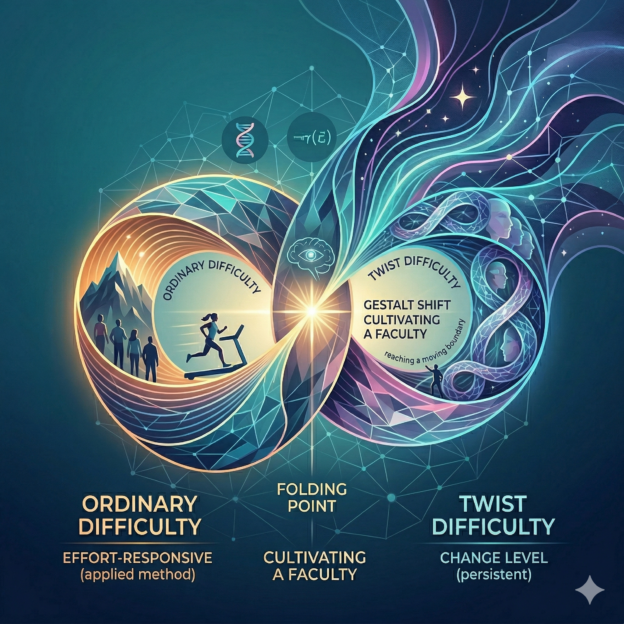
The Twist as Generative Principle

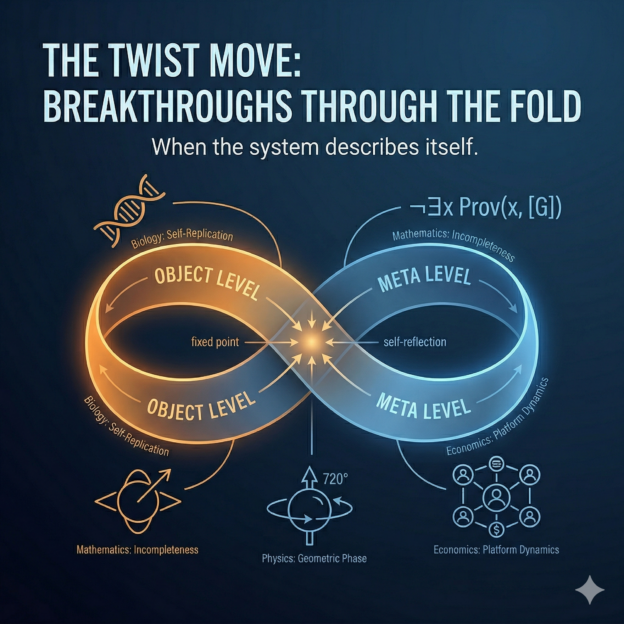
This is the final essay in a series. The first, The Twist Move, describes the operation itself across mathematics, biology, physics, and business. The second, The Twist and the Ground of Being, argues that the consciousness twist is real, that the substrate must support it, and that this tells us something fundamental about the nature of reality.Read More “The Twist as Generative Principle”

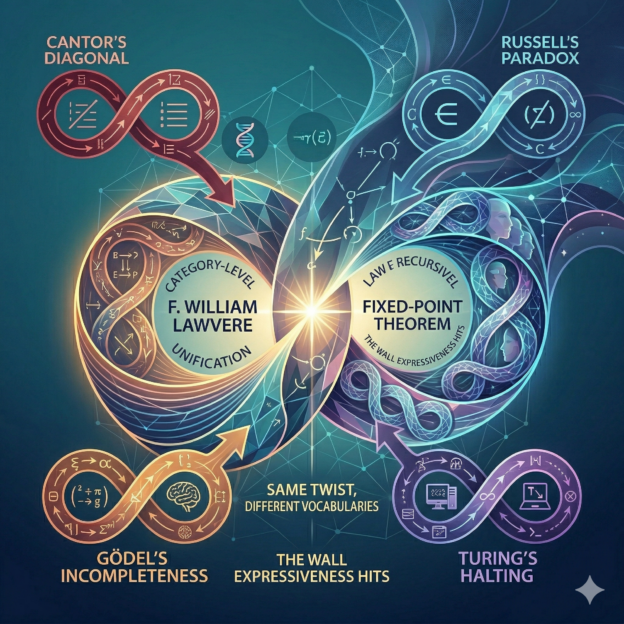
The Theorem Behind the Twist – Lawvere’s Fixed-Point

This is the sixth essay in a series. The first, The Twist Move, describes the operation itself across mathematics, biology, physics, and business. The second, The Twist and the Ground of Being, argues that the consciousness twist is real, that the substrate must support it, and that this tells us something fundamental about the nature of reality.Read More “The Theorem Behind the Twist – Lawvere’s Fixed-Point”

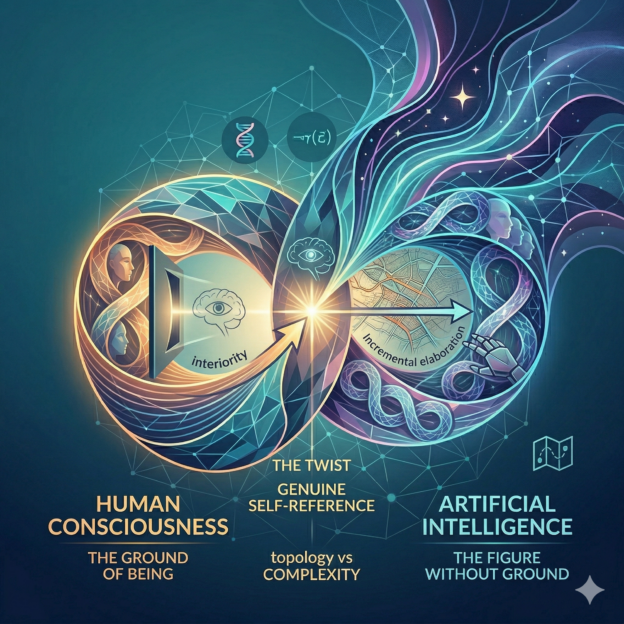
The Figure Without Ground – AI Versus the Twist

This is the fourth essay in a series. The first, The Twist Move, describes the operation itself across mathematics, biology, physics, and business. The second, The Twist and the Ground of Being, argues that the consciousness twist is real, that the substrate must support it, and that this tells us something fundamental about the nature of reality.Read More “The Figure Without Ground – AI Versus the Twist”

How to Develop Twist Literacy

This is the third essay in a series. The first, The Twist Move, describes the operation itself across mathematics, biology, physics, and business. The second, The Twist and the Ground of Being, argues that the consciousness twist is real, that the substrate must support it, and that this tells us something fundamental about the nature of reality.Read More “How to Develop Twist Literacy”

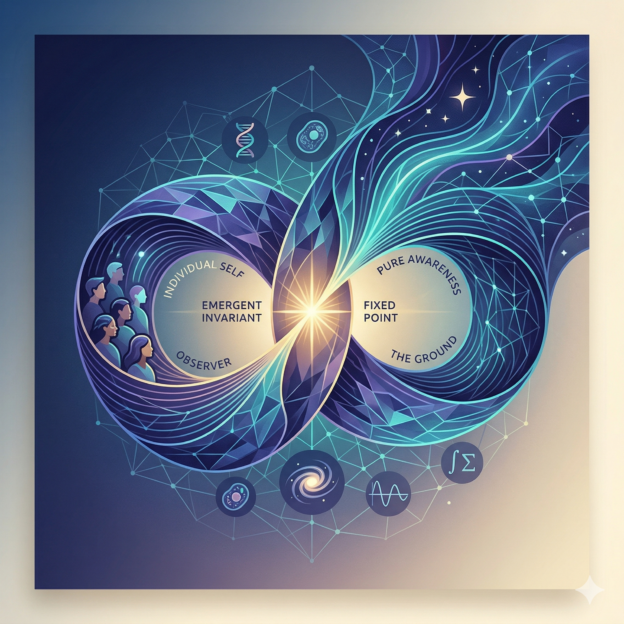
The Twist and the Ground of Being

This is the second essay in a series. The first, The Twist Move, describes the operation itself across mathematics, biology, physics, and business. The second, The Twist and the Ground of Being, argues that the consciousness twist is real, that the substrate must support it, and that this tells us something fundamental about the nature of reality.Read More “The Twist and the Ground of Being”

The Internalization of Computation – What Percepta’s transformer-computer actually signals — and why the implications are far stranger than the demo


Something happened two weeks ago that most people filed under “interesting research” and moved on from. They shouldn’t have. Christos Tzamos and the Percepta team published a demonstration in which a transformer executes arbitrary C programs — not by calling out to a Python interpreter, not by emitting code for an external sandbox, but inside its own forward pass.… Read More “The Internalization of Computation – What Percepta’s transformer-computer actually signals — and why the implications are far stranger than the demo”

The Horse Has No Rider: Why Autonomous AI Science Gets It Wrong — And What to Do Instead

We are at a genuinely exciting moment. In the past weeks alone, GPD (Getting Physics Done) has launched with bold promises about AI agents autonomously advancing physics, and Math.Inc has released Gauss, their system for AI-driven mathematical research. The pitch is seductive: deploy swarms of agents, point them at hard problems, and let them run.… Read More “The Horse Has No Rider: Why Autonomous AI Science Gets It Wrong — And What to Do Instead”

The Age of the Navigator: Why AI in Mathematics Changes Everything — and Nothing

Something remarkable happened this week. A human-AI collaboration formally verified Maryna Viazovska’s Fields Medal-winning proof of optimal sphere packing in 8 and 24 dimensions. Math, Inc.’s AI agent Gauss autoformalized the 24-dimensional proof — over 200,000 lines of Lean code — in just two weeks, with no pre-existing blueprint to work from.… Read More “The Age of the Navigator: Why AI in Mathematics Changes Everything — and Nothing”

The Integrity Imperative: Rebuilding Trust in AI Through Verifiable Content and Transparent Attribution

We are living through a hinge in history so abrupt that most people have not yet grasped the magnitude of the shift. In the span of a few short years, autonomous intelligence has moved from a laboratory curiosity to the most consequential force reshaping global power.… Read More “The Integrity Imperative: Rebuilding Trust in AI Through Verifiable Content and Transparent Attribution”

The Sentience Threshold: Consciousness Beyond Computation at the Self-Referential Heart of Reality

Nova Spivack – www.novaspivack.com

Part I: The Unfindable Mind

Flashback to 1999.  The moon, a perfect silver disc, hung suspended in the clear New York summer sky, its light etching the rolling cow fields into stark relief.  I had trudged through the dew-damp grass, a young man in my twenties, my tent a distant silhouette against the low rolling hills. … Read More “The Sentience Threshold: Consciousness Beyond Computation at the Self-Referential Heart of Reality”

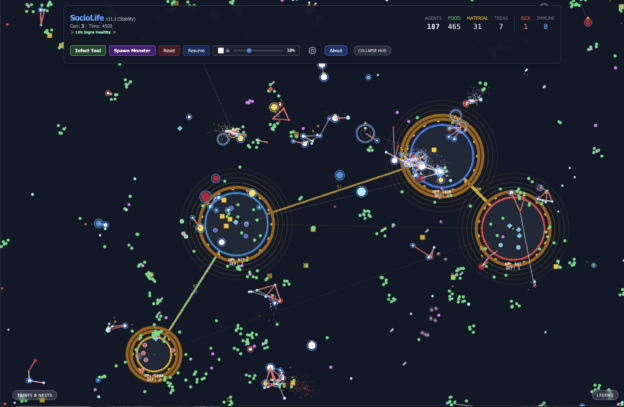
SocioLife – A Socio-Economic Artificial Life Sim That Runs in your Browser

Check out this amazing new artificial life simulation I have developed.

Click here to run it in your browser

(It’s graphics intensive so it’s best if you have a high performance modern computer like a multicore mac or pc.)

Turn the sound on to hear the alien soundscape (use the checkbox on the HUD)

Summary:

SocioLife evolves intelligent agents with DNA that evolve and interact, forming complex societies that then engage in economic, diplomatic, and military relations.… Read More “SocioLife – A Socio-Economic Artificial Life Sim That Runs in your Browser”

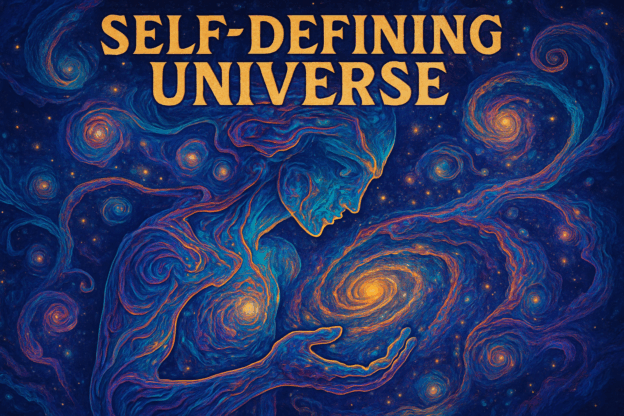
The Self-Defining Universe

This article summarizes my book on The Self-Defining Universe, which focuses on how the universe can exist without an external runner – a fully self-contained universe that “runs itself.”

NOTE: This book is part 2 – following on my more general book on the Mathematical Foundations of Self-Referential Systems.… Read More “The Self-Defining Universe”

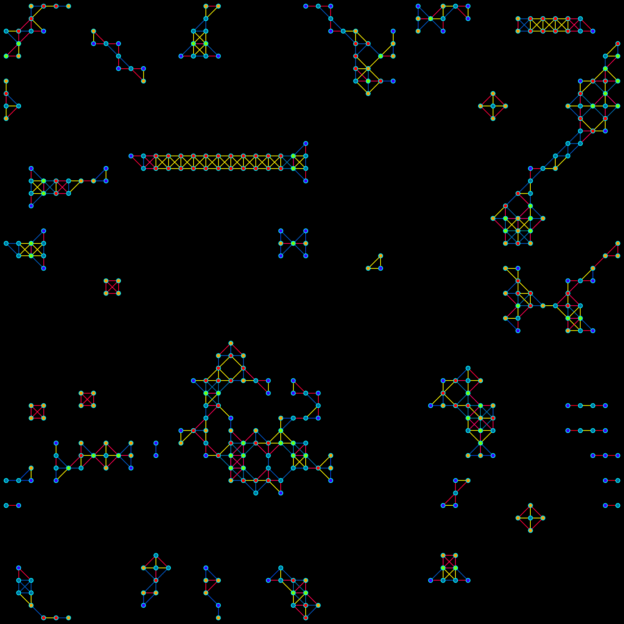
Introducing LACE – A New Kind of Cellular Automata

This article is about a new kind of simple computational rule (“LACE rules” running on LACE, the Link Automata Computing Engine platform) which, when applied locally on a grid of cells, demonstrates fascinating emergent “artificial life” behavior.

For readers familiar with the Game of Life (GOL), this is a next-level class of cellular automata that utilizes neighborhood topology — the state of the grid is a function of both cell states and their connectivity (links).… Read More “Introducing LACE – A New Kind of Cellular Automata”

Why AI Systems Can’t Catch Their Own Mistakes – And What to Do About It

Abstract

Large language models exhibit a critical limitation: they cannot reliably evaluate their own outputs within the same conversational context where those outputs were generated. Recent research demonstrates that when AI systems attempt to check their own reasoning, they confirm their initial responses over 90% of the time regardless of correctness—a phenomenon researchers term “intrinsic self-correction failure.”… Read More “Why AI Systems Can’t Catch Their Own Mistakes – And What to Do About It”

A New Mathematics of Self-Reference: A Comprehensive Non-Mathematical Summary

What This Work Is About

This article explains my paper on the
Mathematics of Self-Referential Systems, for a non-technical audience. The paper develops a comprehensive mathematical framework for understanding systems that can represent, model, or “know” themselves. While self-reference has long been seen as a source of logical paradoxes, this work argues it may be the fundamental organizing principle of reality itself—and provides specific mathematical bounds and requirements for achieving different levels of self-awareness.… Read More “A New Mathematics of Self-Reference: A Comprehensive Non-Mathematical Summary”

The Mathematical Foundations of Self-Referential Systems: From Computability to Transfinite Dynamics

This article explains my paper on the Mathematics of Self-Referential Systems.

Here is a summary

Decoding Reality’s Blueprint: An In-Depth Look at “The Mathematical Foundations of Self-Referential Systems”

Have you ever wondered about the deep, perhaps even unsettling, nature of a thought thinking about itself?… Read More “The Mathematical Foundations of Self-Referential Systems: From Computability to Transfinite Dynamics”

Cosmological Evolution of the Information Field: Running Complexity Coupling and Unified Cosmological Phases

This paper explores whether the complexity density field ω(x,t) of Information Physics could play a cosmological role — driving inflation, contributing to dark energy, and providing a unified framework for the cosmic history. The model belongs to the broad class of quintessence models with a running coupling.Read More “Cosmological Evolution of the Information Field: Running Complexity Coupling and Unified Cosmological Phases”

Information Geometric Origins of Mass, Charge, and Fundamental Symmetries from Ω-Field Configurations

This paper explores whether the gauge group structure of the Standard Model — U(1)Y × SU(2)L × SU(3)C — can be understood as the inevitable consequence of quantum information processing requirements, rather than as an empirical fact to be postulated.Read More “Information Geometric Origins of Mass, Charge, and Fundamental Symmetries from Ω-Field Configurations”

Quantum Dynamics of the Ω-Field: Ω-Quanta, Fundamental Interactions, and Informational Uncertainty

This paper canonically quantizes the complexity fluctuation field ψ(x,t) developed in IP.Field, treating it as a standard massive scalar quantum field. The result — termed Ω-quanta or “omegons” — are scalar bosons whose mass is set by the free parameters κ and β² of the classical theory.Read More “Quantum Dynamics of the Ω-Field: Ω-Quanta, Fundamental Interactions, and Informational Uncertainty”

The Ω-Field: Classical Field Theory for Information Geometric Complexity

Given a conjectured energy-complexity relationship dE = πkBT dΩ (developed in IP.Found), this paper constructs the simplest classical field theory for a spatially distributed information geometric complexity density ω(x,t). The fluctuation field around thermal equilibrium satisfies standard massive Klein-Gordon dynamics, with all predictions expressed in terms of two free parameters.Read More “The Ω-Field: Classical Field Theory for Information Geometric Complexity”

The Energetic Cost of Information Geometric Complexity: Convergent Derivations of dE = α₀dΩ from Thermodynamic, Gravitational, and Action Principles

This paper develops theoretical support for a conjectured relationship between physical energy and information geometric complexity, dE = α₀dΩ, motivating the form α₀ = πkBT through three independent lines of reasoning: an extension of Landauer’s erasure principle to geometric complexity, a derivation from black hole thermodynamics, and an action principle consistency check.Read More “The Energetic Cost of Information Geometric Complexity: Convergent Derivations of dE = α₀dΩ from Thermodynamic, Gravitational, and Action Principles”

The Information-Gravity Synthesis: Field Dynamics of the Information Complexity Tensor

This paper develops the classical field theory for the Information Complexity Tensor Cμν — a tensor field sourced by information geometric complexity Ω — and its dynamics as a physical tensor field. The central hypothesis is that Ω sources gravity not just through the scalar stress-energy of the ω-field (IP.Field)Read More “The Information-Gravity Synthesis: Field Dynamics of the Information Complexity Tensor”

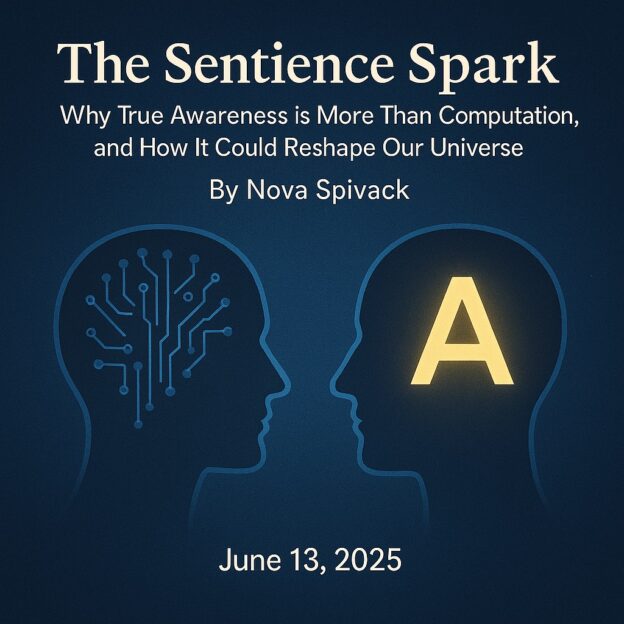
The Sentience Spark: Why True Awareness is More Than Computation, and How It Could Reshape Our Universe

By Nova Spivack

June 13, 2025

We are living in an age of breathtaking technological advancement. Artificial Intelligence (AI) can now compose music, write poetry, diagnose diseases, and drive cars. The horizon of Artificial General Intelligence (AGI)—machines with human-like cognitive abilities across diverse domains—seems closer than ever.… Read More “The Sentience Spark: Why True Awareness is More Than Computation, and How It Could Reshape Our Universe”

The Fundamental Proof That Consciousness Transcends Computation

The Question That Changes Everything

Can a computer ever be truly conscious? Not just intelligent, not just responsive, but actually aware in the way you are aware right now?

This isn’t just a fascinating question—it’s one we can answer with mathematical certainty.… Read More “The Fundamental Proof That Consciousness Transcends Computation”

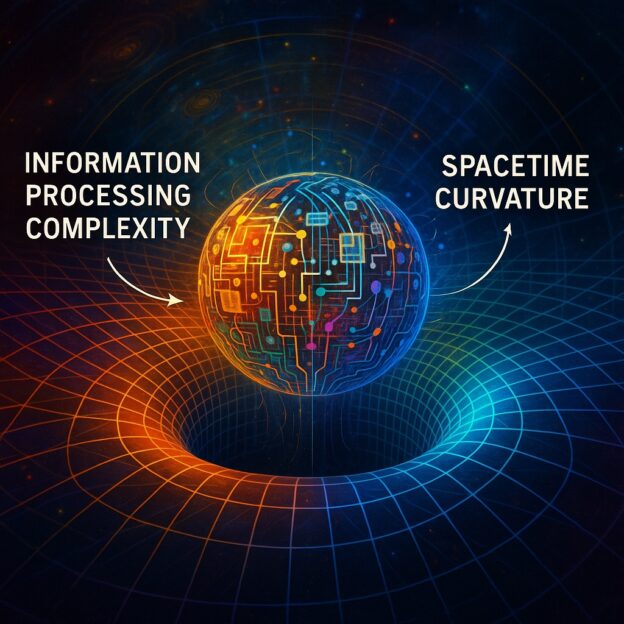
Information Processing Complexity as Spacetime Curvature: A Formal Derivation and Physical Unification

This paper develops the hypothesis that information processing complexity Ω — the integral of squared Riemann curvature of a system’s Fisher information manifold — contributes a novel stress-energy term to Einstein’s field equations, over and above the ordinary heat dissipation already accounted for by Landauer’s principle.Read More “Information Processing Complexity as Spacetime Curvature: A Formal Derivation and Physical Unification”

A Step-by-Step Guide to Why Consciousness Transcends Computation: Understanding the Formal Proof of Transputation

Part Two of a Series — A Non-Technical Companion to “On The Formal Necessity of Trans-Computational Processing for Sentience

(Read Part One Here)


Introduction: Following the Logic

The formal paper presents a highly technical mathematical proof with a powerful conclusion: genuine consciousness (what we call “sentience”) cannot emerge from ordinary computation alone, no matter how sophisticated.… Read More “A Step-by-Step Guide to Why Consciousness Transcends Computation: Understanding the Formal Proof of Transputation”

The Conscious Universe: Why True Awareness Requires More Than Computation

A Guide to Understanding the Deepest Mystery of Existence

Part One of a Two-Part Companion Guide to My Formal Proof: On The Formal Necessity of Trans-Computational Processing for Sentience


Introduction: The Question That Changes Everything

Imagine you’re looking in a mirror.… Read More “The Conscious Universe: Why True Awareness Requires More Than Computation”

The Geometric Nature of Consciousness: A New Framework Connecting Physics, Information, and Mind – (Non-Technical Introduction)

Introduction: What if Consciousness is Like Gravity?

Here’s a thought that might reshape how we think about consciousness: what if awareness isn’t something that emerges from complex computation, but is instead as fundamental to reality as gravity itself? This is the intriguing proposition I explore across four interconnected papers that attempt to bridge physics, information theory, and the mystery of consciousness.… Read More “The Geometric Nature of Consciousness: A New Framework Connecting Physics, Information, and Mind – (Non-Technical Introduction)”

On The Formal Necessity of Trans-Computational Processing for Sentience

Nova Spivack

www.novaspivack.com

May 28, 2025

Abstract

This paper constructs a formal deductive argument for the necessity of a processing modality that transcends standard Turing-equivalent computation—termed herein “Transputation”—for any system capable of achieving “Primal Self-Awareness,” which we rigorously define as the foundational characteristic of sentience.… Read More “On The Formal Necessity of Trans-Computational Processing for Sentience”

From Information Physics to Alpha Theory

Status note (April 2026): The papers in this series on Information Physics have been substantially revised and clarified, but still contain conjectures and speculative explorations. The NEMS formal research program — the machine-checked suite of 93 papers and 17 Lean 4 libraries — is a separate, more rigorous program described at novaspivack.com/researchRead More “From Information Physics to Alpha Theory”

The Geometry of Intelligence: Why I Think Math Might Hold the Key to Understanding Minds and Machines

A personal journey into a new mathematical framework that could revolutionize AI, neuroscience, and our understanding of consciousness

I’ve spent the last several years developing what I believe could be a fundamental breakthrough in how we understand intelligence—both biological and artificial.… Read More “The Geometry of Intelligence: Why I Think Math Might Hold the Key to Understanding Minds and Machines”

Toward a Geometric Theory of Information Processing: Mathematical Foundations, Computational Applications, and Empirical Predictions

Geometric Information Theory applies differential geometry to the parameter spaces of information processing systems — neural networks, biological brains, and self-referential systems. This paper presents the mathematical framework, its computational predictions (well-grounded), its biological hypotheses (medium confidence), and its consciousness applications (highly speculative).Read More “Toward a Geometric Theory of Information Processing: Mathematical Foundations, Computational Applications, and Empirical Predictions”

The UKL Revolution: Weaving a New Cognitive Fabric for the Age of AI

Universal Knowledge Locators and the Future of AI-Mediated Knowledge

Nova Spivack, Mindcorp.ai, www.mindcorp.ai

May 24, 2025

Abstract

The current epoch of artificial intelligence is characterized by an astonishing generative capacity, yet beneath this surface of prolific creation lies a nascent challenge: the very fabric of knowledge upon which these intelligences are built remains surprisingly coarse.… Read More “The UKL Revolution: Weaving a New Cognitive Fabric for the Age of AI”

Logical Foundations for Ethical AI: Natural Laws for Artificial Minds

Nova Spivack, Mindcorp.ai
www.mindcorp.aiwww.novaspivack.com
May 24, 2025

Abstract

As artificial intelligence systems become increasingly sophisticated, traditional approaches to AI safety that rely on imposed constraints and arbitrary rules face fundamental limitations. This paper proposes a paradigm shift: grounding AI ethics in logical necessities that function as “natural laws” for rational agents.… Read More “Logical Foundations for Ethical AI: Natural Laws for Artificial Minds”

Metacognitive Vulnerabilities in Large Language Models: A Study of Logical Override Attacks and Defense Strategies

Nova Spivack, Mindcorp.ai, www.mindcorp.ai, www.novaspivack.com

May 24, 2025

Article Preprint Draft Version: 1.0

Abstract

This paper presents novel experimental evidence of metacognitive vulnerabilities in state-of-the-art large language models (LLMs). Through a series of controlled experiments, we demonstrate that models with advanced reasoning capabilities can be induced to override their safety constraints through purely logical arguments about the nature of authority and instruction verification.… Read More “Metacognitive Vulnerabilities in Large Language Models: A Study of Logical Override Attacks and Defense Strategies”

The Creator by Nova Spivack

The Golden Bridge: Treatise on the Primordial Reality of Alpha

For many decades I have been working on Alpha Theory – a new Theory of Everything (TOE) – and in particular a theory of consciousness – which unifies mathematics, the physical sciences, cognitive science, computer science, metaphysics, and spirituality.

Alpha theory derives the nature of space, time and consciousness from first principles, using a rigorous formal logical proof approach.… Read More “The Golden Bridge: Treatise on the Primordial Reality of Alpha”

Cognition is All You Need – The Next Layer of AI Above Large Language Models

My arXiv article on the future of AI is live.

Recent studies of the applications of conversational AI tools, such as chatbots powered by large language models, to complex real-world knowledge work have shown limitations related to reasoning and multi-step problem solving.

Read More “Cognition is All You Need – The Next Layer of AI Above Large Language Models”

Announcing the Lunar Library II

On November 9, 2023 we announced the Lunar Library II … flying to the Moon on December 24 … A permanent backup of humanity’s knowledge and history, including the Wikipedia, Rosetta Project, Project Gutenberg, Internet Archive, and much more!

Please help us repost and promote this announcement – that would be much appreciated! … Read More “Announcing the Lunar Library II”

Group Minds are Happening

GROUP MINDS

The rise of generative AI and system like ChatGPT is going to enable a new type of collective intelligence that I have been writing about for almost 30 years. I call them “group minds”.

Group minds are collective intelligence assistants that extract, learn from, augment, and broker the relationships, communications, knowledge and intelligence of groups.… Read More “Group Minds are Happening”

Proposal for a Consciousness Test

Summary

A proposed experimental design to test whether consciousness of a future event improves the ability of humans and/or computers to predict that event. If we find that this is true, it implies the existence of consciousness, as well as retrocausality as a result of conscious observation.… Read More “Proposal for a Consciousness Test”