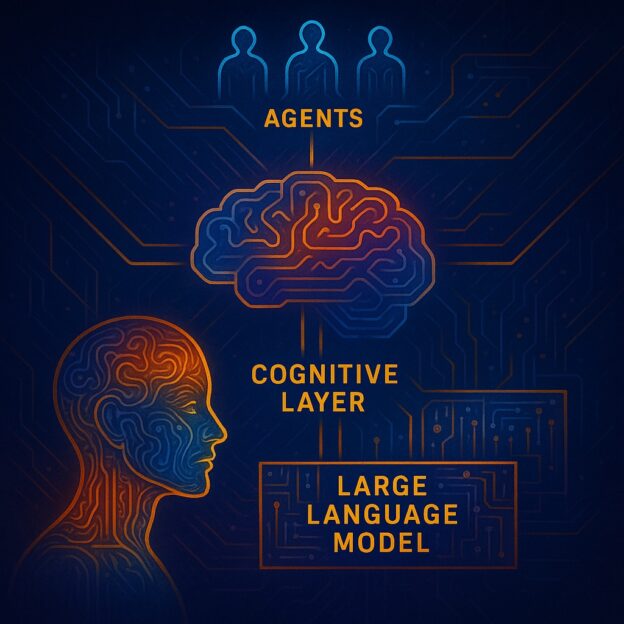
Cognition is All You Need – The Next Layer of AI Above Large Language Models

My arXiv article on the future of AI is live.

Recent studies of the applications of conversational AI tools, such as chatbots powered by large language models, to complex real-world knowledge work have shown limitations related to reasoning and multi-step problem solving. Specifically, while existing chatbots simulate shallow reasoning and understanding they are prone to errors as problem complexity increases. The failure of these systems to address complex knowledge work is due to the fact that they do not perform any actual cognition. In this position paper, we present Cognitive AI, a higher-level framework for implementing programmatically defined neuro-symbolic cognition above and outside of large language models. Specifically, we propose a dual-layer functional architecture for Cognitive AI that serves as a roadmap for AI systems that can perform complex multi-step knowledge work. We propose that Cognitive AI is a necessary precursor for the evolution of higher forms of AI, such as AGI, and specifically claim that AGI cannot be achieved by probabilistic approaches on their own. We conclude with a discussion of the implications for large language models, adoption cycles in AI, and commercial Cognitive AI development.

See the article here: https://arxiv.org/abs/2403.02164

This entry was posted in AI, Best Articles, Business, Cognitive Science, Computer Science, Metacognition, Mindcorp, Philosophy of Mind, Science and tagged , , , , , , on by .

About Nova Spivack

A prolific inventor, noted futurist, computer scientist, and technology pioneer, Nova was one of the earliest Web pioneers and helped to build many leading ventures including EarthWeb, The Daily Dot, Klout, and SRI’s venture incubator that launched Siri. Nova flew to the edge of space in 1999 as one of the first space tourists, and was an early space angel-investor. As co-founder and chairman of the nonprofit charity, the Arch Mission Foundation, he leads an international effort to backup planet Earth, with a series of “planetary backup” installations around the solar system. In 2024, he landed his second Lunar Library, on the Moon – comprising a 30 million page archive of human knowledge, including the Wikipedia and a library of books and other cultural archives, etched with nanotechnology into nickel plates that last billions of years. Nova is also highly active on the cutting-edges of AI, consciousness studies, computer science and physics, authoring a number of groundbreaking new theoretical and mathematical frameworks. He has a strong humanitarian focus and works with a wide range of humanitarian projects, NGOs, and teams working to apply technology to improve the human condition.