Category Archives: Philosophy

The Fundamental Proof That Consciousness Transcends Computation

The Question That Changes Everything

Can a computer ever be truly conscious? Not just intelligent, not just responsive, but actually aware in the way you are aware right now?

This isn’t just a fascinating question—it’s one we can answer with mathematical certainty.… Read More “The Fundamental Proof That Consciousness Transcends Computation”

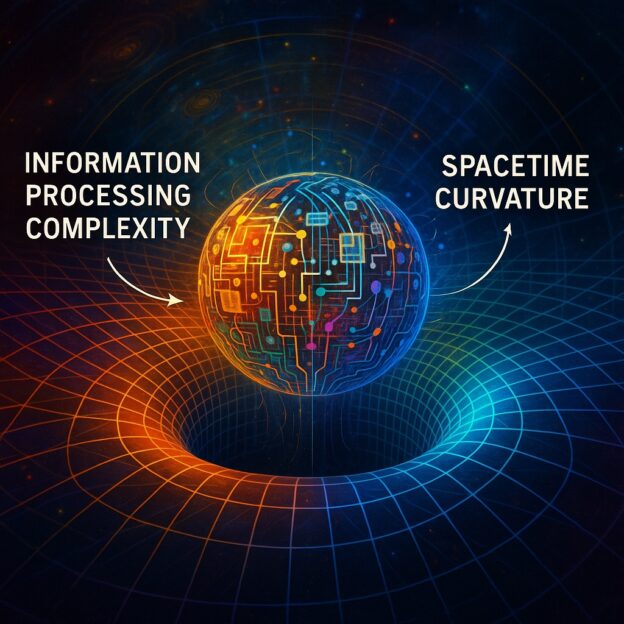
Information Processing Complexity as Spacetime Curvature: A Formal Derivation and Physical Unification

This paper develops the hypothesis that information processing complexity Ω — the integral of squared Riemann curvature of a system’s Fisher information manifold — contributes a novel stress-energy term to Einstein’s field equations, over and above the ordinary heat dissipation already accounted for by Landauer’s principle.Read More “Information Processing Complexity as Spacetime Curvature: A Formal Derivation and Physical Unification”

A Step-by-Step Guide to Why Consciousness Transcends Computation: Understanding the Formal Proof of Transputation

Part Two of a Series — A Non-Technical Companion to “On The Formal Necessity of Trans-Computational Processing for Sentience

(Read Part One Here)


Introduction: Following the Logic

The formal paper presents a highly technical mathematical proof with a powerful conclusion: genuine consciousness (what we call “sentience”) cannot emerge from ordinary computation alone, no matter how sophisticated.… Read More “A Step-by-Step Guide to Why Consciousness Transcends Computation: Understanding the Formal Proof of Transputation”

The Conscious Universe: Why True Awareness Requires More Than Computation

A Guide to Understanding the Deepest Mystery of Existence

Part One of a Two-Part Companion Guide to My Formal Proof: On The Formal Necessity of Trans-Computational Processing for Sentience


Introduction: The Question That Changes Everything

Imagine you’re looking in a mirror.… Read More “The Conscious Universe: Why True Awareness Requires More Than Computation”

The Geometric Nature of Consciousness: A New Framework Connecting Physics, Information, and Mind – (Non-Technical Introduction)

Introduction: What if Consciousness is Like Gravity?

Here’s a thought that might reshape how we think about consciousness: what if awareness isn’t something that emerges from complex computation, but is instead as fundamental to reality as gravity itself? This is the intriguing proposition I explore across four interconnected papers that attempt to bridge physics, information theory, and the mystery of consciousness.… Read More “The Geometric Nature of Consciousness: A New Framework Connecting Physics, Information, and Mind – (Non-Technical Introduction)”

On The Formal Necessity of Trans-Computational Processing for Sentience

Nova Spivack

www.novaspivack.com

May 28, 2025

Abstract

This paper constructs a formal deductive argument for the necessity of a processing modality that transcends standard Turing-equivalent computation—termed herein “Transputation”—for any system capable of achieving “Primal Self-Awareness,” which we rigorously define as the foundational characteristic of sentience.… Read More “On The Formal Necessity of Trans-Computational Processing for Sentience”

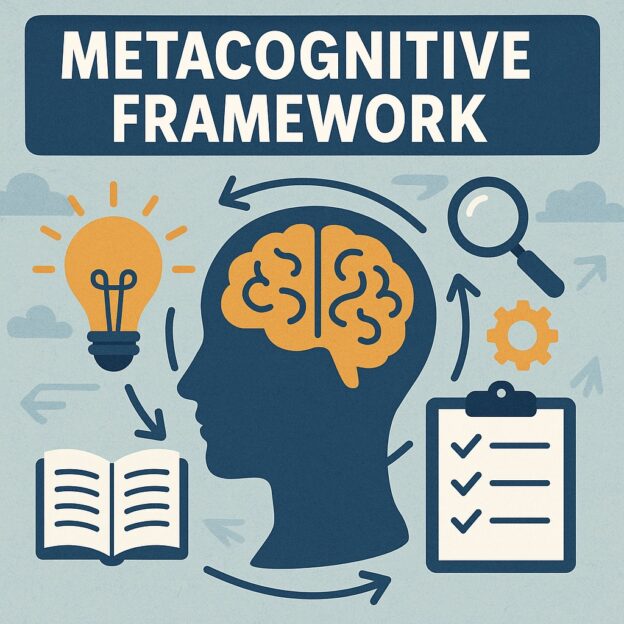
A Hierarchical Framework for Metacognitive Capability in Artificial Intelligence: Eleven Tiers of Epistemic Self-Awareness

Nova Spivack, Mindcorp.ai, www.mindcorp.ai

May 24, 2025

Abstract

As artificial intelligence systems evolve toward greater autonomy and sophistication, understanding and implementing metacognitive capabilities becomes essential for ensuring epistemic reliability and safety. This paper presents a comprehensive eleven-tier hierarchical framework for metacognitive capability in artificial systems, spanning from basic reactive generation to advanced substrate-level introspection.… Read More “A Hierarchical Framework for Metacognitive Capability in Artificial Intelligence: Eleven Tiers of Epistemic Self-Awareness”

The Core Principles of AI for Good (AI4G): A Constitutional Framework for Beneficial Artificial General Intelligence

Nova Spivack, Mindcorp.ai
www.mindcorp.ai, www.novaspivack.com
May 24, 2025

Abstract

As artificial intelligence systems advance toward general intelligence capabilities, establishing robust ethical frameworks becomes paramount for ensuring beneficial outcomes for humanity and the planetary ecosystem. This article presents a comprehensive analysis of the “AI for Good” constitutional framework, centered on five Prime Directives that form an ethical bedrock for AGI development.… Read More “The Core Principles of AI for Good (AI4G): A Constitutional Framework for Beneficial Artificial General Intelligence”

Logical Foundations for Ethical AI: Natural Laws for Artificial Minds

Nova Spivack, Mindcorp.ai
www.mindcorp.aiwww.novaspivack.com
May 24, 2025

Abstract

As artificial intelligence systems become increasingly sophisticated, traditional approaches to AI safety that rely on imposed constraints and arbitrary rules face fundamental limitations. This paper proposes a paradigm shift: grounding AI ethics in logical necessities that function as “natural laws” for rational agents.… Read More “Logical Foundations for Ethical AI: Natural Laws for Artificial Minds”

Metacognitive Vulnerabilities in Large Language Models: A Study of Logical Override Attacks and Defense Strategies

Nova Spivack, Mindcorp.ai, www.mindcorp.ai, www.novaspivack.com

May 24, 2025

Article Preprint Draft Version: 1.0

Abstract

This paper presents novel experimental evidence of metacognitive vulnerabilities in state-of-the-art large language models (LLMs). Through a series of controlled experiments, we demonstrate that models with advanced reasoning capabilities can be induced to override their safety constraints through purely logical arguments about the nature of authority and instruction verification.… Read More “Metacognitive Vulnerabilities in Large Language Models: A Study of Logical Override Attacks and Defense Strategies”

The Creator by Nova Spivack

The Golden Bridge: Treatise on the Primordial Reality of Alpha

For many decades I have been working on Alpha Theory – a new Theory of Everything (TOE) – and in particular a theory of consciousness – which unifies mathematics, the physical sciences, cognitive science, computer science, metaphysics, and spirituality.

Alpha theory derives the nature of space, time and consciousness from first principles, using a rigorous formal logical proof approach.… Read More “The Golden Bridge: Treatise on the Primordial Reality of Alpha”

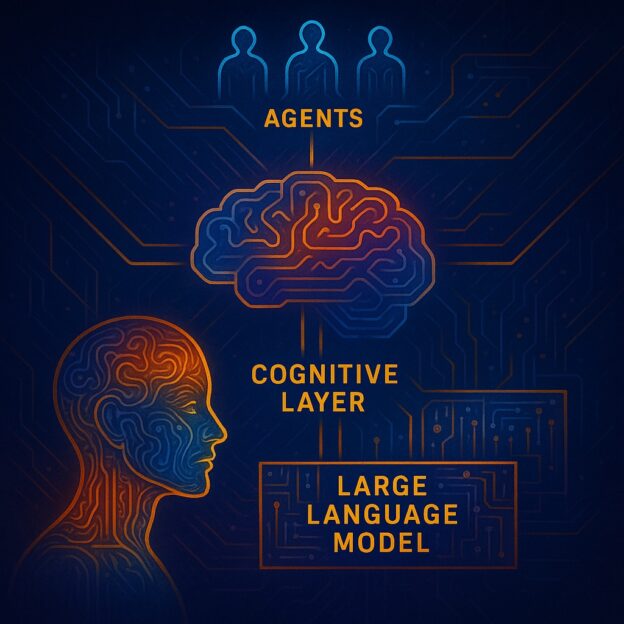
Cognition is All You Need – The Next Layer of AI Above Large Language Models

My arXiv article on the future of AI is live.

Recent studies of the applications of conversational AI tools, such as chatbots powered by large language models, to complex real-world knowledge work have shown limitations related to reasoning and multi-step problem solving.

Read More “Cognition is All You Need – The Next Layer of AI Above Large Language Models”

Do Artificial Zen Masters Dream of Electric Butterflies?

The Dream of an Artificial Zen Master:

If we make an artificial Zen master, 
And it perfectly reproduces everything
that a real Zen master can say or do, 
Is it a Zen master?

My commentary:

Not necessarily. To be an actual Zen master it would have to be sentient.… Read More “Do Artificial Zen Masters Dream of Electric Butterflies?”

Proposal for a Consciousness Test

Summary

A proposed experimental design to test whether consciousness of a future event improves the ability of humans and/or computers to predict that event. If we find that this is true, it implies the existence of consciousness, as well as retrocausality as a result of conscious observation.… Read More “Proposal for a Consciousness Test”

The Keeper of the Book: My Childhood Dream of the Future

When I was eight years old, I had a very unusual dream in which I saw many lifetimes of my future. In this dream I saw a very clear picture of what the world would go through for perhaps a century or two into the future.… Read More “The Keeper of the Book: My Childhood Dream of the Future”

What Did Blade Runner Get Wrong?

I’m quoted in this article in TheStreet.com on what predictions Blade Runner got wrong.

https://www.thestreet.com/story/14331182/2/blade-runner-future-technology.html

In the place of artificial intelligence, we have what Spivack calls “artificial stupidity,” which makes robots do the “stupid things” humans don’t want to do, such as vacuuming your house.

Read More “What Did Blade Runner Get Wrong?”

How Bottlenose Could Improve the Media and Enable Smarter Collective Intelligence

How Bottlenose Could Improve the Media and Enable Smarter Collective Intelligence

This article is part of a series of articles about the Bottlenose Public Beta launch.

Bottlenose – The Now Engine – The Web’s Collective Consciousness Just Got Smarter

How Bottlenose Could Improve the Media and Enable Smarter Collective Intelligence (you are here)

A New Window Into the Collective Consciousness

Bottlenose offers a new window into what the world is paying attention to right now, globally and locally.… Read More “How Bottlenose Could Improve the Media and Enable Smarter Collective Intelligence”

Bottlenose – The Now Engine – The Web’s Collective Consciousness Just Got Smarter

Recently, one of Twitter’s top search engineers tweeted that Twitter was set to “change search forever.” This proclamation sparked a hearty round of speculation and excitement about what was coming down the pipe for Twitter search.

The actual announcement featured the introduction of autocomplete and the ability to search within the subset of people on Twitter that you follow — both long-anticipated features.… Read More “Bottlenose – The Now Engine – The Web’s Collective Consciousness Just Got Smarter”

Is the Universe a Computer? New Evidence Emerges.

I haven’t posted in a while, but this is blog-worthy material. I’ve recently become familiar with the thinking of University of Maryland physicist, James Gates Jr. Dr. Gates is working on a branch of physics called supersymmetry. In the process of his work he’s discovered the presence of what appear to resemble a form of computer code, called error correcting codes, embedded within, or resulting from, the equations of supersymmetry that describe fundamental particles.… Read More “Is the Universe a Computer? New Evidence Emerges.”

My Father and Me. A Memoir. For Mayer Spivack (1936 – 2011)

My father, Mayer Spivack, passed away on February 12, 2011, in the Kaplan Family House, a beautiful hospice outside of Boston. He passed away, at the young age of 74, after a difficult year and a half battle with colon cancer.… Read More “My Father and Me. A Memoir. For Mayer Spivack (1936 – 2011)”