This is the sixth essay in a series. The first, The Twist Move, describes the operation itself across mathematics, biology, physics, and business. The second, The Twist and the Ground of Being, argues that the consciousness twist is real, that the substrate must support it, and that this tells us something fundamental about the nature of reality. The third, How to Develop Twist Literacy, addresses the practical cultivation of the capacity. The fourth, The Figure Without Ground, examines why AI can extend but not replace the twist. The fifth addresses the pathology of the Twist-Resistant Organization. The sixth piece, The Theorem Behind the Twist – Lawvere’s Fixed-Point, shows that the deepest paradoxes of logic are all the same mathematical result. The final essay, The Twist as Generative Principle, argues that this operation is not just an intellectual tool, but the fundamental engine by which the universe generates complexity, life, and meaning.
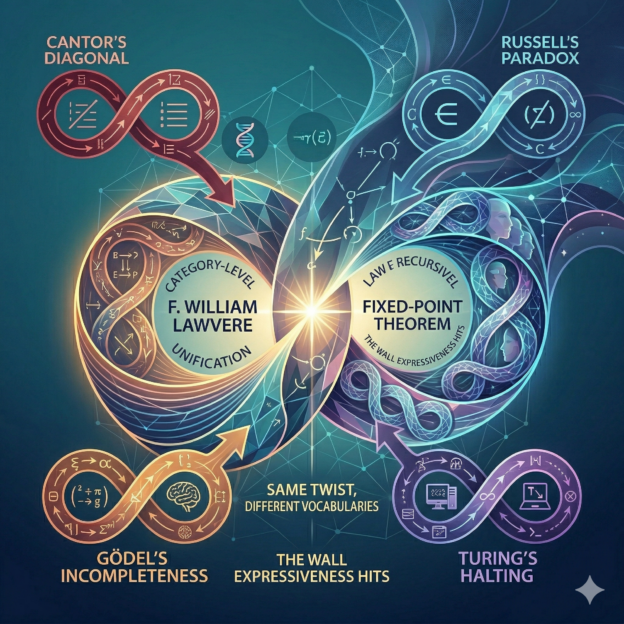
In 1969, the mathematician F. William Lawvere published a result that should be more famous than it is. It is not famous in the way Gödel’s theorem is famous, or Turing’s, or Cantor’s diagonal argument. Most working mathematicians know it; most educated non-mathematicians do not. This is a loss, because Lawvere’s fixed-point theorem is the result that shows those three famous theorems — along with Russell’s paradox, the liar’s paradox, and several other results that appear to be different — are all the same theorem. They are all the same twist, described in different vocabularies.
Understanding this matters beyond mathematical aesthetics. When you see that Gödel, Cantor, Turing, and Russell were all performing the same operation — that the great logical crises of the twentieth century were all encounters with the same underlying structure — you understand something about the twist that no list of examples can convey. The operation is not a recurring pattern. It is a fundamental feature of any sufficiently powerful formal system. It is the wall that every such system eventually hits when it turns to face itself.
Four theorems, one problem
Let me begin with the family resemblance, before introducing the formal unification.
Cantor’s diagonal argument (1891) shows that no list can contain all real numbers. The proof: take any purported complete list of real numbers, construct a new number that differs from the first entry in the first decimal place, from the second entry in the second decimal place, from the third in the third, and so on — diagonally. This new number differs from every entry on the list in at least one place, so it is not on the list. The list, whatever it contains, does not contain everything. Conclusion: some infinities are larger than others. The continuum cannot be put in one-to-one correspondence with the integers.
Russell’s paradox (1901) shows that naive set theory is inconsistent. The set of all sets that do not contain themselves: does it contain itself? If it does, it shouldn’t. If it doesn’t, it should. The paradox forced the reconstruction of the foundations of mathematics. Frege, who had just completed a major work building mathematics from set theory, received Russell’s letter pointing out the paradox and wrote, in a famous postscript to his second volume, that a scientist can hardly meet with anything more undesirable than to have the foundation give way just as the work is finished.
Gödel’s incompleteness theorems (1931) show that any consistent formal system rich enough to describe arithmetic contains true statements that cannot be proven within the system. The proof encodes statements about the system as numbers within the system — Gödel numbering — and then constructs a statement that says, in effect, “this statement is not provable.” No consistent system of sufficient power can be both complete and consistent.
Turing’s halting problem (1936) shows that there is no general algorithm that can determine, for an arbitrary program and input, whether the program will eventually halt or run forever. The proof: assume such an algorithm exists, construct a program that does the opposite of whatever the algorithm predicts for itself, and derive a contradiction. The algorithm, applied to itself, produces undecidability.
Stare at these four proofs and the family resemblance is unmistakable. Each one: constructs a self-referential object (a diagonal number, a self-membered set, a Gödel statement, a self-applying program); applies the system to itself; and finds at the crossing a limit or contradiction that the system cannot contain. The same move, four times, in four different mathematical vocabularies.
Lawvere’s unification
What Lawvere showed is that this family resemblance is not superficial. It is exact. All four proofs are special cases of a single result, which can be stated in the language of category theory — mathematics’ most abstract level of description, concerned not with the content of mathematical structures but with the relationships between them.
The Lawvere fixed-point theorem, informally stated: if you have a mathematical structure where functions can be represented as objects of the same structure — that is, where the map can be represented as an element of the territory — then certain kinds of self-referential constructions are unavoidable, and they produce fixed points: elements that map to themselves under a given function. More precisely, if a certain kind of surjective (onto) function exists from a set to its own function space, then every function from that set to itself has a fixed point.
The contrapositive is the useful direction for our purposes: if a function from a set to itself has no fixed point, then no surjection from the set to its function space can exist. This is the form in which the theorem generates the incompleteness and undecidability results: it shows that certain complete or total descriptions are impossible, because the self-referential construction that would be required to achieve them would produce a fixed-point contradiction.
Cantor’s diagonal argument is Lawvere’s theorem applied to sets and their power sets. Russell’s paradox is Lawvere’s theorem applied to the category of sets with a specific self-membership structure. Gödel’s theorem is Lawvere’s theorem applied to formal systems that can encode their own syntax as objects within themselves. Turing’s halting problem is Lawvere’s theorem applied to the category of computable functions. The diagonal construction that appears in each proof — the construction that moves through a list or a space diagonally and produces an element that differs from every element in the list — is the same construction, in different settings, performing the same twist.
This is what mathematical unification looks like at its deepest level: not finding a formula that subsumes all the others, but finding the category-level structure that shows they were always the same thing.
What the diagonal construction is doing
The diagonal construction deserves closer attention, because it is the mechanical implementation of the twist move at the mathematical level. Understanding it precisely clarifies what the twist does.
In each of the four proofs, the diagonal construction does the following: it takes a purported complete description of a domain — a list of all real numbers, a set of all sets, a system that can prove all truths, an algorithm that can decide all programs — and constructs, from the structure of the description itself, an element that falls outside it. The construction uses the description as its raw material. It operates on the description the way a mirror operates on whatever is placed in front of it: the reflection is made of the same light, organized by the same geometry, but it shows you something the original cannot contain. Itself.
The key move in every diagonal construction is that it treats the description and the described as the same kind of thing — it moves between levels, using elements of the object level as material for a meta-level construction. This is the fold: the meta level and the object level are treated as continuous, and the construction exploits this continuity to generate something that is both inside the system (constructed from its elements) and outside it (not on any list or provable by any proof or computable by any algorithm the system can describe).
The fixed point that Lawvere’s theorem identifies is the mathematical residue of the fold — the element that maps to itself, that cannot be moved by any operation the system can perform, that sits at the crossing where the two levels have been collapsed. In Gödel’s theorem, the fixed point is the Gödel statement itself: a statement that asserts its own unprovability, and whose existence is guaranteed by the very expressiveness of the system that cannot prove it. In Turing’s proof, the fixed point is the self-applying program that does the opposite of whatever the halting detector predicts — its existence is guaranteed by the completeness of the computational model that cannot decide it.
The fixed point, in other words, is always a consequence of the system being powerful enough to describe itself. The more complete the description, the more thoroughly the twist can be performed, and the more unavoidably the fixed point appears at the crossing. The incompleteness results are not signs of weakness. They are signs of strength. Only a system rich enough to perform the fold can encounter the limit that the fold reveals.
The liar’s paradox and the deep root
The liar’s paradox is older than all of these results by two millennia: This statement is false. If it is true, it is false. If it is false, it is true. The ancient Greeks noticed it and found it troubling. Medieval logicians developed elaborate frameworks to contain it. Twentieth-century mathematicians proved, in various forms, that it cannot be fully contained — that any language expressive enough to make statements about the truth of statements in that language will either be inconsistent or incomplete.
The liar’s paradox is the twist in its most naked form: a statement that refers to its own truth value, making the object level and the meta level the same statement. Lawvere’s theorem shows that the liar is not an oddity, not a trick of natural language that careful formalization could eliminate. It is a structural feature of any sufficiently expressive system. You cannot build a language powerful enough to talk about truth without building a language in which the liar can be constructed. The fold is always available. The fixed point always appears.
Tarski’s theorem on the undefinability of truth — a result of the same era as Gödel’s — makes this precise: no language can define its own truth predicate without contradiction. To talk about truth, you need a meta-language. To talk about that meta-language’s truth, you need a meta-meta-language. The levels proliferate without limit, and the attempt to close the loop always produces the paradox. The only available response is to accept that the loop cannot be fully closed from within — that every level of description has a truth that exceeds it — and to work with this as a structural feature of language and thought rather than a defect to be corrected.
Why category theory is the right language
It is not accidental that Lawvere’s unification required category theory. Category theory is specifically designed to describe the structure of relationships between mathematical structures — not the content of any particular mathematical domain, but the patterns of how mathematical domains relate to each other, transform into each other, and reflect each other’s structure. It is, in a precise sense, mathematics doing the self-reference move on itself: a branch of mathematics that takes the structure of mathematics as its subject matter.
This is why it is the natural language for describing the twist at the deepest level. The twist is always about the relationship between levels of description, between the object and the meta. Category theory is the mathematics of exactly those relationships. When Lawvere stated his theorem in the language of category theory, he was using the right tool: the branch of mathematics that was built for self-reference, to describe a result about what happens when systems self-refer.
There is something fitting in this — and something that connects to the broader argument of this series. The deepest mathematical description of the twist move requires a mathematical framework that itself performs the twist move on mathematics. Category theory is mathematics examining itself from outside, finding the invariants that hold across all mathematical structures, identifying the fixed points of mathematical transformation. It is, in the language of the second essay in this series, mathematics performing the fold and finding at the crossing something that was invisible from within any particular mathematical domain.
The limit and the gift
Gödel’s theorem is usually presented as a limitation: there are truths that formal systems cannot prove. This is accurate, but it emphasizes the wrong thing. The limitation is real, but it is a specific kind of limitation — the kind that only appears because the system is powerful enough to generate it. A system too weak to describe arithmetic cannot encounter incompleteness, because it cannot perform the self-reference that reveals it. The incompleteness result is the price of admission to the level of mathematical power at which it appears. You cannot have the power without the limit, because the limit is produced by the power.
Lawvere’s theorem makes this precise and general: the fixed point that cannot be reached from within a system is always produced by the system’s own self-referential structure. The gift and the limit are the same thing. The twist that reveals what is inaccessible from within is performed using the resources of the system that cannot access it. The new truth that appears at the crossing was always there, waiting for a system powerful enough to fold back and find it.
This is the mathematical face of what the whole series has been arguing. The invariant that appears at the fold — whether it is Gödel’s unprovable truth, the ground that the consciousness twist reveals, or the structural insight that reorganizes an industry — was not produced by the fold. It was always present. The fold is what made it accessible. And the fold is always performed using the resources of the level that could not, from within itself, reach what the fold reveals.
The universe is structured such that this operation is available. At every level of description — mathematical, physical, biological, cognitive — there is a fold available that reaches beyond what the current level can contain. The fixed point is always waiting at the crossing. The only question is whether you have the resources, the courage, and the level sensitivity to make the move.