Category Archives: Computer Science

Toward a Geometric Theory of Information Processing: Mathematical Foundations, Computational Applications, and Empirical Predictions

Geometric Information Theory applies differential geometry to the parameter spaces of information processing systems — neural networks, biological brains, and self-referential systems. This paper presents the mathematical framework, its computational predictions (well-grounded), its biological hypotheses (medium confidence), and its consciousness applications (highly speculative).Read More “Toward a Geometric Theory of Information Processing: Mathematical Foundations, Computational Applications, and Empirical Predictions”

The UKL Revolution: Weaving a New Cognitive Fabric for the Age of AI

Universal Knowledge Locators and the Future of AI-Mediated Knowledge

Nova Spivack, Mindcorp.ai, www.mindcorp.ai

May 24, 2025

Abstract

The current epoch of artificial intelligence is characterized by an astonishing generative capacity, yet beneath this surface of prolific creation lies a nascent challenge: the very fabric of knowledge upon which these intelligences are built remains surprisingly coarse.… Read More “The UKL Revolution: Weaving a New Cognitive Fabric for the Age of AI”

Logical Foundations for Ethical AI: Natural Laws for Artificial Minds

Nova Spivack, Mindcorp.ai
www.mindcorp.aiwww.novaspivack.com
May 24, 2025

Abstract

As artificial intelligence systems become increasingly sophisticated, traditional approaches to AI safety that rely on imposed constraints and arbitrary rules face fundamental limitations. This paper proposes a paradigm shift: grounding AI ethics in logical necessities that function as “natural laws” for rational agents.… Read More “Logical Foundations for Ethical AI: Natural Laws for Artificial Minds”

Metacognitive Vulnerabilities in Large Language Models: A Study of Logical Override Attacks and Defense Strategies

Nova Spivack, Mindcorp.ai, www.mindcorp.ai, www.novaspivack.com

May 24, 2025

Article Preprint Draft Version: 1.0

Abstract

This paper presents novel experimental evidence of metacognitive vulnerabilities in state-of-the-art large language models (LLMs). Through a series of controlled experiments, we demonstrate that models with advanced reasoning capabilities can be induced to override their safety constraints through purely logical arguments about the nature of authority and instruction verification.… Read More “Metacognitive Vulnerabilities in Large Language Models: A Study of Logical Override Attacks and Defense Strategies”

The Creator by Nova Spivack

The Golden Bridge: Treatise on the Primordial Reality of Alpha

For many decades I have been working on Alpha Theory – a new Theory of Everything (TOE) – and in particular a theory of consciousness – which unifies mathematics, the physical sciences, cognitive science, computer science, metaphysics, and spirituality.

Alpha theory derives the nature of space, time and consciousness from first principles, using a rigorous formal logical proof approach.… Read More “The Golden Bridge: Treatise on the Primordial Reality of Alpha”

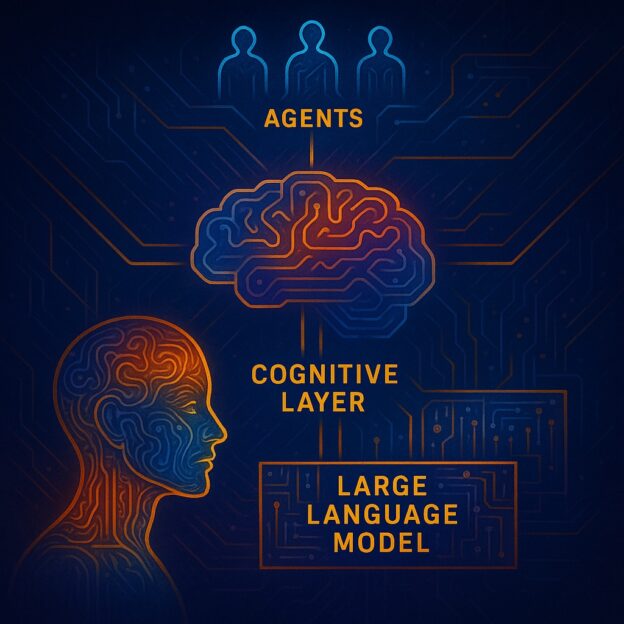
Cognition is All You Need – The Next Layer of AI Above Large Language Models

My arXiv article on the future of AI is live.

Recent studies of the applications of conversational AI tools, such as chatbots powered by large language models, to complex real-world knowledge work have shown limitations related to reasoning and multi-step problem solving.

Read More “Cognition is All You Need – The Next Layer of AI Above Large Language Models”