This is the fifth essay in a series. The first, The Twist Move, describes the operation itself across mathematics, biology, physics, and business. The second, The Twist and the Ground of Being, argues that the consciousness twist is real, that the substrate must support it, and that this tells us something fundamental about the nature of reality. The third, How to Develop Twist Literacy, addresses the practical cultivation of the capacity. The fourth, The Figure Without Ground, examines why AI can extend but not replace the twist. The fifth addresses the pathology of the Twist-Resistant Organization. The sixth piece, The Theorem Behind the Twist – Lawvere’s Fixed-Point, shows that the deepest paradoxes of logic are all the same mathematical result. The final essay, The Twist as Generative Principle, argues that this operation is not just an intellectual tool, but the fundamental engine by which the universe generates complexity, life, and meaning.
My grandfather spent fifty years studying how organizations fail to think. Not how they fail to execute — execution failures are visible, measurable, and correctable within the existing frame. He was interested in the deeper failure: organizations that executed with great discipline in the wrong direction, that optimized for a reality that no longer existed, that solved the wrong problems with increasing precision. This is the failure mode he found most prevalent and most difficult to address, because it does not look like failure from inside. It looks like rigor.
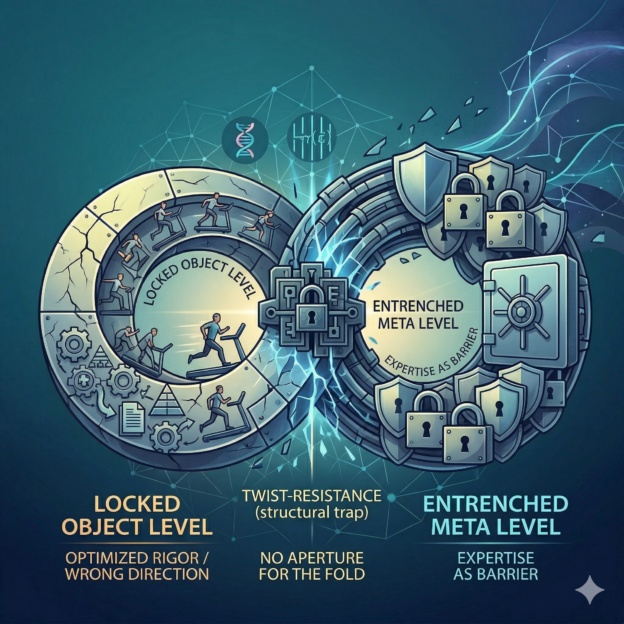
What he was describing, though he did not use this language, is twist-resistance: the organizational equivalent of being unable to change levels, locked into the current frame with increasing commitment, applying more force to a problem that requires a fold rather than a push.
Twist-resistance is not stupidity. It is not laziness. It is not even conservatism, though it often looks like conservatism from outside. It is a structural condition — a set of reinforcing properties that make it progressively harder to perform the fold as the organization becomes more developed, more successful, and more invested in its current description of reality. Understanding how this condition forms, and what it costs, is prerequisite to preventing it.
How twist-resistance forms
Every organization begins with a twist. The founding insight of any viable organization is, at minimum, a constraint twist: someone looked at an existing market or domain and recognized that what everyone else was treating as a limitation was actually an opportunity, or that what was being treated as the product was actually the infrastructure, or that the customer everyone was ignoring was the real customer. The founding is the fold. The new organization is the emergent invariant that appears at the crossing.
Then the organization does what organizations do: it builds around its founding twist. It develops processes optimized for delivering the insight at scale. It hires people who are skilled at operating within the frame the twist established. It develops a theory of its customer, its market, its competitive position — a theory that is substantially correct, because it was built on a genuine structural insight. The frame is good. The investment in the frame is rational. The organization gets better and better at operating within it.
This is where the trap forms. The very properties that make an organization excellent at operating within its frame — developed expertise, efficient processes, deep customer relationships, a coherent culture, accumulated institutional knowledge — are the same properties that make the frame progressively harder to examine from outside. The frame becomes infrastructure. The people inside it do not experience it as a frame at all. They experience it as the structure of reality: this is what customers want, this is how competition works, this is what quality means, this is what success looks like. These are not beliefs they hold tentatively. They are the water they swim in.
Meanwhile, the environment changes. Technology shifts. Customer expectations evolve. New entrants come from adjacent domains, unencumbered by the existing frame, and see the opportunity for a different fold. The problem is not that the existing organization lacks the information that a fold is needed. Often the information is present, sometimes for years before the crisis. The problem is that the information cannot be processed at the level it needs to be processed at, because the processing apparatus — the culture, the incentives, the expertise, the leadership’s mental model — is all calibrated to the existing frame and evaluates new information through it.
A new technology that threatens the current business model is evaluated as a threat to be neutralized rather than a fold to be made. A customer segment that behaves differently from the core customer is treated as an anomaly rather than a signal. A competitor with a structurally different model is dismissed as not understanding the real business until it is too late to respond. The organization is not being irrational. It is being fully rational within its current frame. And the current frame is no longer adequate.
The anatomy of the locked organization
Twist-resistance has a recognizable anatomy. These features tend to appear together and to reinforce each other, which is why breaking one rarely produces the systemic change that is needed.
Frame entrenchment at the top. The leaders who built the organization built it around the founding twist. Their identity, their expertise, their track record — everything that made them leaders — is continuous with the current frame. Performing the fold means partially delegitimizing the history they embody. This is not vanity, though vanity sometimes compounds it. It is a structural problem: the people with the most authority to change the frame are the people most deeply invested in it, for the best possible reasons.
Expertise as a barrier. Deep functional expertise is an extraordinary asset for operating efficiently within a frame. It is a liability when the frame needs to change. The expert’s knowledge is organized around the current level of description. A new level of description initially looks wrong to the expert, because it violates the expert’s model of how things work. The expert is correct that it violates the current model. The expert’s error is treating the current model as the structure of reality rather than as a very good map of a territory that has moved.
Incentive calibration to the existing frame. Incentive systems are always designed to encourage behavior that is valuable within the current theory of the business. As the theory ages, the incentives increasingly reward behaviors that optimize the old frame rather than those that would identify and make the needed fold. The people most rewarded by the organization are therefore the people most deeply invested in the current level of description — which means the organization’s own incentive structure is systematically filtering out twist-capable thinking.
Success as confirmation. A successful organization generates feedback — financial, operational, cultural — that consistently confirms the current frame. The frame produced the success; the success is interpreted as validation of the frame. This is correct, as far as it goes. The problem is that success in the past provides no information about whether the frame is adequate for the future, and the experience of consistent confirmation makes it increasingly difficult to take seriously information that the frame may need to change.
Institutional memory as constraint. Organizations accumulate not just knowledge but the learned lessons of past failures. Many of these lessons were correct and important. But when the environment changes sufficiently, the lessons learned from past failures become contraindications for the moves that the new environment requires. The organization has learned to avoid the fold that was costly last time — but the last time was a different environment, and the cost was produced by a different set of conditions. The institutional memory is not wrong about the past. It is incorrectly generalized to a present that does not resemble it.
The cost
The cost of twist-resistance is not immediately visible, because the organization continues to perform well — sometimes very well — within its existing frame for a substantial period after the fold has become necessary. The treadmill runs smoothly. The metrics look good. The processes are efficient. The customer satisfaction in the core segment is high.
What is being consumed is the organization’s future. The period in which the fold could be made with the full resources and capabilities of a healthy organization — before the crisis that eventually forces it — is passing. When the crisis arrives, the fold will still be made, but it will be made under duress, with depleted resources, by an organization that has lost the people most capable of making it, in a competitive environment that has already reorganized around the new level of description established by whoever made the fold first.
The pattern is so consistent across industries and eras that it almost constitutes a law: the organizations that make the fold from strength — before the crisis, while the existing business is still generating the resources to invest in the new frame — survive and often dominate. The organizations that make it from weakness — forced by crisis, starved of resources, having lost the people and the time they needed — rarely recover to their prior position even when they make the fold correctly. And the organizations that never make it — that optimize the existing frame until there is nothing left to optimize — provide the cautionary examples that fill the business school curricula and that every organization secretly believes it will never become.
What the fold-capable organization looks like
Describing the failure mode in detail risks implying that the solution is merely the absence of the failure. It is not. Avoiding twist-resistance is not the same as developing the capacity for the twist. The former is a set of constraints lifted; the latter is a positive capability developed. They require different things.
The organizations that demonstrate sustained fold-capability over long periods share a set of properties that are worth examining specifically.
Structured dissent as a formal practice. The fold-capable organization does not merely tolerate disagreement. It institutionalizes the role of the person whose job it is to examine the current frame from outside — to ask what is being treated as given that might be chosen, to surface the paradox signals and persistence signals that indicate a fold may be needed. This role has many names in practice — red team, devil’s advocate, internal audit of assumptions — but its function is always the same: to maintain, within the organization, a meta-level capacity that the operating structure tends to eliminate. My grandfather called this function “organized abandonment.” It is the organizational equivalent of the self-reference move in individual cognition.
Investment in peripheral vision. The folds that reorganize industries almost always begin at the edges — in adjacent markets, in customer segments that are not the core, in technologies that do not yet meet the performance bar for the current application. The organization that is attending only to its core is attending to where the last fold landed, not to where the next fold will come from. Systematic investment in peripheral attention — customer discovery outside the core segment, technology scouting outside the current stack, competitive analysis of entrants that don’t yet look threatening — is the organizational version of maintaining level sensitivity.
Leaders who can hold the frame lightly. This is the hardest one to develop, and the one that matters most. The capacity to be fully committed to the current frame — to execute it with discipline and resource it properly — while simultaneously holding it as a frame rather than as reality, is the organizational equivalent of what the third essay describes as developed twist literacy. It requires leaders who have done sufficient inner work — through experience, through reflection, through whatever practice develops the capacity to observe one’s own assumptions in real time — that they can notice when the texture of a situation shifts from ordinary-difficult to twist-difficult, and respond appropriately.
This cannot be fully systematized, which is why it matters so much who is in the leadership role. Systems and processes can support the capacity. They cannot substitute for it. At the moment when the fold is genuinely needed — when the organization’s entire accumulated investment is pointing in the wrong direction — the system will not make the call. A person will. And that person needs to be able to see the frame they are standing in.
Mechanisms for the fold itself. Recognizing that a fold is needed is necessary but not sufficient. The organization must also have structural mechanisms for making the fold — for committing resources to a new level of description before the old one has failed, for protecting the emerging fold from the organization’s natural immune response to anything that threatens the current frame, and for managing the transition in which both the old frame and the new one need to run simultaneously. This is genuinely hard. The new frame typically looks wrong by the metrics of the old one. It requires resources that the old frame could deploy more efficiently. It threatens the expertise and status of the people who built the old frame. The fold-capable organization has thought through these tensions in advance, rather than discovering them in the middle of a crisis.
The individual dimension
Everything said here about organizations applies to individuals. Careers, intellectual frameworks, personal identities, and relationships all develop the same twist-resistant properties over time. The expertise that makes a person excellent at their current level of description becomes the barrier to changing levels. The identity built around a particular kind of contribution becomes the thing that makes it hardest to see when a different kind of contribution is what the situation needs. The relationships built on a shared frame become the context in which challenging the frame feels like a threat to the relationship itself.
The individual facing this condition is not in a different situation from the organization. The question is the same: can I hold the frame I have built lightly enough to examine it from outside when the evidence suggests that the fold is needed? Can I notice the persistence signal and the paradox signal in my own situation? Can I apply the self-reference move to my own operating assumptions rather than only to the problems I am trying to solve within them?
My grandfather’s concept of the second career — the deliberate restructuring of one’s professional contribution at midlife, building on the accumulated experience of the first career but not merely extending it — was his practical answer to individual twist-resistance. The second career is not a restart. It is a fold: the constraints and capabilities developed in the first career become the resources from which the second is built, at a different level of description. The constraint twist, applied to a life.
The civilizational dimension
I want to end at the largest scale, because the stakes there are the highest and the twist-resistance the most entrenched.
Civilizations develop twist-resistance over centuries. The frames that organized successful periods of human history — about the nature of authority, the structure of knowledge, the relationship between humanity and the natural world, the definition of progress — become progressively more entrenched as they become more successful. Institutions are built around them. Expertise is organized within them. Identities, both individual and collective, are constituted by them. The investment in the current frame is total in a way that no single organization can match.
We are in a period in which several of the frames that organized modern civilization are encountering the persistence signal and the paradox signal simultaneously. The frame of unlimited material growth on a finite planet. The frame of human cognitive work as the irreducible locus of economic value. The frame of nation-states as the adequate unit for addressing planetary-scale problems. The frame of consciousness as a product of material processes rather than a feature of the substrate. Each of these is showing the texture of a twist problem: intelligent, well-resourced people pushing harder within the frame, producing diminishing returns, encountering paradoxes that the frame cannot resolve.
The fold is needed. It will come — it always does, eventually, because twist problems do not yield to linear force, and civilizations are not exempt from this. The question is whether it comes from strength, made deliberately by people who can see the frame they are standing in, or from weakness, forced by the crisis that arrives when the frame has been pushed past its limits. History suggests that civilizations, like organizations, are capable of both. The difference lies entirely in whether the people with the capacity to see the frame — and the courage to say so — are in positions where that capacity can be used.
The twist-resistant organization is a tragedy of investment: all that accumulated capability, all that institutional memory, all that expertise, pointed in a direction that the world has moved away from. The tragedy is not inevitable. It is the predictable result of failing to develop and maintain the one capacity that no amount of object-level excellence can substitute for: the ability to see the frame you are standing in, and to make the fold when the fold is what is needed.