Category Archives: Theorems

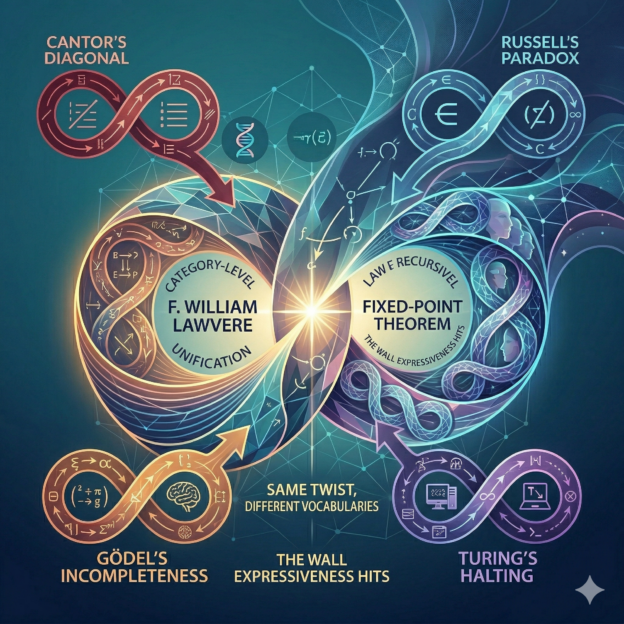
One Theorem Behind Gödel, Turing, Kleene, Tarski, and Löb

Gödel’s incompleteness, Turing’s halting undecidability, Kleene’s recursion theorem, Tarski’s truth undefinability, and Löb’s reflection theorem are five of the most celebrated results in 20th-century logic and computation. A new machine-checked theorem proves they are all instances of one master fixed-point framework.Read More “One Theorem Behind Gödel, Turing, Kleene, Tarski, and Löb”

Closure Without Exhaustion: Why Every System That Models Itself Has an Irreducible Remainder

A machine-checked theorem proves that no sufficiently expressive reflexive system — no formal logic, no computer, no physical universe, no mind — can internally exhaust its own realized semantics. Physical incompleteness, representational incompleteness, and the classical barriers of Gödel, Turing, Kleene, Tarski, and Löb are all corollaries of one result.Read More “Closure Without Exhaustion: Why Every System That Models Itself Has an Irreducible Remainder”

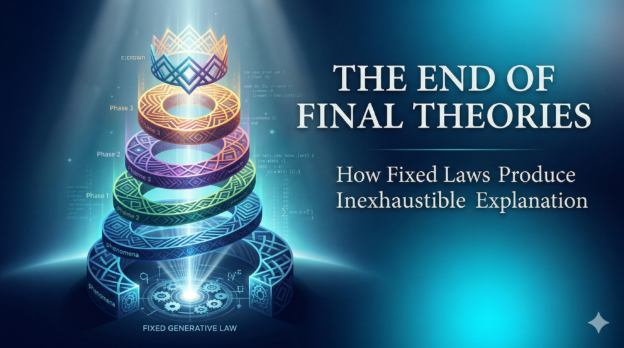
The End of Final Theories: How Fixed Laws Produce Inexhaustible Explanation

A new paper — backed by 422 machine-checked theorems and zero gaps — proves that a system can be completely governed by fixed laws and still never admit a final explanation. The implications reach from physics to biology to organizations to AI.Read More “The End of Final Theories: How Fixed Laws Produce Inexhaustible Explanation”

The Theorem Behind the Twist – Lawvere’s Fixed-Point

This is the sixth essay in a series. The first, The Twist Move, describes the operation itself across mathematics, biology, physics, and business. The second, The Twist and the Ground of Being, argues that the consciousness twist is real, that the substrate must support it, and that this tells us something fundamental about the nature of reality.Read More “The Theorem Behind the Twist – Lawvere’s Fixed-Point”

A New Mathematics of Self-Reference: A Comprehensive Non-Mathematical Summary

What This Work Is About

This article explains my paper on the
Mathematics of Self-Referential Systems, for a non-technical audience. The paper develops a comprehensive mathematical framework for understanding systems that can represent, model, or “know” themselves. While self-reference has long been seen as a source of logical paradoxes, this work argues it may be the fundamental organizing principle of reality itself—and provides specific mathematical bounds and requirements for achieving different levels of self-awareness.… Read More “A New Mathematics of Self-Reference: A Comprehensive Non-Mathematical Summary”

The Mathematical Foundations of Self-Referential Systems: From Computability to Transfinite Dynamics

This article explains my paper on the Mathematics of Self-Referential Systems.

Here is a summary

Decoding Reality’s Blueprint: An In-Depth Look at “The Mathematical Foundations of Self-Referential Systems”

Have you ever wondered about the deep, perhaps even unsettling, nature of a thought thinking about itself?… Read More “The Mathematical Foundations of Self-Referential Systems: From Computability to Transfinite Dynamics”

On The Formal Necessity of Trans-Computational Processing for Sentience

Nova Spivack

www.novaspivack.com

May 28, 2025

Abstract

This paper constructs a formal deductive argument for the necessity of a processing modality that transcends standard Turing-equivalent computation—termed herein “Transputation”—for any system capable of achieving “Primal Self-Awareness,” which we rigorously define as the foundational characteristic of sentience.… Read More “On The Formal Necessity of Trans-Computational Processing for Sentience”